Choosing a fiber laser cutting machine is not simply a matter of selecting the highest laser power or the lowest purchase price. The right machine must match your materials, cutting thickness, production volume, part dimensions, and workshop conditions.
This guide explains how to choose a fiber laser cutting machine based on practical production requirements, including laser power, material compatibility, working area, machine structure, cutting head, CNC system, automation, and long-term ownership costs. It also provides a practical checklist to help you compare suppliers and identify the configuration that delivers the best value for your operation.
1. Start from the work you turn down
The most useful input to a specification is not your comfortable order book. It is the work you refuse, subcontract or run on overtime, because those jobs describe the capacity you are trying to buy. Build a one-page inventory of routine work with weekly laser-on hours, occasional work, everything refused or subcontracted in the last twelve months, and the downstream requirement — whether the edge is welded, painted or bent afterwards. Record it in hours, not pieces, and accept an estimate within a factor of two. Confirm the process first: fiber laser vs plasma vs flame cutting sets out where each technology earns its place.
Split thickness into three tiers, because they are bought differently. Regular production thickness sets the power band that earns its cost. Occasional thickness sets the ceiling. Maximum required thickness sets only the floor you must not fall below; it should not set the price you pay.
Two traps sit in that list. Sizing to the occasional row means a machine built for a job that arrives four times a year carries the purchase price and running cost of an unused capability for the other forty-eight weeks. Measuring demand in part count is the second: ten thousand small brackets a month and two hundred enclosure panels give identical part counts and completely different requirements, because what the machine sells is minutes.
2. Match power to machine hours, not to millimetres
Power converts into cutting speed, and cutting speed only becomes money when the hours saved land on work you actually run.
| Where your hours sit | What it implies | Where the money goes |
|---|---|---|
| Mostly 3 mm and thinner | Speed differences get absorbed by piercing, rapid moves and sheet handling | Table size, loading cycle and nesting discipline, not watts |
| A real share between 4 and 10 mm | The band where power changes cycle time enough to show up in cost per part | A source sized to hold the upper end without running flat out |
| Regular work above 12 mm | Throughput is limited by the process, not the motion system | Power, gas strategy, Z-axis travel and rigidity together |
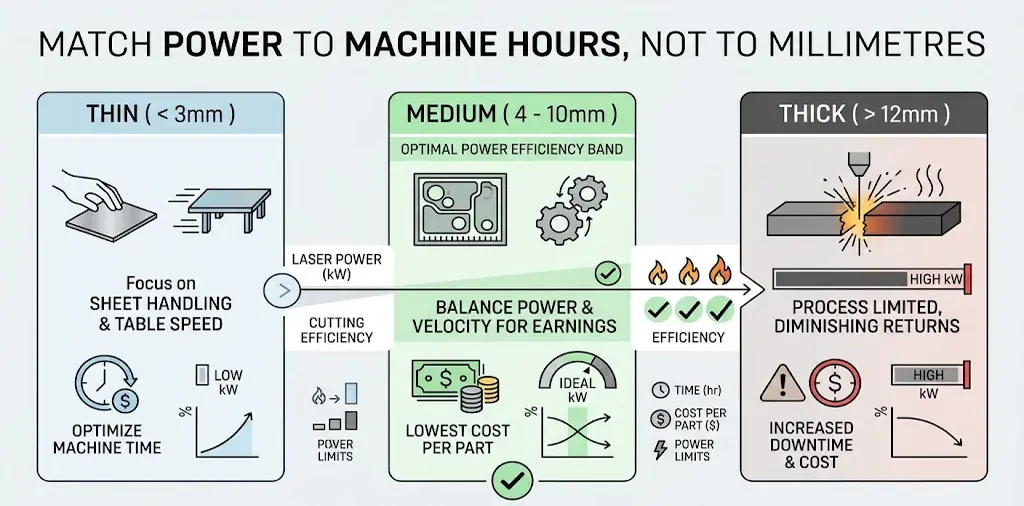
The diminishing return is published, not a sales argument. By TRUMPF’s own figures, its 24 kW machines cut steel to 60 mm and cut thick material up to three times faster than a 6 kW machine — three times, not four, for a fourfold increase in source power. Brett Thompson, its laser technology and sales consulting manager, was blunter in an interview with The FABRICATOR: “anything below approximately ¼ in. thick is probably going to cost more if it is cut at high power, even though the total processing times are shorter.”
Run the arithmetic rather than accepting either the floor or the ceiling. If the thick band is 10 percent of your hours and a larger source cuts it 30 percent faster, total cutting time falls about 3 percent — against a higher machine price, a higher hourly running cost and faster wear on every consumable in the beam path.
As a working band: up to about 6 kW covers mixed thin-to-medium sheet where flexibility matters more than cycle time; between 6 and 12 kW, power starts changing cost per part on 4–10 mm work; above 12 kW the process, not the motion system, sets throughput — and that is now a mainstream band, so distrust any chart that stops at 12 kW. Power is only half the cycle: how fast the head accelerates, settles and changes direction decides throughput on nests of small, intricate parts, and “which one dominates depends on what an operation needs” (The FABRICATOR, 11 September 2025).
3. Settle format and working area as one decision
Both are fixed by the sheet you buy, and format is the choice buyers make last.
| Format | Suits | Real cost | Wrong when |
|---|---|---|---|
| Open-type single table, 1500 × 3000 or 2000 × 4000 mm | Job shops, prototypes, mixed one-offs, tight floor space | Every sheet change stops the laser; fumes and sparks open to the aisle | Manual loading already runs close to cutting time and volume is growing |
| Fully enclosed, automatic exchange table, to 6000 mm and beyond | Production where loading is the constraint; fume containment and a defined perimeter required | Footprint, foundation, second table frame, more maintenance points | Cutting time per sheet is long and loading is quick — the table waits alongside the laser |
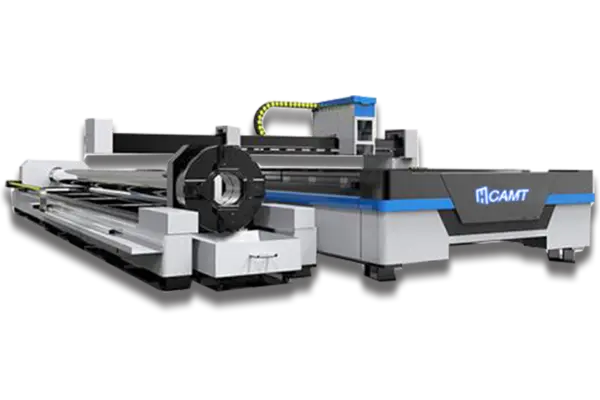
| Tube and profile machine, or dual-purpose plate/tube unit | Output includes round, square or rectangular tube and open profiles | Chuck maintenance, and a work envelope compromised if plate is the main business | Tube is a small fraction of revenue, or plate throughput is the priority |
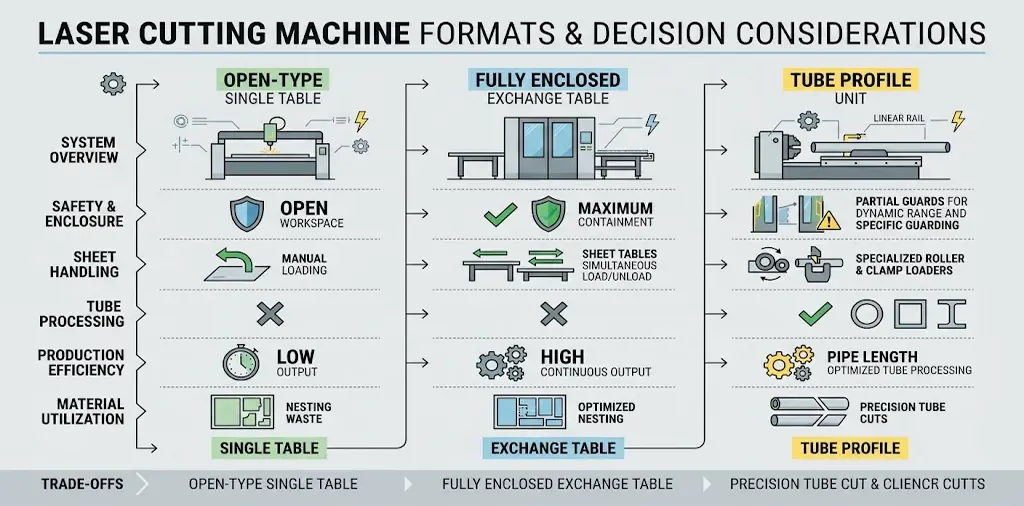
An open machine stops for every sheet; an enclosed machine with two pallets stops only for the pallet swap. Neither stops for the reason most buyers plan around: they size for thickness, then find the cycle is set by handling.
Enclosure is a procurement item, not a comfort feature. OSHA’s laser hazard guidance notes that “the human eye is almost always more vulnerable to injury than human skin,” which is why the interlocks, the window specification and the laser class belong in the contract as technical requirements — plus the question rarely asked: what class does the machine become if an interlock is defeated?
Then check how the sheet reaches the table. A 1500 × 3000 sheet can be walked in by two people; a 4000 or 6000 mm sheet usually cannot, and then the loading side needs crane clearance. Match the table to the format you buy and your largest regular part; oversizing buys nesting flexibility and charges floor space and a longer walk on every small job. Our laser cutting table size guide works through the same loading arithmetic with worked examples.
4. The exchange table pays only when loading is the bottleneck
This is the most expensive line on most quotations and the one almost never modelled.
- Cutting time per sheet (T_c) — laser-on time for one nest, first pierce to last cut.
- Manual handling time (T_l) — from cutting end to the next sheet located and clamped, including unloading, clearing the skeleton, fetching and positioning.
A single-table machine is idle for the whole of T_l, so U_single = T_c / (T_c + T_l). On an exchange-table machine the second pallet is loaded while the first is cut, so handling overlaps with cutting; what still stops the machine is the swap:
U_exchange = T_c / (max(T_c, T_l) + T_swap)
The gap between T_l and T_swap is where spreadsheets go wrong. A dual-table shuttle completes the physical change in seconds — the BLM LS7 at Bell Steel Fabrications is reported as having “material changeover taking only nine seconds.” That is the swap. The several minutes of unloading and reloading happen on the outside pallet, in parallel with cutting, and never enter the figure.
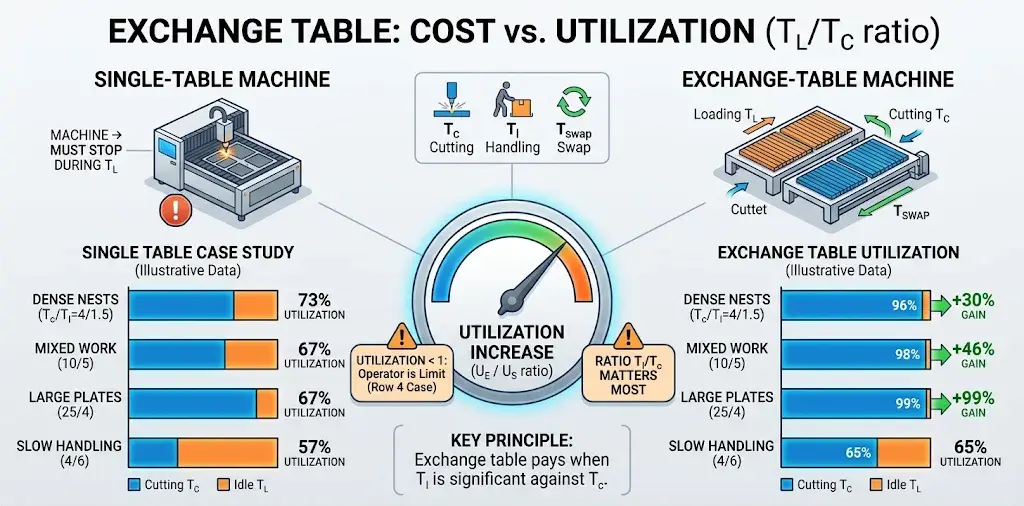
| Case | T_c | T_l | Single table | Exchange table | Gain |
|---|---|---|---|---|---|
| Dense nests, quick handling | 4 min | 1.5 min | 73% | 96% | 1.3× |
| Mixed work, medium nests | 10 min | 5 min | 67% | 98% | 1.5× |
| Large thick-plate parts | 25 min | 4 min | 86% | 99% | 1.15× |
| Handling slower than cutting | 4 min | 6 min | 40% | 65% | 1.6× |
Illustrative figures — use your own stopwatch values.
Read by ratio, not by row. The gain tracks T_l/T_c and peaks where the two are roughly equal: the machine is then idle about half of every cycle and the pallet recovers nearly all of it. Move away either way and the gain decays toward 1 — quick handling leaves little idle time to recover, and very slow handling makes the operator the constraint.
Two conditions must hold together: the ratio must be close enough to 1 for the gain to matter, and the resulting utilisation must be high enough that the machine is earning. Row four satisfies the first and fails the second — 65 percent means an operator, not a pallet, is the limit. So the case is not “high volume”: row three may run hundreds of sheets a week and still not justify one. It is that handling time is significant against cutting time and that gap is costing you orders.
5. Read the specification sheet before you read the price
Specification sheets are written to be compared on price, which is why the numbers that matter are buried among the ones that do not.
| Specification | What it determines | How to verify it |
|---|---|---|
| Positioning accuracy | How close the head gets to the commanded coordinate | Ask which standard and test length. A figure without a test method is marketing |
| Repeat positioning accuracy | Whether the tenth part matches the first — the number that governs production | Repeatability should equal or beat accuracy, because systematic error can be compensated and scatter cannot. If it is worse, the two values came from different sources and neither is trustworthy |
| Maximum acceleration | Corner behaviour, small-feature cycle time, and how much of the headline speed you ever reach | Ask for the value with the actual gantry load, not a bare-frame figure |
| Z-axis travel and focus range | Whether thick plate and bevel work are physically possible | Compare against the thickness you intend to cut, with margin |
| Beam quality, not just power | Thick-section capability at a given wattage | Ask for spot size at focus and the parameter library for your materials |
| Frame construction | Whether year-one accuracy is still there in year eight | Welded structure, stress relief and shipping weight tell you more than a brochure adjective |
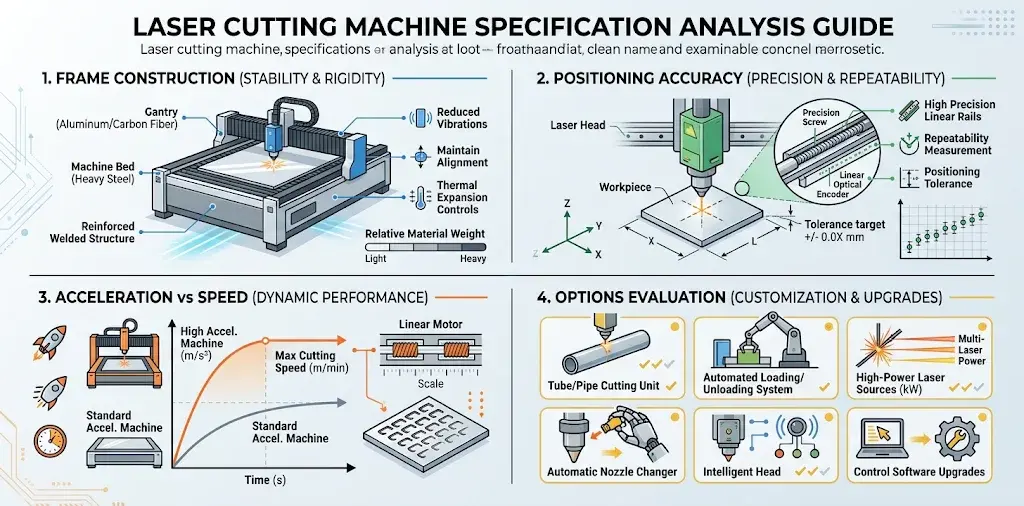
Maximum running speed is deliberately absent: 120 m/min is reached on a long straight move, while real nests are short segments, so acceleration and settling decide the cycle. Accuracy is normally quoted at a controlled ambient temperature — ask over what range it holds. Then two questions: does the CNC read your CAD/CAM and nesting output without conversion, and do the axes use linear scales or the encoder alone?
The options list is where a well-chosen machine becomes an expensive one. Automatic loading, towers and robots pay when batches are large and repeat and the same nest runs for hours; Bell Steel’s 8 kW machine could have taken a shuttle-fed tower and deliberately stopped at the dual table, because its production “is characterised by small batch sizes and one-off prototypes, with large runs being relatively uncommon.” Ask every supplier to price the machine twice, with and without each option, then what it costs to own: every added mechanism needs space and a maintenance routine.
6. Put gas, power and wear parts in the same column as the price
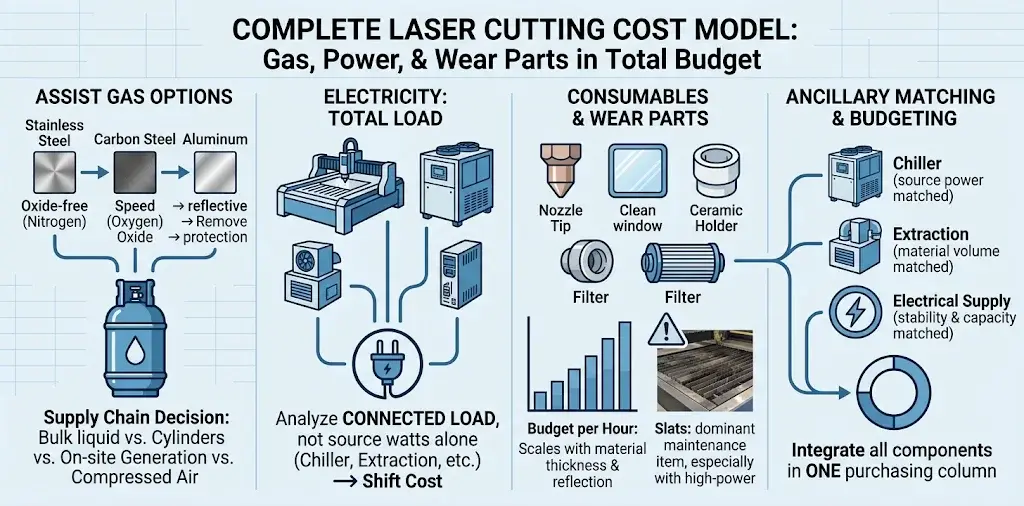
Assist gas. Stainless needs nitrogen for an oxide-free edge; carbon steel is usually faster on oxygen but leaves an oxide that must be removed before painting; aluminium is reflective and conductive, so it needs its own parameters and, at higher power, back-reflection protection. The purchasing question is therefore not “oxygen or nitrogen” — that follows from material and edge requirement — but “bulk liquid, cylinders, on-site generation or compressed air, and at what consumption each becomes cheapest.” Reporting on on-site generation calls nitrogen “a significant expense in laser cutting” and treats supply chain as part of the decision: Yorkshire Profiles moved to generating on site partly because “delayed liquid nitrogen deliveries disrupted YP production.”
Electricity. Compare total connected load, not source wattage: chiller, extraction, servo drives and compressed-air plant all draw, and a smaller source with oversized extraction can consume more than a larger machine with efficient ancillaries. Convert to cost per shift, then divide by accepted parts.
Consumables and slats. Nozzles, windows, ceramic holders and filters scale with how much thick and reflective material you cut — budget them per hour of laser-on time. Slats are the item nobody models; the TRUMPF source above calls this the dominant maintenance problem on high-power machines, because “high laser powers cause the slats to be consumed much more quickly.” Pricing is on the spare parts and consumables page.
Chiller, extraction and electrical supply belong in the same budget: capacity matched to the actual source and head, extraction matched to the materials, and a supply stability check rather than only a capacity check.
7. Test the machine, and make the test contractual
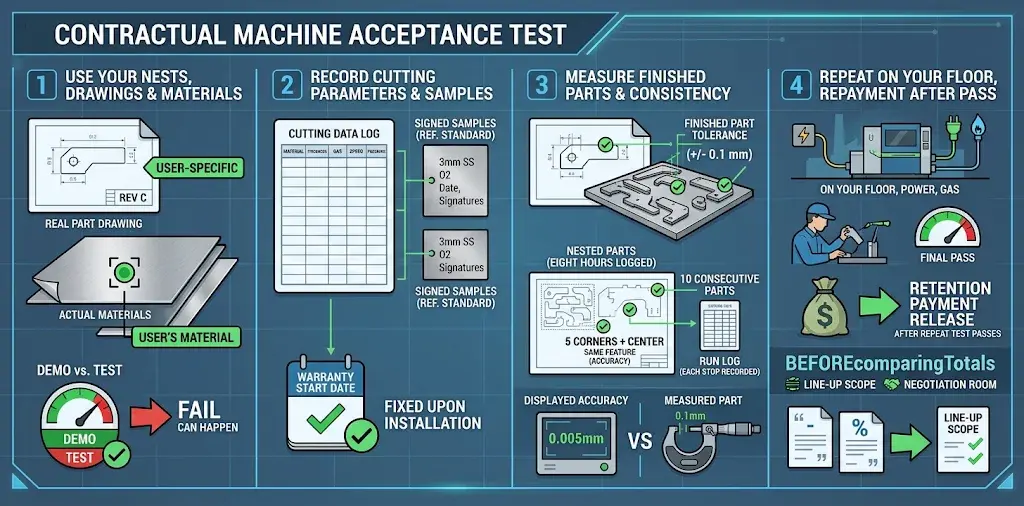
Every supplier offers a demonstration; the difference between a demonstration and a test is that a test can fail. A useful one uses your material, your drawing at your revision, a nest you would actually run, and acceptance numbers agreed in writing before the first cut.
Record and attach to the purchase order: cutting speed per material and thickness with gas, pressure and focus; a retained edge sample per material, signed and dated, with the quality criterion in words; ten consecutive parts measured against the drawing; the same feature cut at four corners and the centre; and eight hours of production with every stop logged.
Two clauses do most of the contractual work. Acceptance is measured on finished parts, not the machine’s displayed accuracy — a machine can sit inside its positional tolerance and still make parts outside the drawing through kerf compensation, focus and gas. And the samples become the reference, so a dispute in month six is settled by comparing parts. Repeat the test on your floor, on your own power and gas, before the retention payment is released.
Two quotations for “6 kW, 3015, exchange table” can differ by thirty percent with neither being wrong. Line up what is in scope — named source, head and controller with warranty start dates; table, extraction and ducting; gas and air plant; installation, training and spares — before comparing totals, because the empty lines are both where the difference sits and where negotiation has room. Get the warranty start date written: a machine that spends six weeks in transit loses ten weeks of cover before it cuts a part.
8. Match the machine to your shop
| Shop profile | Machine family | Why it fits |
|---|---|---|
| Small and medium workshops, mixed one-off work, tight floor space | ULF open-type single desktop | Compact open gantry, direct access for hand loading, 1500 × 3000 and 2000 × 4000 mm formats, 1–6 kW |
| Production work where each sheet change is lost time, or fume containment and a defined perimeter are required | ULE enclosed exchange table | Automatic twin pallet, enclosed frame, formats to 6000 mm and beyond, 6–12 kW |
| Output includes tube, profiles, or a plate-and-tube mix | ULT pipe and tube machine | Round, square and rectangular tube, 3D bevel capability, plate capability on dual-use builds |
| Format still open, or work spans several | Fiber laser cutting machines | Full range with the specification comparison across families |
If your profile falls between two rows, the tie-break is the utilisation calculation: whichever constraint actually stops the machine is the one to buy for. A shop whose operators spend six minutes a sheet handling material against four minutes of cutting is an enclosed case regardless of how its volume compares with a neighbour’s.
The same logic has a forming-side counterpart in how to choose a press brake. Support belongs in the specification too: what technical support includes, whether maintenance and upgrades cover the source and the exchange table, and how many operators training covers.
Send the inventory from section 1 — materials, thicknesses, weekly hours and sheet formats — and we will come back with a configuration and the reasoning, including where a smaller machine would do the same job. The contact page reaches the technical team directly.
Related reading
- How Much Laser Power Do You Need? 1kW to 12kW Explained
- Fiber Laser Cutting Thickness Chart by Power and Material
- Open-Type vs Fully Enclosed Fiber Laser Cutter: How to Choose
- Sheet Metal Laser Cutting vs. Tube Laser Cutting: Which Machine Do You Need?
- Fiber Laser Cutting Machine Price: What Drives the Cost
- How to Choose a Fiber Laser Cutting Machine for Thick Plate Processing