Buying too little power means the machine can’t hold the jobs you quote; buying too much means paying for wattage that never earns its keep. So how much laser power do you actually need? The question is not “which kW number is best.” It is “which band carries the work my shop actually runs, week after week.”
Before you shortlist machines:
- 1–3 kW covers shops living in thin gauge, where the motion system and sheet handling decide throughput more than the beam does.
- 6 kW is the upper-middle band for mixed work — the point where power starts moving cost per part on medium plate, not just thin sheet.
- 8–12 kW is for plate work and pierce-heavy nests, where instantaneous piercing and speed on thicker sections change what you can quote.

What Laser Power Actually Buys — and What It Doesn't
A wattage number appears on every quotation, but it converts into money through three channels only: the thickest section you can cut at production quality, the travel speed of the beam through medium and thick material, and the piercing speed at the start of every contour. Everything else on the machine — positioning accuracy, repeatability, edge finish on thin sheet — is decided by the motion system, the optics and the assist gas, not by the source’s rating.

That distinction matters most on thin work. Matt Milazzo, laser product manager at AMADA AMERICA, described a nest of intricate parts in 18-gauge carbon steel placed on a 12 kW machine: “The limitation now is in the motion system. The 12-kW system could be set to 2,000 in. per minute, but it’s never going to get there” (The FABRICATOR, June 2025). On thin sheet, a bigger beam buys nothing the machine can use. As Milazzo put it, customers don’t pay for fast cutting speeds; they pay for quality products delivered on time.
What power does move, and moves hard, is the pierce — which is where most buyers’ comparisons stop too early. We’ll come back to that.
The Power Ladder, Run by Run
Published maximum-thickness figures vary with optics, assist gas and machine generation, and vendor charts disagree with each other — treat any capability table, ours included, as a starting point to verify with your own material. What the ladder below shows instead is what each band changes about your operation, and what it leaves untouched.
| Power band | What it changes | What it does not change | It fits when… | Skip it when… |
|---|---|---|---|---|
| 1–1.5 kW | Entry cost, floor space, power draw | Throughput on nests — motion and handling dominate | Thin gauge is your whole book; profiles are short and pierce counts are low | You quote anything above a few millimetres regularly |
| 3 kW | The practical baseline for general fabrication; reasonable piercing on mid material | Speed on thin nests — again, motion-limited | Your volume-weighted core sits in thin-to-medium sheet with occasional heavier jobs | Plate is a repeat requirement, not an exception |
| 6 kW | Cost per part on medium work starts moving; thicker ceiling on nitrogen cutting | Edge quality class on thin sheet | Mixed-thickness work where cycle time on the 4–10 mm band shows up in delivery dates | Your hours are 90% thin gauge — you'd pay for speed the motion system can't deliver |
| 8–10 kW | Near-instantaneous piercing on plate; the mid-thick band becomes a nitrogen-cut band | Labour and loading — the machine outruns its feed unless loading keeps up | Plate share of hours is real and growing; you quote work others outsource | Automation, gas supply or floor space can't keep pace yet |
| 12 kW | Plate throughput; piercing disappears from the cycle on most thicknesses | Part accuracy; downstream sorting capacity | Heavy plate is a core product, and downstream can absorb the output | The thick job appears a few times a year — outsourcing it usually beats owning the capacity |
Two cautions when reading any ladder. First, pick the band for your volume-weighted core workload — the thickness band where most of your beam-on hours sit — not for the heaviest job you might ever win. Second, if you regularly run a specific demanding material such as thick carbon steel, the decision belongs to a dedicated process discussion, not to the ladder alone.
Understanding Each Power Level
The ladder above is a decision view. Here is what each band means on the shop floor.
1 kW: The Entry Band for Thin Gauge
A 1 kW fiber laser is the economical entry point for shops whose book is thin sheet: thin carbon steel components, stainless panels, electrical enclosures, decorative parts. The investment is modest, the footprint is small, and the power draw is the lowest on the ladder — which is exactly why it suits maintenance workshops and businesses moving over from conventional cutting.
The limit shows up the moment section thickness grows. On thicker carbon steel or stainless, a 1 kW source cuts slowly, needs careful parameter work, and pays for it in piercing time and process stability.
Choose 1 kW when your materials are mostly thin sheet, daily volume is light, and the initial investment leads the decision. Skip it when you expect to quote anything beyond a few millimetres on a regular basis — a 2 kW or 3 kW machine is the better long-term bet.

2 kW: Flexibility for Mixed Orders
A 2 kW machine buys headroom over the entry band: more capacity on thin and medium sheet, and a wider variety of orders a shop can accept without turning work away. For a manufacturer that cuts 1–3 mm stainless every week but occasionally wins a thicker carbon steel job, 2 kW is often the practical middle.
Choose 2 kW when mixed orders are the norm and you want balance between investment and capability. Skip it when thick plate is a substantial share of the workload rather than an occasional exception — that book belongs at 3 kW or above.
3 kW: The Practical Baseline for General Fabrication
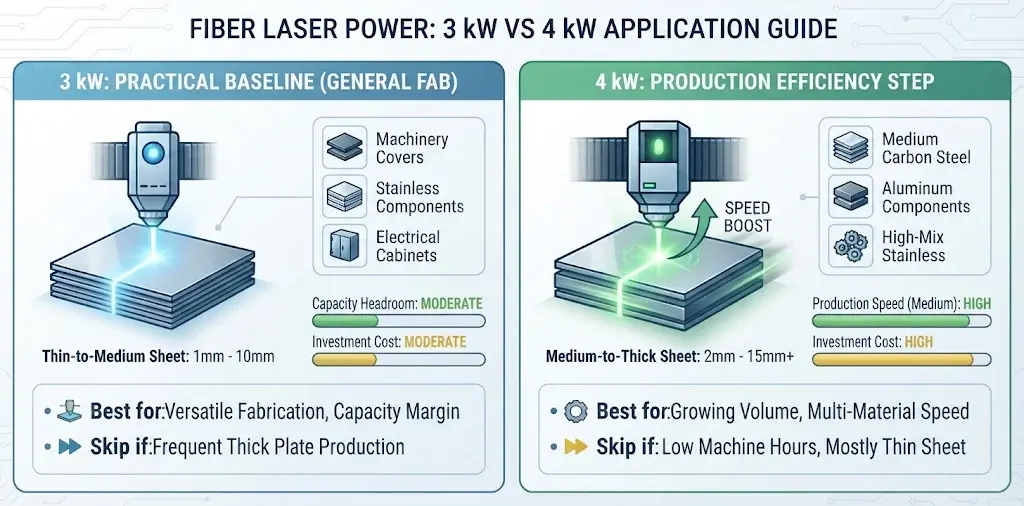
For most general metal fabrication — machinery covers, electrical cabinets, stainless components, custom work across several material types — 3 kW is the band where the machine stops feeling like a compromise. It handles thin and medium sheet with reasonable piercing, and it carries occasional heavier jobs without straining.
It will not, however, deliver production speed on thick plate. If large batches with tight delivery dates are a recurring requirement, the return on investment usually sits at 4 kW or 6 kW instead.
Choose 3 kW when your volume-weighted core is thin-to-medium sheet across several metals and you want capacity headroom without jumping to a high-power investment. Skip it when plate is a repeat requirement, not an exception.
4 kW: A Step Toward Production Efficiency
A 4 kW machine suits manufacturers whose order volume has outgrown mid-range systems: medium-thickness carbon steel, stainless fabrication, aluminum components, and job shops that switch between materials all week. Against a 3 kW machine, its advantage is speed on medium sections — valuable when order volume, not capability, is the constraint.
That advantage only pays if the machine actually runs. A shop cutting a few hours a day on mostly thin sheet will not recover the difference between 3 kW and 4 kW.
Choose 4 kW when medium-thickness work is regular, volumes are climbing, and speed across materials matters. Skip it when machine hours are low and the book is thin gauge — the extra wattage sits idle.
6 kW: Where Cost Per Part Starts Moving
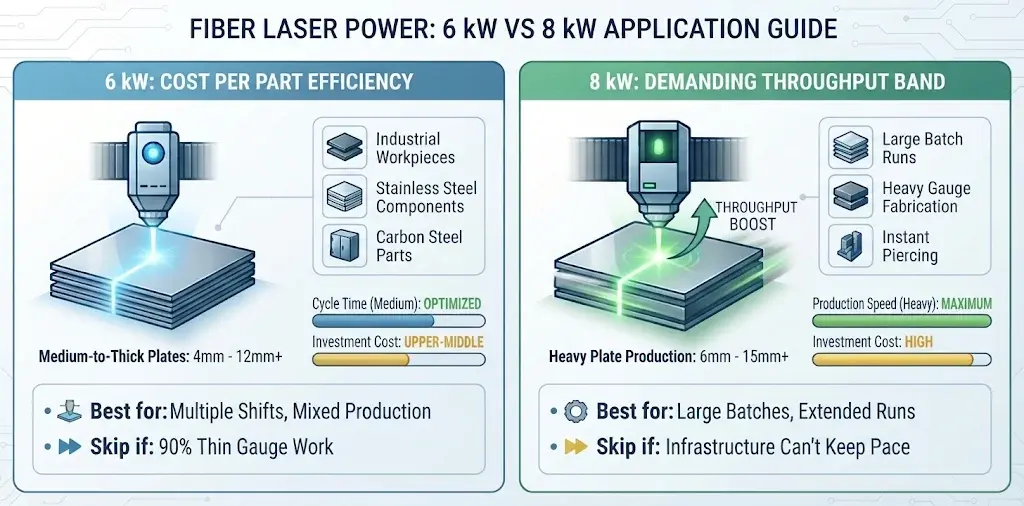
A 6 kW fiber laser is the upper-middle band for mixed industrial work. Its real value is not only a thicker ceiling; it is cycle time on the 4–10 mm band, where a lower-power machine may technically cope but slowly enough that delivery dates and shift planning suffer. A workshop regularly processing 6–12 mm carbon steel and stainless will feel the difference in parts per shift, not just in capability.
Choose 6 kW when medium and thicker plates are common, you run multiple shifts, and cycle time on medium sections directly affects deliveries. Skip it when your hours are 90% thin gauge — the motion system, not the beam, would set the pace anyway.
8 kW: Throughput Band for Demanding Workloads
At 8 kW the machine crosses into territory where productivity engineering dominates: large batches of 6–12 mm plate on extended runs, near-instantaneous piercing, and spare capacity for occasional heavier orders. The source is no longer the only thing being bought — the cutting head, motion system, cooling, electrical supply and gas infrastructure must all be specified to sustain the duty.
Choose 8 kW when plate share of your hours is real and growing, and cutting speed decides how much work you can accept. Skip it when automation, gas supply or floor space can’t keep pace yet — a starved 8 kW machine delivers less than a well-fed 6 kW one.
10–12 kW: For Plate Work as a Core Product
A 10 kW or 12 kW machine is built for shops whose thick-plate work is the product, not the exception: heavy industrial components, construction machinery parts, large-scale fabrication. On materials that would crawl on lower-power machines, the cycle-time difference reshapes scheduling — and on pierce-heavy nests, the higher band takes whole minutes out of programs (more on that below).
The capacity has to land somewhere, though. Downstream sorting, deburring and loading set the ceiling on how much extra wattage converts into shipped parts; some OEMs have walked customers down from the power they assumed to the power their process could actually absorb.
Choose 10–12 kW when heavy plate is a core product, batches are large, and your downstream can absorb the output. Skip it when the thick job appears a few times a year — outsourcing it usually beats owning idle wattage.
How Does Laser Power Affect Cutting Thickness?
The most common purchasing mistake is choosing a machine from the maximum thickness on the manufacturer’s chart. In production, cutting thickness depends on the whole process:
- Laser output power.
- Material type and composition.
- Assist gas type and pressure.
- Cutting head and focusing optics.
- Nozzle diameter and condition.
- Cutting speed and piercing parameters.
- The edge quality the finished part requires.
Materials also respond differently to the same beam. Carbon steel, stainless steel, aluminum, brass and copper have different thermal and optical properties, so a machine’s carbon steel capacity cannot be read across to stainless or aluminum. The TRUMPF specification sheet for its 12 kW TRULaser machines makes the point concretely: at identical laser power, maximum thickness differs across mild steel, stainless, aluminum, copper and brass.
| Laser Power | Carbon Steel | Stainless Steel | Aluminum |
|---|---|---|---|
| 1kW | Thin to medium sheets | Thin sheets | Thin sheets |
| 2kW | Thin to medium sheets | Thin to medium sheets | Thin sheets |
| 3kW | Medium-thickness sheets | Thin to medium sheets | Thin to medium sheets |
| 4kW | Medium to thicker sheets | Medium-thickness sheets | Medium-thickness sheets |
| 6kW | Medium to thick plates | Medium to thick plates | Medium-thickness plates |
| 8kW | Thick plates | Medium to thick plates | Medium to thick plates |
| 10kW | Thick plates | Thick plates | Medium to thick plates |
| 12kW | Thick plates | Thick plates | Thick plates |
Read the table as broad planning ranges, not guaranteed specifications — and keep two distinctions in mind. Maximum thickness and stable production thickness are not the same thing: a successful demonstration cut through thick plate proves penetration once, not queue throughput. And the useful question at quotation time is not “can this machine cut 12 mm steel?” but “how quickly can it cut 12 mm steel while holding the edge quality my customers pay for?”
For the millimetre-level numbers behind these bands — by material, gas and power — see our [thickness chart overview].
Material Type and Assist Gas Change the Answer
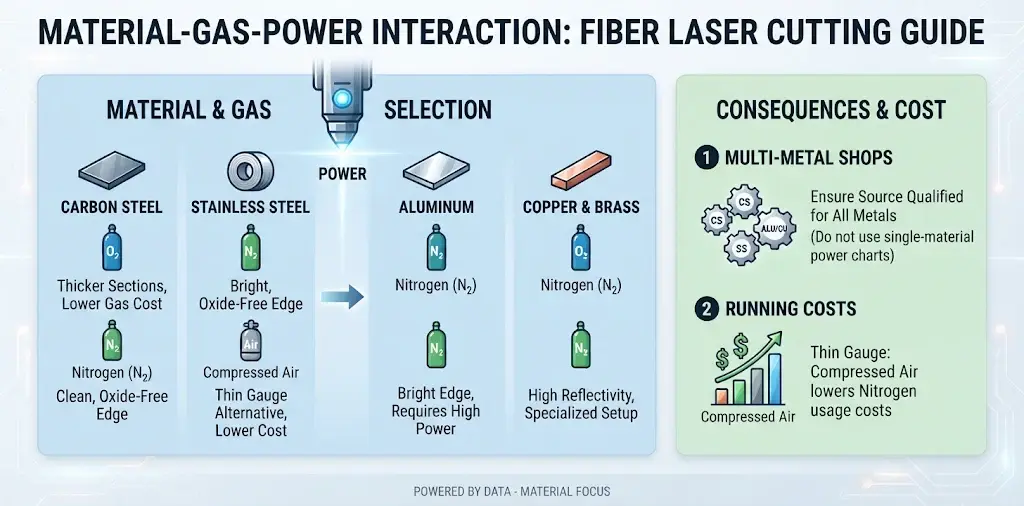
Power selection is half the decision; gas selection is the other half, and they interact.
- Carbon steel is commonly cut with oxygen, which supports the burn process on thicker sections at low gas cost, or with nitrogen when a clean, oxide-free edge matters more than speed.
- Stainless steel is frequently cut with nitrogen to keep the edge bright and free of oxide — which is why nitrogen supply becomes a production variable, not a utility detail.
- Aluminum cuts well with the right parameters and equipment configuration, but its reflective, conductive nature demands more from the source and the optics.
- Copper and brass need additional care because of high reflectivity; the laser source and cutting setup must be specified for them explicitly.
Two consequences follow. If your shop processes several metals, make sure the source and cutting system are qualified for all of them — do not pick power from a carbon steel chart when aluminum or copper is a regular order. And on thin gauge, compressed air is increasingly a legitimate alternative to nitrogen, which changes the running-cost picture later in this guide.
The Piercing Efficiency Nobody Prices

Comparing two machines on cutting speed alone misses where high power pays back fastest: the pierce. “That 3-kW fiber laser will need a few seconds to get through 0.25-in. material, while a 9- or 12-kW system will basically give you an instantaneous pierce,” Milazzo said. “If you have 600 or 700 pierces in a nest, we can take a substantial amount of time out of the program just through those rapid piercing commands.”
That changes how a nest should be judged. A pallet of small holes, slots and lightweight parts can carry more pierces than metres of cutting — and on those nests, piercing speed dominates the program time while the beam’s travel speed barely matters. The practical consequence: two machines with close cutting speeds can be minutes apart on the same nest, and the difference will never appear on a specification sheet.
So before comparing wattages, count the pierces in the jobs you actually run. If your book is pierce-heavy, the higher band buys back more program time than its cutting-speed advantage suggests. If your nests are long, open profiles in thin material, it doesn’t.
The Bills That Climb With the Ladder
The quote sheet covers the machine. The ladder also raises running costs, and two of them behave in ways that surprise first-time buyers.
| Bill | What scales it | The question to ask the supplier |
|---|---|---|
| Nitrogen | Flow rises with thickness and speed — but per part, it can fall | "What is consumption per part on my jobs, per hour, and what generator size covers my three-year plan?" |
| Shop air / compressed air | An alternative on thin gauge that trims the gas bill | "Which of my thicknesses can run on air, and what filtration does that require?" |
| Electrical supply and cooling | Larger sources, larger chillers, possibly a service upgrade | "What is connected load at full duty, and does the chiller cool the source only or the cutting head too?" |
| Consumables | Protective lenses and nozzles wear faster at high power and high duty | "What is a realistic annual consumable budget at my duty cycle?" |
| Automation and floor space | A fast machine starves without feeding | "What loading and sorting does this machine need to hit the cycle times in the quotation?" |
Nitrogen is the one to understand properly, because the monthly invoice can shock shops that only compared machine prices. The per-part picture is friendlier than the per-hour one. “A 10 kW has a cutting speed of roughly double that of a 6 kW,” John Kemp of Bystronic observed. “Yet in both cases, the nitrogen consumption is basically equal, so your nitrogen consumption per part goes down when using the 10 kW” (Canadian Metalworking, 2017). Hank White, then at Mitsubishi Laser, made the same point from the other side: on quarter-inch and thicker material consumption might run 25 to 40 per cent higher than thin work, “but it’s never double.”
The trap sits in gas infrastructure, not in the machine. Generators sized for current consumption are the classic failure: “If you size it for what your needs are now and not what you plan to build, you can end up starving the generator in a couple of years when you add another laser,” Kemp warned — and a starved generator shows up as edge quality that drifts within a single day. If nitrogen generation is on your roadmap, size it for the plan and put the purity and duty figures in the contract, not in a conversation.
On the electrical side, Nikki Amico, product manager at Bystronic, noted in Canadian Metalworking (2020) that consumption rises moving from a 4 kW class machine to 8–10 kW models, and that a 12 kW machine without automation able to keep up “can’t be used to its full potential.” Neither statement is a reason to stay low; both are reasons to price the ladder’s full infrastructure in the same column as the machine.
Power Is a System Upgrade, Not a Setting
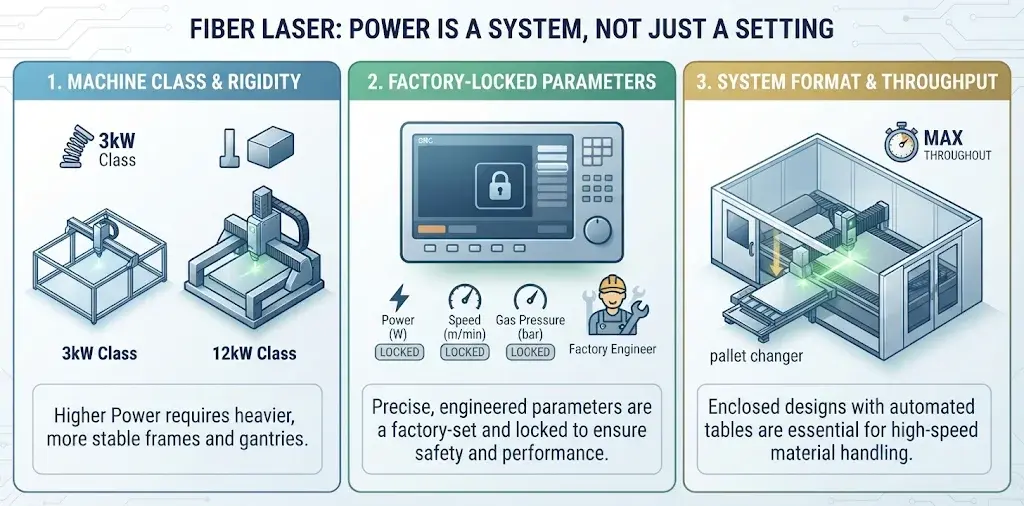
The wattage on the order form is one line of a machine that has to deliver, focus and stabilise that beam. “All of these components create an ecosystem,” said Grant Fergusson, product manager for 2D fiber optic lasers at TRUMPF. “When you increase power levels, you need your machine to be more rigid, the frame to be more stable. When you’re cutting at those higher powers, it’s not just about the laser. So many people make the engine more powerful, but they forget to make the brakes, the shock absorbers, all of those components more powerful too” (The FABRICATOR, May 2026).
Three consequences follow for a buyer comparing 3 kW against 12 kW:
- Machine class moves with the power. Higher bands assume a more rigid frame, heavier gantry and better vibration behaviour; comparing a small machine with a big source fitted against a properly engineered machine is not a fair fight.
- Cutting parameters are factory engineering, not operator tuning. “As power levels go up, so does the importance of having very robust and engineered parameters,” said Kenny Criger of BLM Group in the same article — the best manufacturers ship those parameters locked, because at high power a novice can damage a machine by freestyling settings. Ask any supplier exactly which parameters arrive engineered and which you maintain.
- The machine format tends to follow the band. At the top of the ladder, enclosed designs with automatic exchange tables are common not as luxury but as throughput and safety equipment: the machine cuts so fast that loading becomes the constraint.
When you compare machines within a band, inspect the whole system rather than the source: the laser source’s manufacturer, rated output and warranty terms; the cutting head’s optical configuration and autofocus; the rigidity of the bed and frame under high-speed movement; the motion system’s guides, drives and CNC control; a chiller sized for the source and the optics together; and a gas supply whose type, purity, pressure and flow match the process. A higher-power laser cannot compensate for an undersized gas system or a frame that flexes.
From Workload to Quotation: Profile, Test, Decide

Suppliers recommend well when they’re given real data. Before requesting quotations, build a one-page production profile:
- List the materials you process — carbon steel, stainless, aluminum, brass, copper, galvanized — and note which are regular orders versus occasional ones.
- Sort your thicknesses into three bands: the band you cut most often, the maximum you cut regularly, and the occasional maximum.
- Estimate daily volume and shifts — parts or sheets per day, and whether the shop runs one shift, two, or continuously.
- Define edge quality requirements — clean edges, minimal burr, low heat distortion, consistent accuracy, minimal secondary grinding.
Then make suppliers compete on that profile:
- Run your own nests, not the supplier’s demo parts. Demo pieces are chosen to flatter the machine; your three representative jobs are not negotiable.
- Record cycle time and pierce count separately. The pierce line is where the power difference hides, and it is invisible in a single combined cycle figure.
- Cut with the gas your production uses, at rated power. A machine demonstrated on oxygen that you will run on nitrogen is telling you about a different machine.
- Ask what happens downstream. Sorting, deburring and loading capacity set the ceiling on what extra power converts into shipped parts.
- Confirm which cutting parameters ship engineered and locked from the factory — and which ones your team will own at 3 a.m. when edge quality drifts.
A supplier who resists the three-job test at the band you’re considering has answered a different question than the one you asked.
Where CAMT Machines Sit on This Ladder
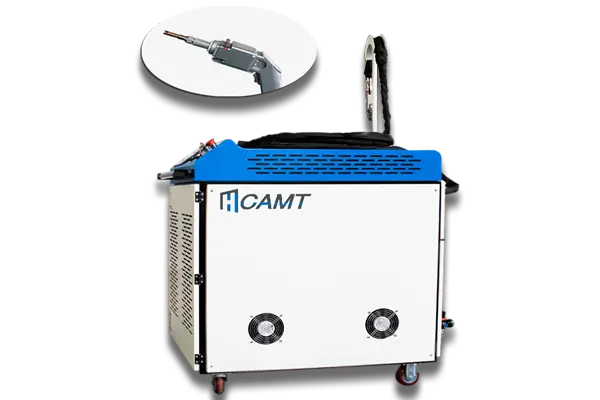
CAMT builds across the full 1–12 kW span with two formats that map onto the ladder’s logic.
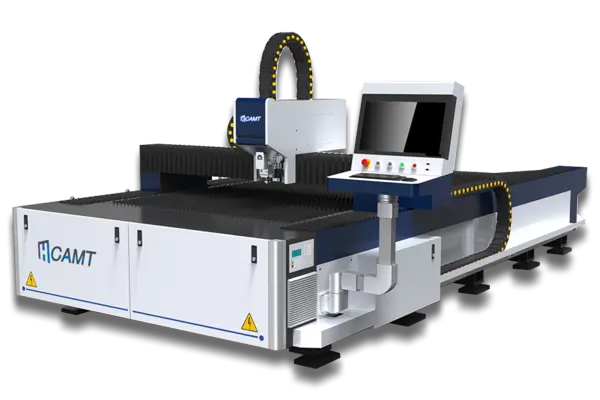
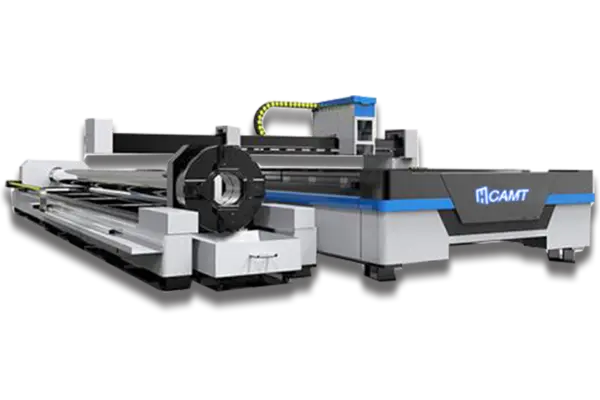
The ULF open-type fiber laser cutter carries the 1–6 kW band in a compact open-gantry format, with working sizes from 1500 × 3000 mm to 2000 × 4000 mm and larger customized options, positioning accuracy up to ±0.03 mm and repeatability of ±0.02 mm. It processes carbon steel, stainless, aluminum and other common metals, and its open structure keeps loading and maintenance straightforward — the band where flexibility and floor space lead the economics.
The ULE fully enclosed exchange-table fiber laser cutter spans 1–12 kW and beyond behind a fully enclosed protective structure, with working sizes from 1500 × 3000 mm up to 2000 × 6000 mm, the same ±0.03 mm / ±0.02 mm accuracy figures, and dual automatic exchange tables. While one table cuts, the other loads — which is what turns the upper bands’ speed into daily output — and the enclosure contains sparks, dust and fumes when integrated with suitable extraction.
| Requirement | ULF Open-Type | ULE Enclosed Exchange-Table |
|---|---|---|
| Workshop type | Small to medium workshops | Medium to large production facilities |
| Laser power | 1–6 kW | 1–12 kW+ |
| Structure | Open-type | Fully enclosed |
| Table system | Single table | Automatic exchange table |
| Production focus | Flexible custom production | Higher-volume production |
| Main advantage | Flexible layout and economical entry | Productivity and operator protection |
If you’re still weighing the machine as a whole — format, table size, automation — our [fiber laser buying guide] walks the full decision in order. And whether your book is thin gauge or heavy plate, send us your three representative jobs; we’ll return cycle times, pierce counts and gas consumption per part rather than a brochure — and work that data into a machine specification with you.
Ready to Size Your Machine?
Bring us your material list, thickness bands, working area and expected daily volume, and we’ll recommend a configuration from the ladder rather than the top of a price list — including cycle times, pierce counts and gas consumption per part for your actual jobs. Contact CAMT or explore our fiber laser cutting machines to compare structures and configurations.
FAQs: How Much Laser Power Do You Need? 1kW to 12kW Explained
Is 3kW enough for a fiber laser cutting machine?
For most general fabrication across thin and medium sheet, yes. A 3 kW machine suits shops working carbon steel, stainless and aluminum that don’t require high-speed thick-plate cutting. Suitability still depends on your exact thicknesses, required speeds and edge quality — which is what the three-job test is for.
Is 6kW better than 3kW for metal cutting?
On medium and thicker plate, yes — cycle time and the thickness ceiling both improve. For a shop living in thin sheet, no: the motion system limits throughput long before the beam does, and the 3 kW machine offers better investment value. Compare cost per part on your own nests rather than on wattage.
Can a 1kW laser cut stainless steel?
Yes. With proper parameters, cutting head and assist gas, a 1 kW fiber laser cuts thin stainless sheet cleanly. Its performance on thicker stainless is limited compared with higher-power systems.
How thick can a 6kW fiber laser cut?
It depends on the material grade, cutting head, assist gas and required edge quality — at the same 6 kW, maximum thickness differs across carbon steel, stainless and aluminum. Treat vendor charts as starting points and request cutting parameter data for your specific grades; a 6 kW machine handles a substantially wider range than a 1 kW one, but the numbers belong to your materials, not to a generic table.
Does higher laser power always mean faster cutting?
No. Speed depends on material properties, thickness, beam quality, focus, cutting gas, nozzle configuration and machine acceleration. On thin nests, the motion system caps speed regardless of wattage; a poorly configured high-power machine can lose to a properly optimized lower-power one on the same job.
Is a 12kW fiber laser worth the investment?
For shops where thick plate is a core product and batches are large, yes — the throughput and piercing gains reshape scheduling. For businesses mainly cutting thin sheet, the extra capacity sits unused and the return rarely arrives. Decide on production time savings and cost per part, not on the kW figure.
Will a 12kW machine cost much more to run?
Per hour, yes — more gas, electricity and cooling. Per part, often no: cycle time halves on medium and thick material while hourly cost rises by a fraction, and nitrogen consumption per part can fall because flow rates don’t double with speed. Get the per-part figures for your jobs in writing.
Should I buy one high-power machine or a second smaller one?
Shops that already run fiber lasers usually add capacity rather than replace capability — automation on the existing machine or an additional cell. If thick plate is a rare exception, a second smaller machine or outsourcing the heavy job beats owning idle wattage; if plate is core, the high-power band is the tool that wins the work.
Can I upgrade from 3kW to 6kW later?
Only if the machine’s original design supports it — the laser source, cutting head, cooling, electrical infrastructure, motion system and control configuration all have to take the new source. Never assume a power upgrade is a simple source swap; if growth is planned, discuss upgrade paths with the manufacturer before purchasing.
Which is better: an open-type or enclosed fiber laser cutting machine?
Open-type machines suit shops prioritizing flexible access, convenient loading and lower initial investment — typically the 1–6 kW band. Enclosed exchange-table machines suit manufacturers needing operator protection, fume containment and continuous production — typically the upper bands, where loading must keep pace with cutting. The choice follows your production volume, layout and safety requirements.