
J21 Fixed Bed Power Mechanical Press For Sale| 100-160 Ton | CAMT
Deliver consistent stamping results with a reliable mechanical press engineered for speed, energy efficiency, and long-term stability in demanding manufacturing environments.
- Up to 120 strokes per minute
- ±0.01 mm precision accuracy
- 40% lower energy consumption
- Open C-frame for easy operation
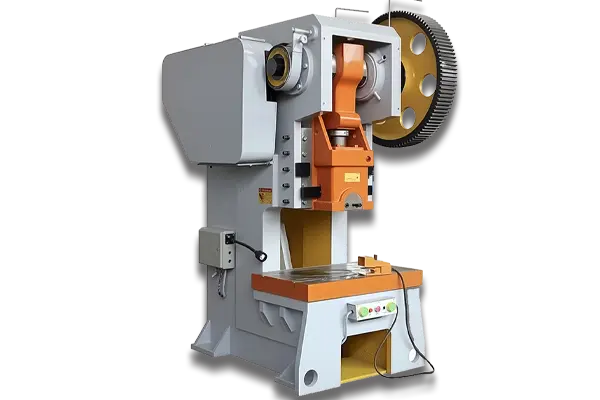
The CAMT J21 Fixed Bench Punching Machine is a high-efficiency mechanical press designed for precise and reliable stamping operations. Powered by a robust crank-slider mechanism, it converts rotary motion into vertical reciprocating force, enabling fast and accurate punching, blanking, bending, and shallow drawing on both metallic and non-metallic materials.
Built for modern manufacturing demands, the J21 combines high-speed performance (up to 120 strokes per minute) with excellent energy efficiency through flywheel energy storage, reducing power consumption by approximately 40%. Its open C-frame structure provides convenient access for die changes and material handling, while the precision drive system delivers consistent accuracy of ±0.01 mm.
Ideal for high-volume production environments, the J21 is widely used in automotive components, precision electronics, new-energy battery casings, hardware fabrication, and rubber molding. With low maintenance requirements, stable operation, and a cost-effective design, it offers manufacturers a practical and productive solution for everyday stamping needs.
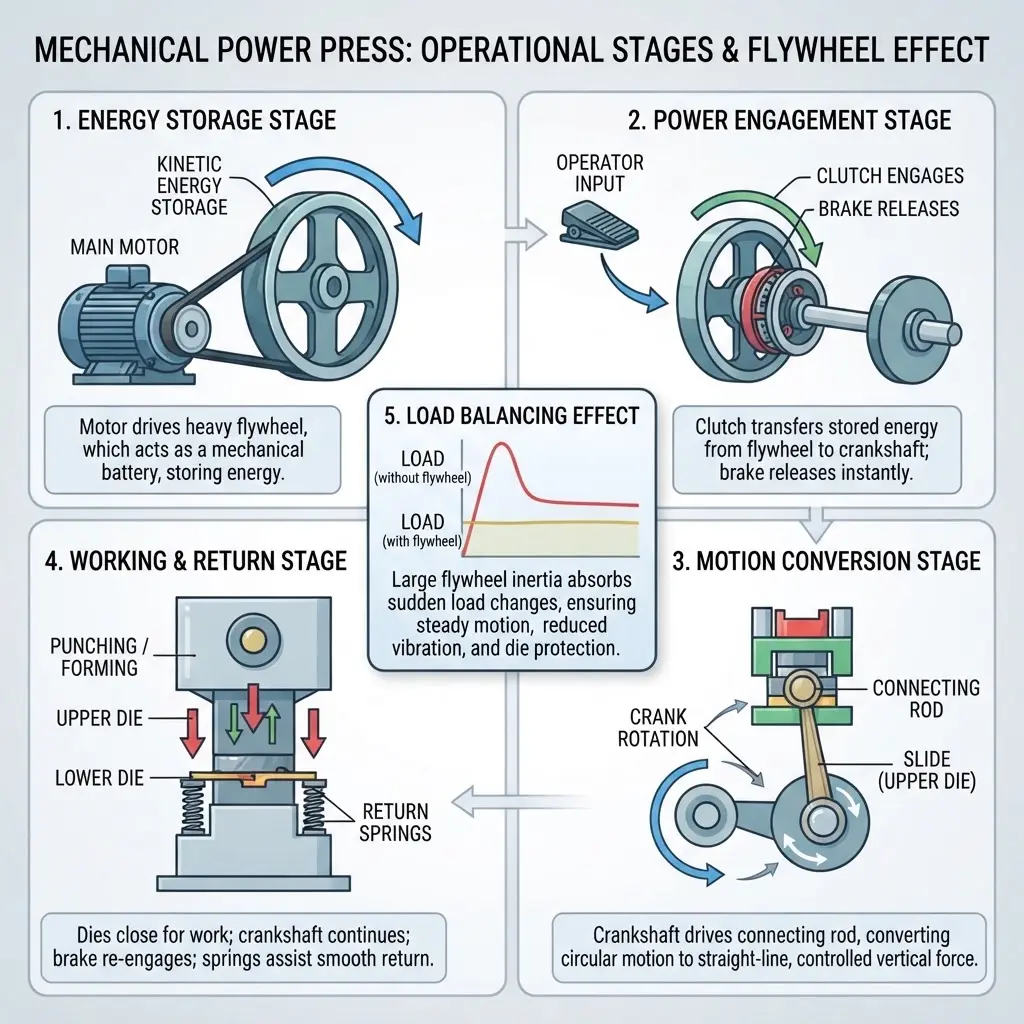
The CAMT J21 Mechanical Press uses a classic crank-slider mechanism to convert rotary motion into precise vertical stamping force. Here’s how the power flows through the machine in a complete cycle:
Energy Storage Stage
The main motor drives a heavy flywheel through a belt and pulley system. The flywheel continuously stores kinetic energy while spinning, acting like a mechanical battery. This stored energy is ready to be released instantly when needed, reducing the peak load on the motor and keeping power consumption stable.
Power Engagement Stage
When the operator presses the foot pedal or button, the clutch engages and transfers the flywheel’s stored energy to the crankshaft. At the same time, the brake releases, allowing the crankshaft to start rotating. This engagement is fast and precise, ensuring the slide begins its downward stroke without delay or lag.
Motion Conversion Stage
The rotating crankshaft drives a connecting rod that converts the circular motion into straight-line reciprocating movement. The connecting rod pushes the slide (which carries the upper die) vertically downward with controlled force and speed. The entire drive chain is rigidly engineered so that every stroke delivers consistent position and pressure.
Working & Return Stage
As the slide reaches the bottom of its stroke, the upper and lower dies close to perform punching, blanking, bending, or shallow forming. After the working point, the crankshaft continues rotating, the brake re-engages, and return springs assist the slide in rising smoothly back to the top dead center, ready for the next cycle.
Load Balancing Effect
Throughout the entire process, the flywheel’s large rotational inertia absorbs sudden load changes caused by different material thicknesses or cutting resistance. This keeps the slide motion steady, reduces vibration, protects the dies, and ensures the machine runs smoothly even during continuous high-speed production.
Advantage Of CAMT Mechanical Press
High-Speed Production
Achieve up to 120 strokes per minute, significantly shortening cycle times. Ideal for high-volume orders, this speed helps you meet tight delivery schedules without adding extra shifts or machines.
Energy-Saving Operation
Flywheel energy storage reduces power consumption by approximately 40% and lowers peak motor load. You get lower electricity bills and more stable factory power demand during continuous running.
Consistent Precision
Maintain stamping accuracy of ±0.01 mm over long production runs. This minimizes dimensional variation, reduces scrap rates, and ensures parts fit perfectly in downstream assembly.
Low Maintenance & High Reliability
Mechanical drive system has fewer failure points than hydraulic presses. Expect longer service intervals, lower spare-parts costs, and less unplanned downtime on the production floor.
Easy Material & Die Access
Open C-frame design allows quick manual or semi-automatic feeding and fast die changes. Operators spend less time on setup and more time producing, improving overall equipment efficiency.
Lower Total Cost of Ownership
Competitive purchase price combined with reduced energy use and maintenance expenses delivers a faster return on investment compared with hydraulic alternatives of similar capacity.
Multi-Process Versatility
One machine handles punching, blanking, bending, shallow drawing, and press-fitting. You can switch between different jobs without investing in multiple specialized presses, saving both floor space and capital.
Smooth & Stable Continuous Running
Flywheel inertia effectively balances load fluctuations, keeping the slide motion steady even under varying material thickness. This reduces vibration, protects dies, and extends the service life of both machine and tooling.
J21 Fixed Bench Mechanical Press Specifications
| Name | J23-10 | J23-16 | J23-25 | J23-40 | J23-63 | J23-80 | J21-100 | J21-125 | J21-160 | JH21-200 | JH21-250 |
|---|---|---|---|---|---|---|---|---|---|---|---|
| Nominal force KN | 100 | 160 | 250 | 400 | 630 | 800 | 1000 | 1250 | 1600 | 2000 | 2500 |
| Stroke of Nominal force mm | 2 | 2 | 3 | 5 | 5 | 6 | 6 | 8 | 8 | 12 | 14 |
| Stroke of sliding block mm | 50 | 60 | 70 | 100 | 100 | 120 | 130 | 130 | 160 | 180 | 200 |
| Number of strokes times/min | 130 | 110 | 60 | 55 | 50 | 45 | 43 | 35 | 28 | 28 | 28 |
| Closed height mm | 180 | 190 | 210 | 325 | 350 | 370 | 380 | 400 | 400 | 420 | 430 |
| Closed height adjustment mm | 35 | 40 | 50 | 65 | 80 | 90 | 100 | 110 | 120 | 120 | 130 |
| Distance from slider block centre to the frame mm | 130 | 150 | 180 | 250 | 260 | 275 | 310 | 340 | 390 | 390 | 390 |
| Length between columns mm | 140 | 160 | 230 | 270 | 310 | 410 | 520 | 560 | 580 | 680 | 700 |
| Hole size for die handle Diameter mm | 35 | 35 | 40 | 50 | 50 | 60 | 60 | 70 | 80 | 90 | 100 |
| Depth mm | 50 | 60 | 60 | 70 | 70 | 70 | 90 | 120 | 150 | 150 | 170 |
| Size of worktable Left-right mm | 360 | 440 | 500 | 680 | 720 | 750 | 900 | 930 | 1140 | 1390 | 1500 |
| Front-back mm | 240 | 270 | 320 | 460 | 480 | 530 | 630 | 630 | 740 | 820 | 900 |
| Blanking hole diameter mm | 80 | 100 | 130 | 150 | 160 | 180 | 180 | 200 | 200 | 220 | 250 |
| Table plate thickness mm | 35 | 40 | 50 | 65 | 80 | 100 | 120 | 130 | 150 | 150 | 150 |
| The maximum tilt angle • | 35 | 35 | 30 | 30 | 20 | 20 | |||||
| Dimensions Left-right mm | 680 | 730 | 920 | 1060 | 1130 | 1350 | 1480 | 1590 | 1855 | 2015 | 2340 |
| Front-back mm | 630 | 950 | 1180 | 1435 | 1480 | 1715 | 1815 | 1890 | 2045 | 2475 | 2675 |
| Height mm | 1658 | 1750 | 2040 | 2350 | 2450 | 2670 | 2750 | 2850 | 2920 | 3780 | 3850 |
| Power KW | 1.1 | 1.5 | 2.2 | 4 | 5.5 | 7.5 | 11 | 11 | 15 | 18.5 | 22 |
FAQs When Purchase Mechanical Press
What is the nominal force (tonnage) of this mechanical press? How do I choose the right tonnage?
What is the maximum strokes per minute (SPM)? Is it suitable for high-volume production?
What level of stamping accuracy can it achieve? Will accuracy decline over long-term use?
What are the main differences between mechanical and hydraulic presses? Why recommend the mechanical type?
What material thickness can it process? Which materials are suitable?
Is die change convenient? How long does a typical die change take?
What safety protection measures does the machine have?
Is daily maintenance complicated? Are maintenance costs high?
How is the energy consumption performance? How much electricity can it save?
Does it support automatic feeding or integration with production lines?
Is the machine noisy or does it produce strong vibration during operation?
What is the warranty period? How is after-sales service guaranteed?
What is the approximate delivery time?
Can the machine be customized according to our process requirements?
Can we arrange a machine trial or visit existing customer sites before purchasing?
Have more questions, or need a customized Mechanical Press solution?
Contact our team for detailed advice, technical support, or a tailored quotation. We’re ready to help you find the right configuration for your production needs.
Welcome To Contact Us!
Please fill out the form, and we will contact you as soon as possible.
Not familiar with China? Need a reliable team to handle your machinery imports? Looking for a specific sheet metal processing machine? Or searching for a long-term partner in the metal fabrication equipment industry? Tell us what you need, and we’ll make it happen.