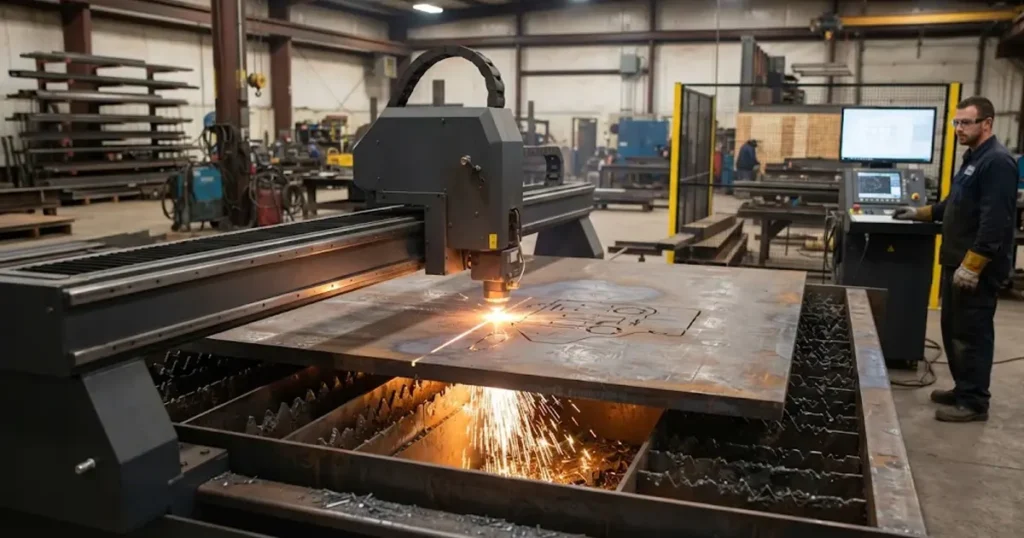
A thick-plate fiber laser is not bought on kilowatts. It is bought on the edge it leaves behind. A machine that severs 30 mm plate cleanly in a demonstration can still send every part to a grinding bench before welding, because an oxide layer, adherent dross or a tapered cut fails the next operation. Name that operation first, write its edge requirement into the enquiry, then choose the power, gas path, cutting head and table that hold it on the plate you actually buy.
- Size for the thickness you run every shift, not the thickness in the brochure headline.
- Power buys speed. Assist gas, piercing control and the edge criterion decide whether the part ships without a second operation.
- Ask for a repeatable production thickness with material, gas, pressure, focus, speed and edge criterion attached.
- Ask for the rated table load. A full plate plus its skeleton is heavier than the parts you invoice.
- Incoming plate varies by heat and surface condition; accept the machine on your own material, not a display coupon.
1. Define the job before you compare kilowatts
Record the mix you actually run, then treat the maximum as a capability to verify, not the setting you buy for.
| What to record | What to ask | It changes |
|---|---|---|
| Material grades | Carbon steel, stainless, aluminium? | Gas, nozzle, parameter library |
| Typical thickness | What runs most shifts? | Power, cycle time, consumables |
| Maximum thickness | Thickest plate you must cut? | Minimum capability, pierce strategy |
| Next operation | Weld, coat, machine, bend, assemble? | Edge criterion, gas, acceptance test |
| Plate format and weight | Sheet size, thickness, full-plate mass | Working area, rated table load, handling |
| Hours and future orders | Shift pattern, thicker work coming? | Automation, cooling, spare capacity |
The line most buyers leave out is the next operation. Write it as a sentence in the enquiry: 20 mm carbon steel, oxygen assist, as-cut edge goes straight to robotic fillet welding with no grinding. Every later decision is measured against it. Positioning accuracy is not part accuracy either: a machine’s positioning figure does not guarantee the same dimensional tolerance on every grade and thickness.
2. Choose power for production thickness, not the advertised maximum
| Power band | Use it to shortlist |
|---|---|
| 3–6 kW | Sheet work and selected medium-thickness plate jobs |
| 6–12 kW | A wider mix of medium and thick plate where speed matters |
| 12 kW and above | Demanding thick-plate work and higher volumes |
A maximum thickness figure is a severance limit under one set of conditions; it says nothing about edge quality, gas consumption or how many consecutive parts held that result. Ask each supplier for a repeatable production thickness for your grade, with gas, pressure, focus, cutting speed, edge criterion and the number of consecutive parts stated. Two 12 kW quotations with different answers are not comparable yet. Cutting head, beam characteristics, nozzle, focus position and material condition all have to work with the source; more watts do not repair a mismatch.
Higher power also raises the purchase price and the demands on electrical supply, cooling, gas plant and optics. Compare the extra throughput against the full ownership cost — chiller, compressor, filtration, extraction and electrical installation included. Oversizing for occasional thick jobs usually buys idle capacity, not parts.
3. Check the structure, cutting head and cooling as one package
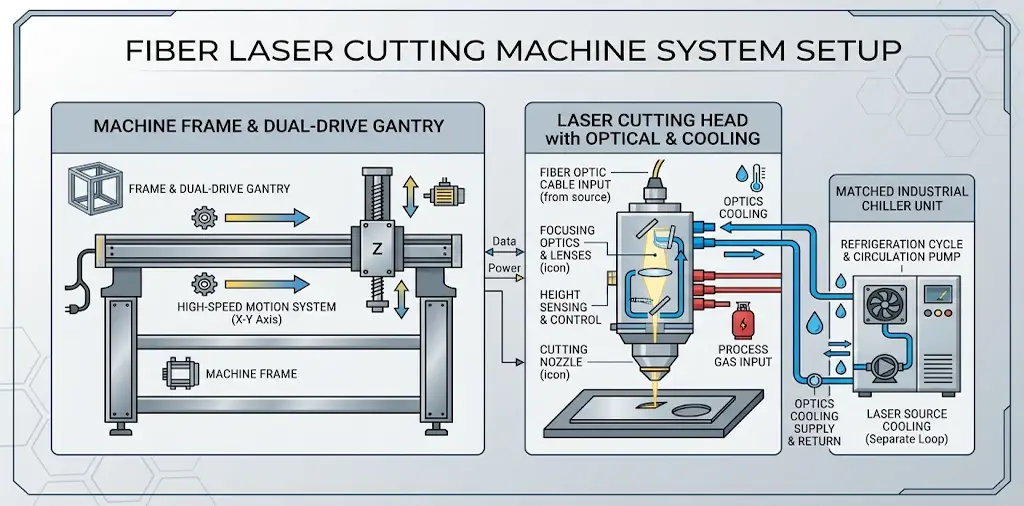
The published specification tables for the ULE enclosed exchange-table machine and the ULF open-type single-table machine list power bands, working areas, running speed, positioning and repeat accuracy, acceleration, Z travel, connected load, drive system, frame construction, laser source, cutting head and controller. They describe a welded, heat-treated frame and a dual-drive gantry. They do not publish a maximum cutting thickness with its conditions, or a rated table load. That is not a claim that either machine cannot do the work; it is a statement that neither number can be inferred from the table. Both have to arrive in writing.
Ask for four things in one line each: positioning and repeat accuracy measured with a loaded gantry; the cutting head’s rated power together with its optical, nozzle and cooling configuration for your thickness range; chiller capacity matched to the laser source and head; and the guarding, interlock and extraction interfaces for the grades you cut. A fiber laser cutting machine range page may quote a broader power band than a model’s own sheet. Take the model sheet as governing and ask for the applicable material list confirmed in writing. Descriptive phrases about edge finish or machine life on any supplier page are marketing language, not acceptance values.
4. Pick the assist gas from the next operation
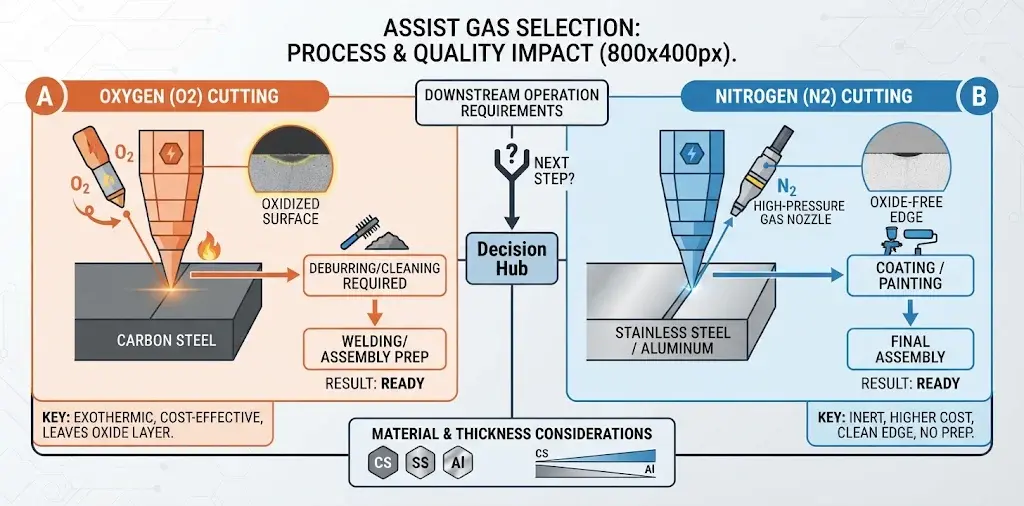
Oxygen helps clear the kerf on carbon steel through an exothermic reaction and usually costs less per hour than high-purity nitrogen, but it leaves an oxidised surface. Nitrogen gives an oxide-free edge for stainless, aluminium and carbon-steel parts that go to coating; flow and pressure demand grow with thickness, and so does the bill. A 2015 account in The FABRICATOR makes the point that decides this choice: a machinist and a welder can judge the same edge differently, because the application requirements dictate what counts as a quality edge. It also notes that overall cycle time barely moves when parts queue at a deburring operation. Cut both ways on your own plate and let the next operation decide, not a comparison table.
For the quotation, ask for gas type, working pressure, consumption rate and supply equipment for each material and thickness. Add three process questions that no brochure answers: how the machine confirms breakthrough before it starts moving, how spatter is kept off the protective window during a thick pierce, and what the recorded replacement interval is for nozzles and windows at your thickness mix. Thick-plate cycle time often sits in piercing and gas flow rather than contour travel, so these answers belong in the budget.
5. Size the table, working area and plate handling
Full plate plus its uncut skeleton, not the parts you ship, is what the table carries. A 2 × 6 m × 20 mm steel plate is 0.24 m³ × 7850 kg/m³, about 1,884 kg before fixtures or a larger format. Recompute that with the sheet size you actually buy, then ask for the rated table load in kg or kg/m² for the exact working area, including the exchange mechanism and the support slats.
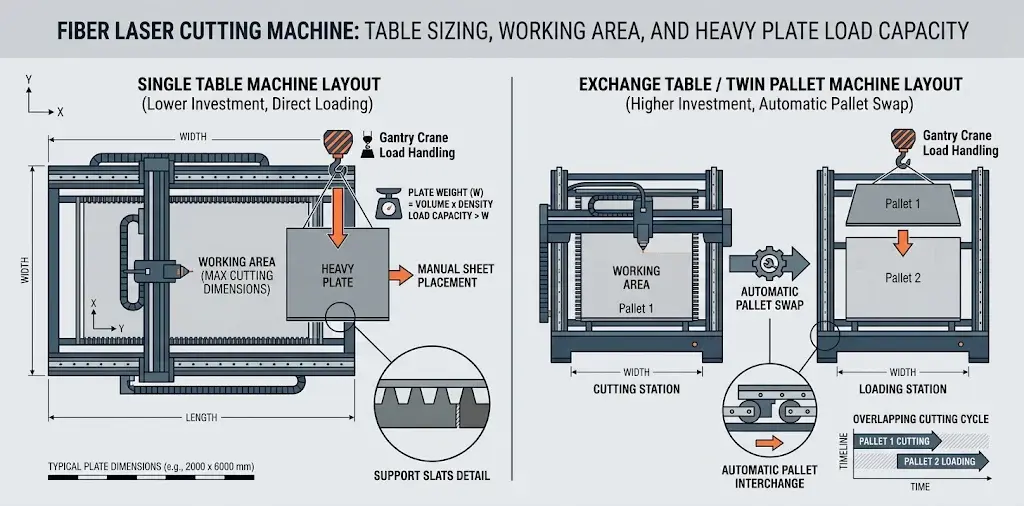
| Single table | Exchange table | |
|---|---|---|
| Investment | Lower | Higher |
| Loading | Interrupts cutting | Overlaps with cutting |
| Best fit | Custom work, small runs | Medium to large batches |
| Thick-plate caveat | Crane access must be direct | Rated pallet load must cover the full plate |
An exchange table changes how a heavy plate reaches the cutting position; it does not change what the table has to carry. Decide the load first and the loading method second. If cutting time per sheet dominates and loading is quick, the second pallet has little to recover. The ULE enclosed exchange-table machine is published with a 6–12 kW band and automatic twin pallets; the ULF open-type single-table machine with 1–6 kW and a single table. Neither page publishes a thickness limit or a rated table load, so that answer comes back in writing against the edge criterion in section 1.
6. Judge the edge the way the next operation will
| Next operation | The edge must satisfy | The check demonstrations skip |
|---|---|---|
| Fillet or robotic weld, as-cut | No adherent dross, no notches, consistent land | Trial weld on the cut edge, not a visual inspection |
| Groove or bevel weld prep | Angle, land, squareness, no gouges | Measuring angle and land, not just the outer profile |
| Coating, painting or plating | Oxide-free edge; oxide lifts the coating | Adhesion check on a coated coupon after cure |
| Machined datum | Squareness, taper, minimum stock at the narrowest point | Sizing the allowance from the bottom of the cut |
| Bent after cutting | Deburred edge, no heat-affected notch on the bend line | Trial bend on the actual die |
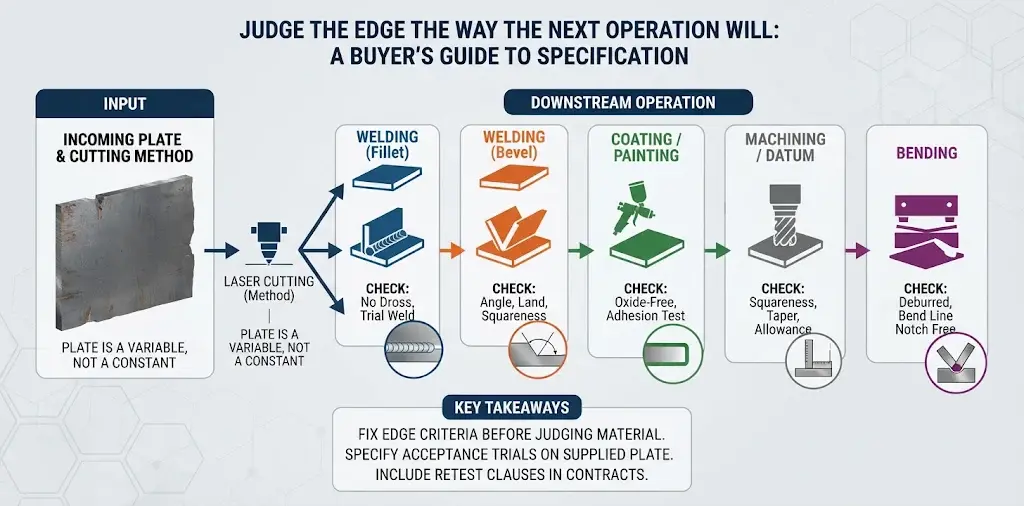
Incoming plate is a variable, not a constant. TWI’s controlled trials on twelve carbon and C-Mn steels found the spread from material composition and surface condition exceeded the combined effect of machine and operator — a 2002 CO₂-laser result on 6 and 12 mm plate assessed against DIN 2310, so its magnitude has to be re-measured on your own thick plate. What carries over is the method: fix the edge criterion before judging a material. TWI’s overview of cutting in fabrication also names materials handling, heat, fume and noise among the hazards requiring a risk assessment. For a buyer that means requesting the guarding boundary, extraction airflow at the table and the laser classification in writing, then letting the responsible authority in your plant determine what the installation needs.
ASTM A6/A6M-24 requires rolled structural plate to be marked with grade, heat number, size and thickness, and states that its supplementary requirements apply only where specified individually in the purchase order. Put that in the contract: acceptance trial on plate the buyer supplies from a named heat, mill certificate attached, measured thickness and surface condition recorded, and a retest clause for a new heat, mill or surface condition.7. Calculate cost per part the next operation releases

The quotation is not the total. Add the chiller, compressor and drying, gas supply, dust extraction and electrical installation; then power, gas, nozzles, protective windows, slats and filters; then labour, loading, maintenance and downtime. Most of all, add the minutes spent grinding an edge that failed section 6.
Cost per released part = (material + power + gas + consumables + labour + rework) ÷ parts the next operation accepts without rework.
Quote both gases and both table options on the same denominator. Reporting on high-power bevel cutting in 2024 describes shops choosing different quality levels because higher cut quality carries a higher part cost, and notes that it still boils down to per-part cost — for many applications plasma cutting is not going away. A cheaper oxygen cut that adds four minutes of oxide removal per part is not the cheaper cut. Compare the full old route too: cut, clean, machine, and the scrap risk.
8. Test the machine before you sign
Ask for a trial on your own CAD drawings and your own plate. Have the supplier record the laser source and rated power, cutting head and nozzle; material grade, heat number and measured thickness; gas type and pressure, focal position and actual cutting speed; piercing method, pierce time and breakthrough detection; edge condition, dross and squareness at the bottom of the cut; and the cycle time across consecutive parts.
Then add the question most factory acceptance tests miss: will the edge be released by the next operation? From one mother plate take three adjacent coupons of the same size and orientation — adjacent, because a plate that has already been cut and handled is no longer the same starting condition. Cut one with the supplier’s parameters, one with your own, and one on plate from a second heat or a different surface condition. Put each through the real next step: weld, coat, machine or bend. Record what the next operator rejects and how many minutes of rework each rejection costs. Keep the signed coupons and the parameter page, and repeat when the heat, nozzle batch or gas supply changes. The pass criterion is downstream release, not a clean-looking cut face.
9. Shortlist the configuration and put the questions in writing
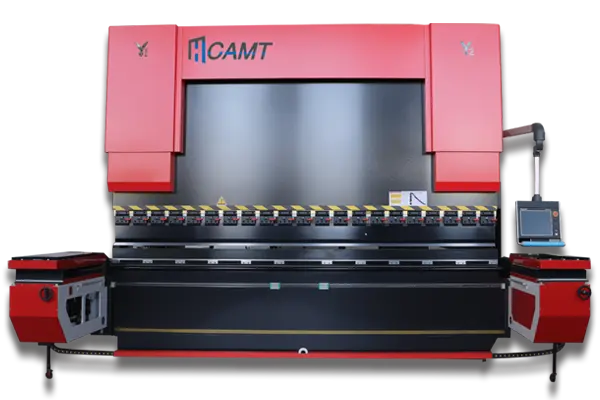
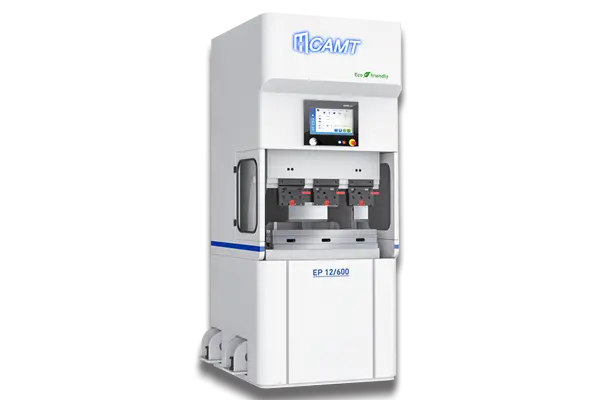
With the edge criterion, the missing specification lines and the incoming-plate clause written down, the machine family is a short conversation: how a full plate reaches the table, how often the laser waits for loading, and whether the guarding and extraction boundary can be administered in your shop. Round, square or structural tube is different work, so put the ULT pipe laser cutting machine beside the plate machines only if tube is on the order book. If forming is part of the same route, thick-plate bending belongs in the same layout discussion.
Send one page to every supplier on the shortlist, including us: the edge criterion per part family in words; a repeatable production thickness with its conditions; rated table load, slat part numbers and change interval; peak gas flow and pressure under simultaneous operation; pierce detection, spatter protection, nozzle and window schedule; and the incoming-plate clause with the three-coupon trial protocol.
On our side those questions split across functions, so send the same page to each rather than routing it through one sales contact: process parameters and the trial protocol to technical support; nozzle, window and slat part numbers to spare parts and consumables; optical inspection and service intervals to maintenance and upgrades; the retest routine to training; the guarding and extraction boundary to safety arrangements. The full scope sits under CAMT services, and company details are on about us.
We will not put a thickness limit without its conditions, a promise that secondary finishing disappears, or a compliance determination for your plant into a quotation unasked. Send that one page with your grades, thickness range, sheet format and next operation to Contact CAMT; the shortlist comes back with the reasoning attached, including the case where a smaller configuration is the right answer.
FAQ
Can a 6 kW fiber laser cut thick steel plate?
For some medium and thicker carbon steel work, yes, but the answer depends on grade, gas, cutting head and the edge you need. Ask for a repeatable production thickness on your material with pressure, speed and edge criterion stated, then ask what changes if the next operation needs an oxide-free or weld-ready edge. A single maximum figure answers neither.
Is 12 kW enough for regular thick-plate production?
It can be, and it is where many shops start shortlisting. If most of your work sits near the machine’s upper thickness limit, compare cost per released part and the old route — plasma or oxy-fuel may still win on parts that do not need a precision edge. Have the limit demonstrated on your plate across consecutive parts, not one coupon.
Oxygen or nitrogen for thick carbon steel?
Oxygen clears the kerf with an exothermic reaction and usually costs less, but leaves an oxide layer that has to come off before coating. Nitrogen gives an oxide-free edge at higher flow, pressure and cost. Cut both ways on your plate and let the next operation decide.
Does an exchange table pay off on thick plate?
It follows from how often the laser waits for loading, not from thickness alone. Rated table load and the handling method come first; the pallet only overlaps loading with cutting. If cutting time per sheet dominates and loading is quick, there is little to recover.
Why do the same parameters fail after a new plate delivery?
Composition, surface condition and measured thickness shift the cut. TWI’s controlled trials on 6 and 12 mm carbon steels found the spread from material exceeded that from machine and operator combined — a 2002 CO₂-laser result to re-measure on your plate. Record heat number, measured thickness and surface condition with every parameter set.
What should an acceptance trial include besides a sample cut?
Three adjacent coupons from one mother plate, cut under the supplier’s parameters, your own parameters and a second heat or surface condition, each then put through the real next operation. Keep the signed coupons and parameter page, and define the retest triggers in the contract.
Conclusion
Send the one-page enquiry to at least three suppliers and run the same three-coupon trial on each machine. The comparable answers are the ones that come back with material, gas, edge criterion and rework minutes written down.