Copper and brass will cut on a fiber laser — and cut well — but they are the two metals most likely to punish a machine that was not configured for reflective material. The failures are rarely exotic: a copper part that never pierces no matter how the parameters are tuned, a back-reflection alarm that trips mid-job, a brass job shipped with dull edges because the wrong gas was chosen. The reliable path is not a parameter table copied from the internet. It is knowing which problems tuning can fix, which only the machine’s configuration can answer, and what to have in writing before you feed red metal into the machine.
Why Copper and Brass Behave Differently Under a Fiber Laser
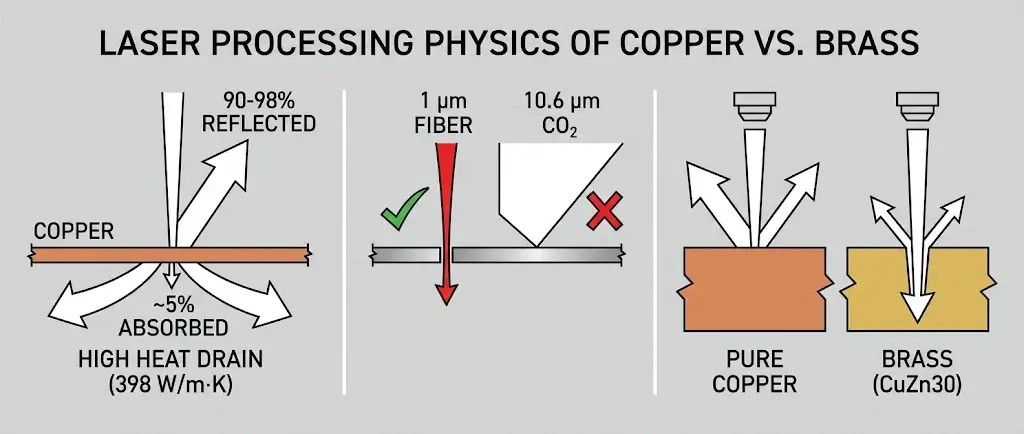
The core difficulty is optical. A 2024 peer-reviewed review of copper laser processing puts numbers on shop experience: solid copper absorbs only about 5% of near-infrared laser energy and reflects 90–98% of it, and even molten copper absorbs only around 7% (Khandpur et al., Metals, 2024). They come from powder-bed fusion research, not sheet cutting, but it is the same physics the cutting head faces: at the ~1 µm wavelength a fiber laser emits, cold copper behaves mostly like a mirror, absorption rises sharply at shorter wavelengths — which is why green and blue sources exist — and its thermal conductivity, roughly 398 W/m·K for wrought material, drains heat from the kerf faster than steel ever would.
This is also why the fiber laser changed the conversation. Copper and brass cutting with a 10.6-micron CO₂ laser was, in The FABRICATOR’s words, “(and still is) rare,” while at the fiber laser’s 1-micron wavelength “aluminum cuts very well, as do even copper and brass” (Tim Heston, The FABRICATOR). Wavelength alone does not do the job, but it moved copper and brass from “barely possible” to “production-realistic.”
Brass complicates the picture usefully. It is a copper-zinc alloy — common sheet grade C26000, also sold as cartridge brass or CuZn30, sits near 70/30 — and shops generally find it more forgiving than pure copper. It still reflects like a red metal and still demands a machine rated for reflective alloys, but alloying takes the edge off the pure-copper extremes:
| Aspect | Pure copper (e.g., C11000 ETP) | Brass (e.g., C26000 cartridge brass) |
|---|---|---|
| Composition | Elemental copper, electrolytically refined | Copper-zinc alloy, ~70/30 on common sheet grades |
| Near-IR behavior | Extreme end of reflectivity; ~5% absorption reported | Reflective, but generally more forgiving in practice |
| Heat behavior | Very high thermal conductivity drains the kerf | Alloying lowers conductivity; heat stays closer |
| Surface condition | Polished plate is the hardest first mirror; oxide and scale absorb differently | Same physics, plus surface-specific parameters per finish |
| Fume consideration | Copper fume | Fume can contain zinc oxide — has exposure limits |
| Typical disposition | Configuration-gated; test cut required | Commonly listed on machine materials specs |
| Default gas | Nitrogen for a clean edge; oxygen as a studied trade-off | Nitrogen for a clean edge; air for economy on non-cosmetic parts |
Distinguish parameter tuning from hardware configuration issues when laser cutting copper and brass
Most frustration with red metals comes from treating a configuration problem as a tuning problem. The two classes behave completely differently:
| Symptom | Class | First move |
|---|---|---|
| Rough, striated, or oxidized edge on brass | Parameter | Gas type, focus, nozzle condition, speed–power balance |
| Icicle dross on the bottom edge | Parameter | Gas pressure and focus before power; diagnose by dross shape |
| Thin copper or brass sheet comes off the table distorted | Either | Heat input per contour: nesting, cutting order and speed before power |
| Cut starts, then dies partway through the contour | Either | Check optics and nozzle first; then it is a penetration problem |
| Never pierces through copper at any parameter combination | Configuration | Gas pressure at the workpiece; machine's reflective rating |
| Back-reflection alarm trips repeatedly mid-job | Configuration | Stop tuning. Have the protection spec confirmed in writing |
| Alarm trips on some jobs but not others | Configuration | Check what changed: alloy, thickness, surface condition, power |

The configuration side has hard evidence. In a study of thin copper plate cutting with a Q-switched single-mode fiber laser, a traditional convergent nozzle with nitrogen made cutting “impossible to cut under any experiment condition” — the pressure arriving at the workpiece was simply too low; with a Laval nozzle delivering higher working pressure, the same copper cut at 30 mm/s with dross under 10 µm (Shiwayama, Uno and Okamoto, ICPMT2006, via Okayama University’s research archive). The parameters did not fail — the pressure at the kerf did. Nothing on the control panel changes what the nozzle delivers.
The dividing line: parameters set how well a capable process runs; configuration decides whether a capable process exists at all. Repeated back-reflection alarms across parameter changes belong to the second class — tuning through them risks the optics.
Follow five setup steps to safely dial in red-metal laser cuts
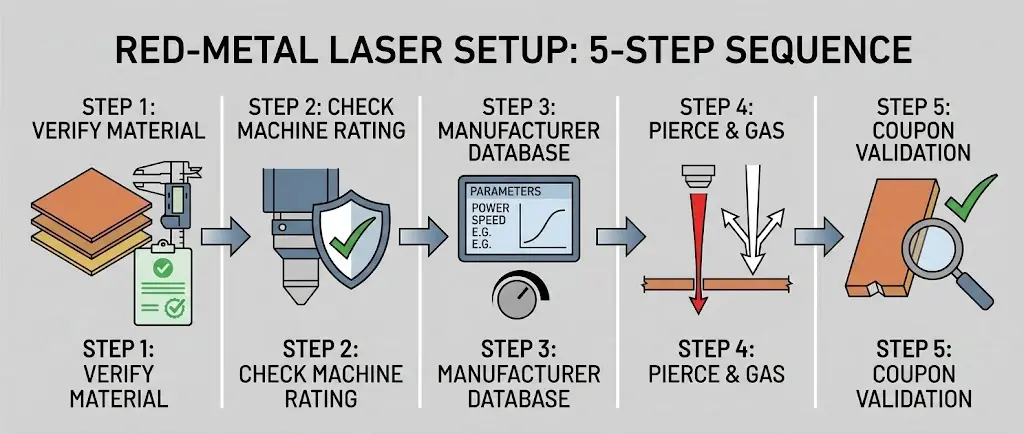
Step 1 — Identify the exact alloy, thickness and surface. Confirm whether the sheet is pure copper or a specific alloy, and for brass the grade and zinc content wherever the mill certificate allows. Check actual thickness, surface finish, oxidation, protective films, oil contamination and flatness. Two sheets of the same nominal thickness can behave differently — treat every new lot as a new material until a coupon proves otherwise.
Step 2 — Confirm the machine is rated for this job. One conversation with the supplier settles it: reflective-material rating at your power class, back-reflection protection behavior, gas delivery at the head — the full list lives in the checklist below. A machine that cuts stainless steel is not automatically cleared for copper.
Step 3 — Start parameters from the manufacturer’s database, not a chart. There is no universal parameter table for copper and brass: a setting that pierces thin brass can stall in thicker copper, and polished versus oxidized sheet changes the initial absorption. Take the approved starting point for your grade and thickness, then tune one variable at a time.
Step 4 — Nail the pierce and the gas before chasing speed; the next two sections cover each in depth.
Step 5 — Validate on a coupon before production. Never commit an expensive sheet untested. Check full penetration along the path, edge condition top and bottom, burr and dross, discoloration, distortion and dimensional accuracy. Repeat to confirm consistency, then document the approved parameters for that grade, thickness and surface.
Get the Pierce Right Before You Worry About the Edge
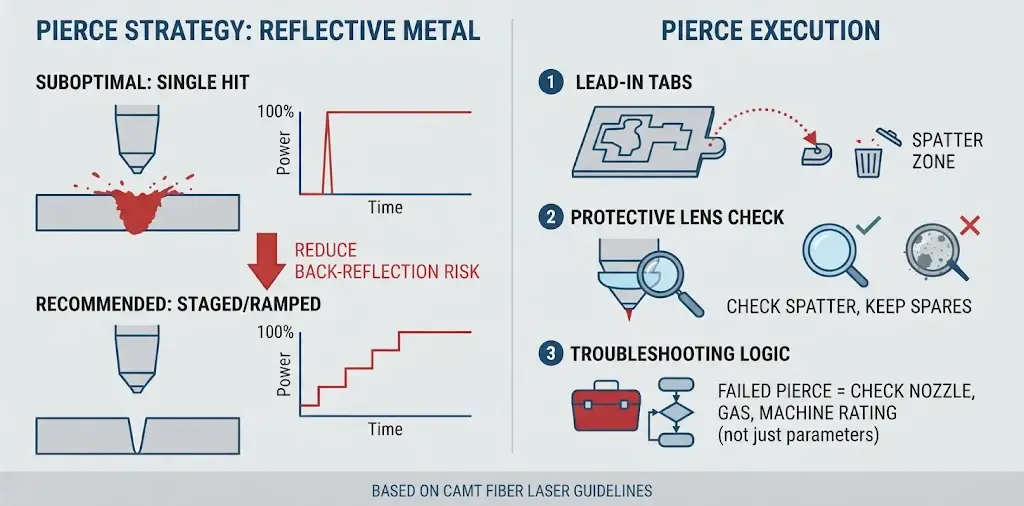
The pierce is where solid, reflective metal sits under the beam longest — once the keyhole opens and the melt pool forms, absorption improves and the process settles. The first moments happen against the worst optical condition the job will ever present, so shop practice concentrates caution there:
- Use the machine’s staged or ramped piercing mode rather than a single continuous hit, so energy rises in steps instead of slamming full power into a cold mirror.
- Put pierces on scrap or lead-in tabs where the design allows, so spatter and discoloration land outside the part outline.
- Watch the protective lens. A spattering pierce shows up later as unstable power delivery, and a contaminated lens produces edge defects that look exactly like bad parameters. Fresh lenses and nozzles are cheap next to a job of rejected brass — keep spares on hand through a supplier such as CAMT spare parts and consumables.
- Treat a failed pierce as information, not encouragement. If copper will not pierce at reasonable settings, the answer is usually in the nozzle, the gas plumbing, or the machine’s rating — not in the twentieth parameter attempt.
Broader symptom-to-cause logic for failed pierces and cut loss lives on the troubleshooting pillar, Fiber Laser Cutting Troubleshooting: Dross, Burrs and Rough Edges; this page stays on what is specific to red metals.
Use nitrogen for clean red-metal edges and verify actual nozzle pressure
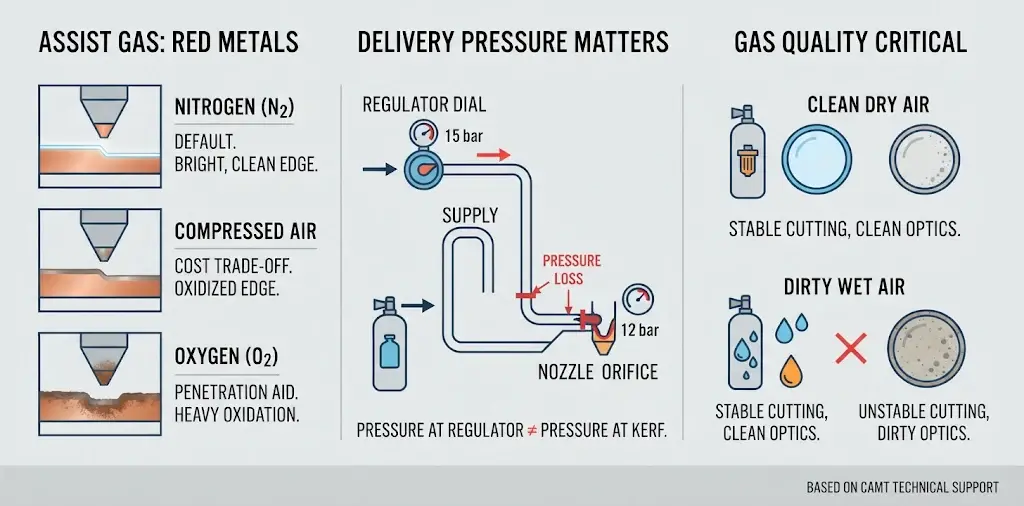
Nitrogen is the default for a clean brass or copper edge. It does not react with the melt — it clears mechanically — so the edge stays bright and oxide-free, which matters more on red metals, whose edges are often visible, decorative, or electrical contact surfaces. Compressed air trades edge quality for cost — it carries oxygen, so expect oxidation and a duller edge, acceptable only on non-cosmetic parts after a validated trial — and air quality matters: moisture and oil in the supply show up as unstable cutting and dirty optics. Oxygen changes the kerf chemistry and can aid penetration on certain copper thicknesses, at the predictable cost of an oxidized edge and a different post-processing conversation. The decision belongs to your edge specification and coupon test; because gas consumption lands in the per-part cost account, the three-gas economics are covered in Laser Cutting Assist Gas: Oxygen vs Nitrogen vs Compressed Air.
One caution applies to all three: the pressure that matters is the one arriving at the kerf, not the one on the regulator dial. Long or undersized lines, wrong nozzle series, and worn seals eat delivery pressure silently — and the Okayama study shows what that costs on copper. When a gas-related defect resists tuning, ask what the head actually receives before what the supply room delivers; CAMT’s technical support team works through gas plumbing and nozzle configuration as part of process setup.
Cutting Brass: Alloys, Edge Finish and Zinc Fume
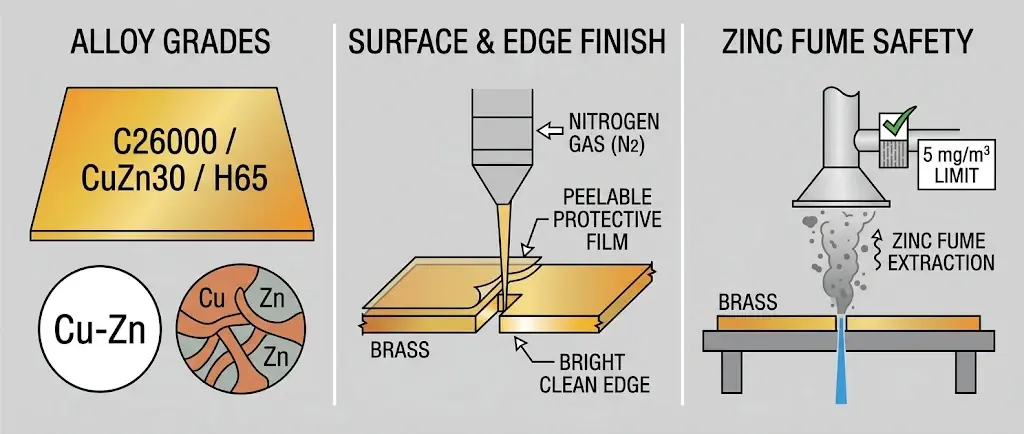
Brass sourcing starts with the alloy designation. The same metal answers to C26000, cartridge brass, CuZn30 or H65 depending on which standard and country your supplier speaks; the Copper Development Association maintains a public alloy database for composition and properties. Composition is worth checking, because zinc content shifts both cutting behavior and fume behavior.
On edge quality, brass is where the appearance standards are usually strictest — signage, nameplates, decorative panels, electrical contacts. That shifts the priorities: nitrogen becomes harder to argue away, nozzle condition and clean optics matter more, and protective films should stay on the sheet as long as the process allows. Scratches that steel parts would hide under paint become rejects on polished brass.
The safety topic brass brings that copper mostly does not is zinc fume. Heating brass can carry zinc oxide into the cutting fume, and zinc oxide fume has published occupational limits: the NIOSH Pocket Guide lists a REL of 5 mg/m³ TWA (10 mg/m³ short-term), an OSHA PEL of 5 mg/m³, and names the consequence of overexposure as metal fume fever — chills, muscle ache, nausea, fever, and a metallic taste (NIOSH Pocket Guide, Zinc oxide). We do not assert compliance or quantify emissions; extraction, monitoring and respiratory-protection decisions belong to the supplier and your EHS function in writing. What can be said plainly: fume extraction on brass is an occupational-health topic with real published limits — and blocked or saturated filters quietly kill airflow, so filter and duct inspection belongs on the maintenance schedule.
Configure machine optics and gas delivery to successfully cut pure copper
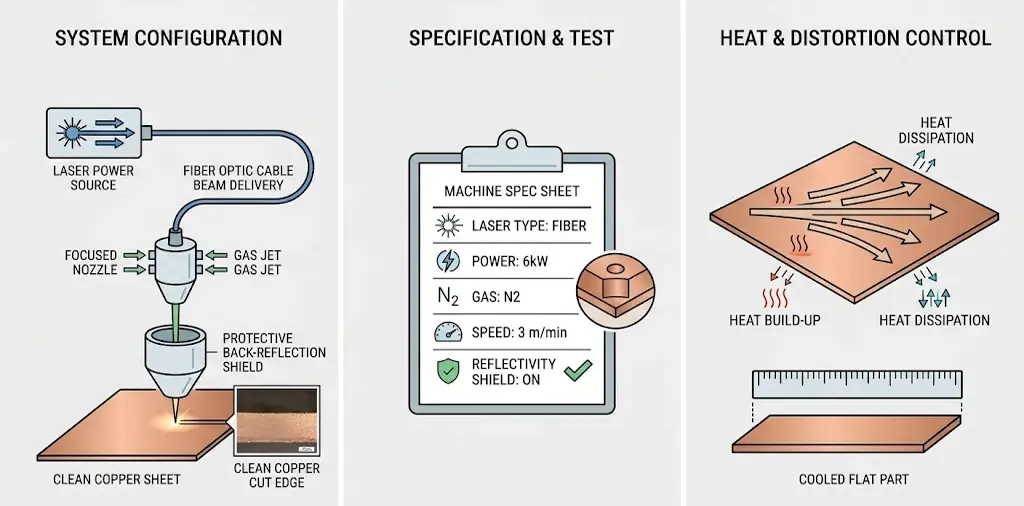
Pure copper is where the two problem classes collide hardest. Thin copper can cut beautifully — the Okayama work showed a correctly delivered gas jet taking thin plate with nearly no dross — but the thickness you can reliably reach is set by power class, beam delivery, nozzle series and back-reflection protection working together. There is no universal copper ceiling: every honest answer depends on the configuration, which is why written confirmation and a test cut on your alloy and thickness outrank any chart.
Machine fit deserves a careful read. A family overview may list copper for a manufacturer’s range, while each model’s spec sheet lists a narrower set — our ULE enclosed machine page, for example, lists carbon steel, stainless steel, galvanized sheet, aluminum alloy, brass and titanium, and its spec sheet governs that model. Treat the overview as orientation and the model sheet you are buying as the contract; if copper is the core job, get its thickness band at your chosen power in writing, backed by a test cut.
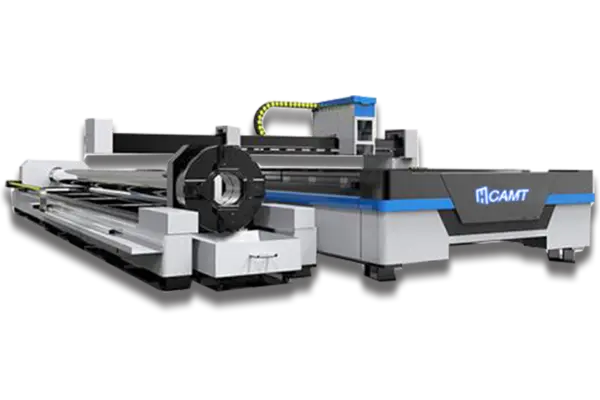
The perspective worth keeping: copper was never impossible — just unforgiving of shortcuts. Charles Caristan of Air Liquide recalled a fabricator who cut 0.125-inch copper alloy on a 2.5-kW CO₂ laser for years — “The cutting head moved slowly, and the operator had to stop the cutting cycle midway through to let it cool. It was not pretty, but it was doable” (Heston, The FABRICATOR). Modern fiber machines remove most of that pain when protection and delivery are specified for the job. Within CAMT’s range, the fiber laser cutting machine lineup covers open-type and fully enclosed sheet models in the ULF and ULE series, and the enclosed exchange-table layout keeps dust, sparks and fume contained on red-metal jobs.
One more copper topic: thin-gauge work distorts. Copper’s conductivity spreads heat wide, so slow speeds, closely spaced contours and poor nesting accumulate distortion fast. Sequence contours to spread heat across the sheet, support the sheet properly, and inspect precision parts after they cool — dimensions measured hot are not dimensions shipped.
Manage laser back-reflection, fume extraction, and operator training
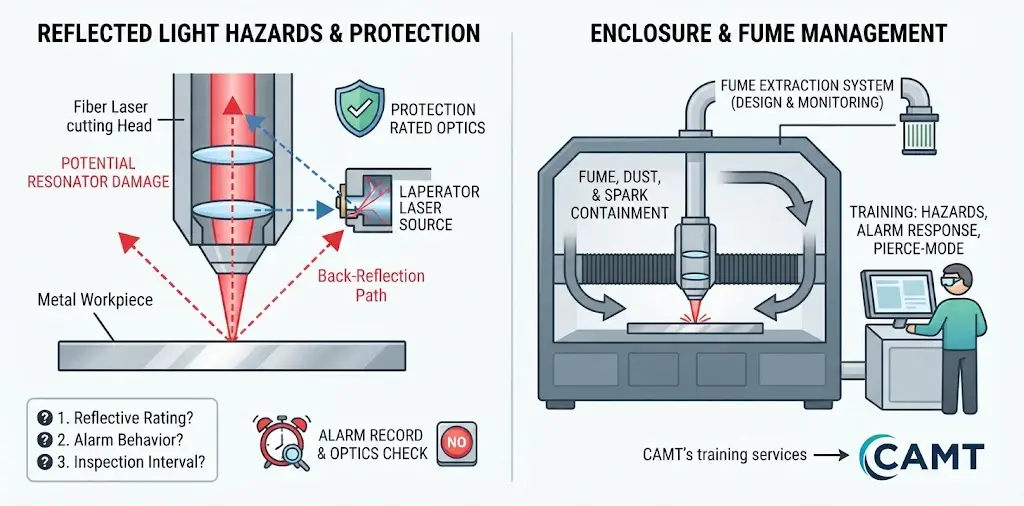
Back-reflection is the hazard unique to reflective-metal cutting. As Caristan described the early CO₂ era, reflected light traveled “back through the optical systems, going all the way back to the laser resonators’ cavities, often destroying them,” though most modern machines, fiber lasers included, have built-in optics and controls that mitigate or prevent it (Heston, The FABRICATOR). The correct reading is not “modern machines are immune” — protection exists, its rating varies by brand, power class and configuration, and only the supplier can state what your machine has. Three questions to have answered in writing: the source’s reflective-material rating, how the protection behaves when it trips, and the inspection interval for protective lenses at your power class. When an alarm trips, pull the alarm records and inspect the optics per the manual before restarting — a reset is not a diagnosis.
An enclosed machine changes day-to-day fume exposure by containing dust, sparks and cutting fume inside the work envelope — but containment is not extraction design, and extraction, filtration and monitoring decisions still belong with your supplier and EHS function in writing. Operator competence closes the loop: machine-specific hazards, alarm response and pierce-mode behavior are what structured training such as CAMT’s training services covers.
What to Confirm in Writing Before You Cut or Buy
Red-metal cutting punishes verbal assurances. Before committing copper or brass to a machine — or a machine purchase to copper and brass jobs — get these six answers on paper:
| # | What to confirm | Why it matters on red metals |
|---|---|---|
| 1 | The machine's rated reflective materials and thickness band at your power class | Family overviews and model spec sheets do not always list the same materials; the model sheet governs |
| 2 | Back-reflection protection behavior when it trips | Validated for the complete source-plus-head system, not one component; defines your alarm response |
| 3 | Protective lens grade and inspection/replacement interval | Reflective jobs load the lens faster; intervals should reflect your material mix |
| 4 | Gas train pressure rating and delivery at the cutting head | The pressure at the kerf decides copper piercing, not the regulator reading |
| 5 | A test cut on your alloy, temper and thickness | Your coupon, your edge spec, your verdict — cutting samples on your own specifications, not a brochure table |
| 6 | Extraction, consumables and service support for red-metal production | Fume decisions belong with supplier and EHS; lens and nozzle supply keeps the recipe stable |
If copper is central to your order book, treat power the same way: what a kilowatt class changes and does not change is laid out in How Much Laser Power Do You Need? 1kW to 12kW Explained, and how aluminum behaves under the same reflective-metal physics in How to Laser Cut Aluminum Without Excessive Burrs or Dross. When configuration answers and coupon results line up, close the gap between “listed material” and “your production part” at CAMT’s contact page with your alloy list and thickness range.