A press brake’s price is built from five cost blocks: structure, power and drive, control and axes, tooling, and compliance with support. They do not grow at the same rate, and they are not equally visible. Two machines with the same tonnage and the same bending length can be quoted far apart because the cheaper one has moved cost out of blocks you cannot inspect once the frame is painted.
This article does not give you a number, because any figure published online — including any figure we might publish — is a snapshot of one configuration, one steel price, one exchange rate and one freight market on one day. What it gives you is a way to read a quotation, and a way to defend the decision afterwards.
The Five Blocks Behind Every Quote
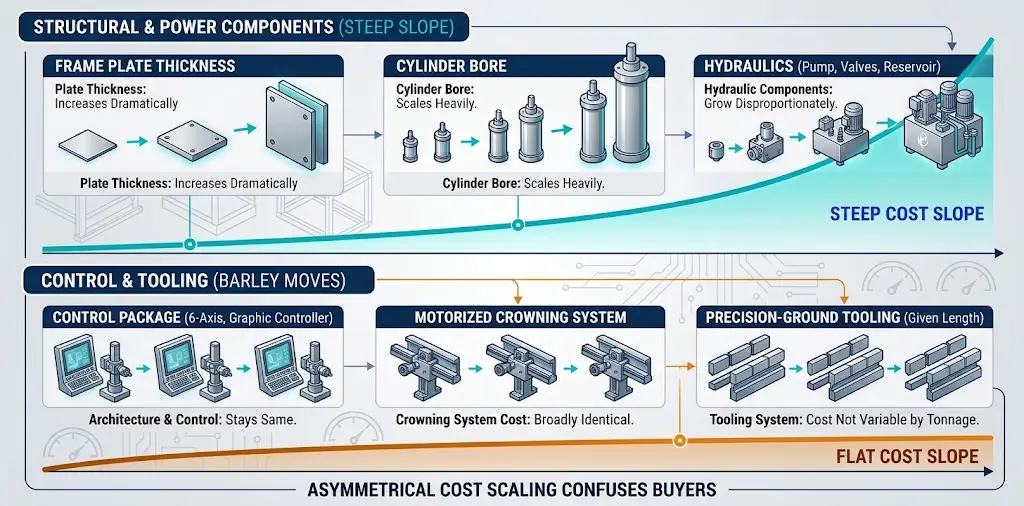
The blocks do not have the same slope, and this is the part buyers miss.
Structure and power climb steeply with size. More tonnage means thicker plate in the frame, larger cylinder bores, a bigger pump, larger valves, a larger reservoir, heavier machining and heavier handling. Each step up is not proportional to the tonnage number; it is steeper, because several of these items scale together.
Control and tooling barely move with tonnage at all. A control package with six axes, a graphic controller and per-side position feedback costs broadly the same whether it is mounted on a 40-tonne frame or a 300-tonne one: what changes is the size of the axes it drives, not the architecture of the system. The same is largely true of a motorized crowning system and of a set of precision-ground tooling of a given length.
That asymmetry explains most of the pricing behaviour that confuses buyers. On a small machine a high specification is a large share of the invoice, and it is the easiest place for a supplier to move the number in either direction. On a large machine the same specification is a small share, so arguing over it saves less than arguing over structure and drive. It also tells you where to spend: options are cheapest, in relative terms, on the machine you are already buying for its tonnage.
Drive architecture is a step, not a slope
The three families buyers actually compare — mechanical torsion-bar synchronization, electro-hydraulic servo synchronization, and full servo drive using screws or belts — sit in three price bands because each carries a fixed block of content the others do not: a torsion bar and mechanical linkage; proportional valves, per-side feedback and a closed-loop controller; or servo motors and the transmission and frame layout that suit them. You are not paying for a label, you are paying for the components that make the label true. Which architecture suits your parts is a separate question, set out in servo-electric vs hydraulic vs hybrid press brakes and in CNC vs NC vs torsion-bar press brakes.
One pricing detail hides in the safety standard. ISO 6909:2026, published in May 2026, applies to four machine types — hydraulic, hydraulic servo-drive, screw servo-drive and belt-spring servo-drive — and states plainly that it does not cover machines using a combination of technologies (ISO 6909:2026). Two consequences for a buyer: conformity is an obligation on the party that designs, manufactures and supplies the machine, so it is a cost inside the price rather than an extra; and a hybrid machine falls outside that scope, so its conformity route has to be argued on its own terms rather than assumed.
Tonnage and Length: Two Different Cost Curves
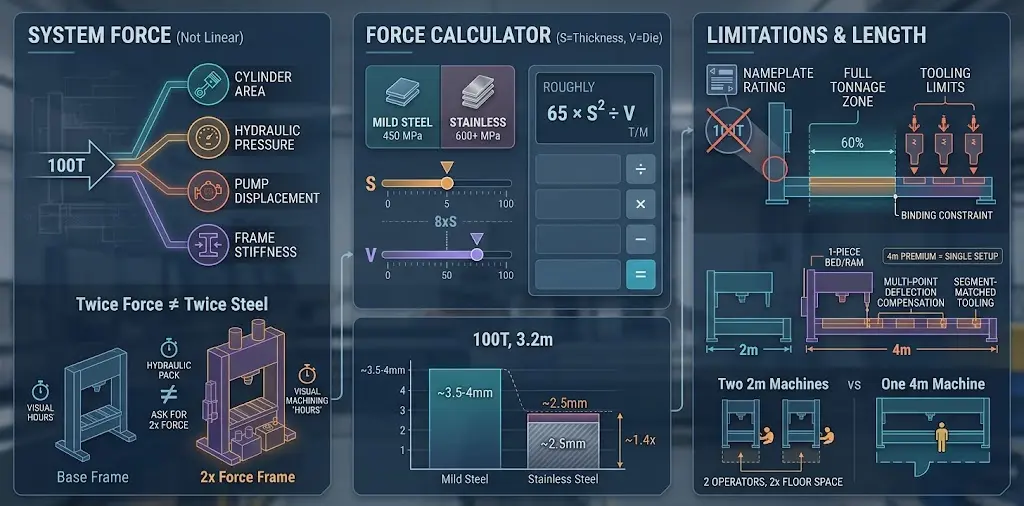
Tonnage is not bought linearly. Force comes from a system — cylinder area, hydraulic pressure, pump displacement, valve size, frame stiffness and the tooling that transmits it. Ask for twice the force and you do not get twice the steel: you get a heavier frame in the sections that carry the load, bigger cylinders, a larger hydraulic package, and more machining and handling hours on every one of those parts.
The force itself is easy to check. For 450 MPa mild steel in air bending, required force runs at roughly 65 × S² ÷ V tonnes per metre, with thickness and die opening in millimetres and the V opening at about 8 × S. That is why a 100-tonne machine over 3.2 m lands at around 3.5 to 4 mm of mild steel in most specification tables, and why stainless of the same thickness needs roughly 1.4 times the force. Run your part through the tonnage calculator before you discuss price; a machine bought on nominal tonnage alone is frequently either oversized or quietly incapable.
There is also a limit inside every rating that the nameplate does not show: full tonnage cannot be concentrated on a short window between the uprights. The common working rule is that full force should not be applied over less than roughly 60% of the distance between uprights, and the tooling carries its own load limit per metre, which is usually the binding constraint on short, heavy work.

Length is worse than linear. A 4 m machine does not cost twice a 2 m machine, and the reason is not marketing. Bed and ram are single pieces of steel that must be machined straight over their whole length, stress-relieved, transported and lifted as one unit. Deflection compensation has to work across the full span, which on long machines means several independently adjustable points rather than one. Tooling has to be supplied in longer, straighter, segment-matched lengths. Two 2 m machines are also not a substitute: they need two operators and twice the floor space, which the arithmetic usually hides.
What the 4 m premium actually buys is a single-setup capability — one part, one handling, one operator, angle consistency end to end. If your work is long panels, that is a production capability rather than capacity, and on that work it is worth more than the same money spent on tonnage.
What is welded in, and what a purchase order can still change
The rule that follows: length, throat depth, opening height and tonnage are decided by steel and cannot be revisited; control, crowning, clamping, tooling and guarding are decided by a purchase order and can. Never compress a dimension you will need for ten years in order to add an option you can add next year.
What the Price Does Not Cover
A quotation is bounded by its terms, and buyers routinely compare numbers with different boundaries.
Validity is arithmetic, not pressure selling. A press brake is quoted today and built later, out of steel bought later. In an interview published in Modern Metals in September 2026, Marc Lerman, chief commercial officer of the steel processor Steel Warehouse, described a market where a USD 50 to 60 per ton change can happen inside one week, with mill lead times of about eight weeks for hot-rolled and nine for cold-rolled and coated, and spot availability close to nonexistent (Modern Metals, 21 September 2026). Frame steel, tooling steel, the reservoir, the guarding, the container and the currency all have to be committed before the machine ships. So put four things side by side rather than one: price, validity, delivery term in Incoterms 2020 language, and lead time with its starting point — a lead time counted from order confirmation and one from deposit receipt are different promises.
Landed cost is not machine cost. The following sit outside a machine price and you pay for them regardless:
- Freight from the factory to your door, and marine insurance
- Port charges, terminal handling and documentation at both ends
- Customs duty, and any certification or inspection your country requires on import
- Inland transport from the port, plus a low-bed trailer if the machine is long
- Unloading and positioning: a crane or forklift rated for the machine’s weight, often rented by the day
- Foundation work, levelling pads or anchor bolts, and floor preparation
- Electrical supply to the machine, including a transformer if site voltage does not match
- First fill of hydraulic oil, where it is not shipped with the machine
- Commissioning, and the travel and accommodation of the engineer who does it
- Training, including the days your people are not producing
- A first spare-parts order, and the wait before a second one arrives
Two consequences. The comparison flips more often than buyers expect: an ex-works quote plus freight, duty, unloading and commissioning regularly lands above a delivered quote that looked higher on paper. And the only honest comparison is one where every supplier quotes the same delivery term and the same scope of supply, stated explicitly rather than as “delivered”.
Support is a line item even when it is not priced. A press brake is a ten-year asset, and the difference between a supplier who stocks spare parts and consumables for your model and one who orders them per incident is measured in weeks of lost production, not in the purchase price.
What a Low Quote Leaves Out
A low price is a statement about scope, not about the market. Something has been removed, and the useful question is what, and when you will meet it again.
Seen on paper, the same gap usually looks like this:
Neither column is automatically better. For one product, generous tolerances and a maintenance team on site, Supplier A is the correct buy; for a shop running several profiles a week, B pays for itself in setup time. The mistake is taking the savings without knowing which ones you took.
You do not have to accept any of this on a supplier’s word, including ours. Ask for the frame stress-relief procedure as a document, not a sentence. Ask for photographs of the pump, valve and controller nameplates on the machine that will actually ship. Ask for the load rating per metre of the exact tool being supplied. Ask for a customer within driving distance running the same model on similar work, and call them. Ask what happens, in writing, if the machine fails to hold angle during acceptance. A supplier who answers those five in documents is a different proposition from one who answers them in adjectives.
Turning a Price Difference Into Billable Hours
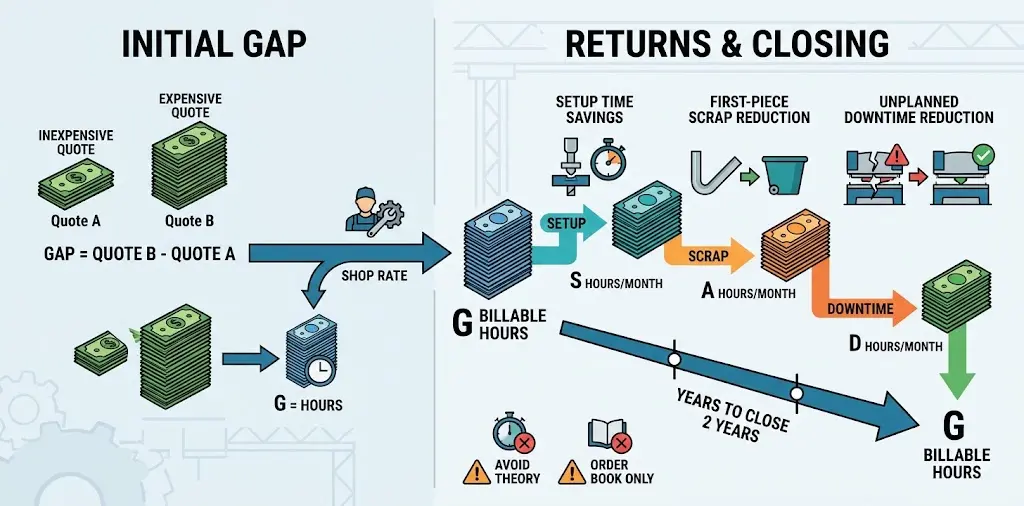
Take the difference between the two quotes and divide it by your shop rate. The answer is no longer money; it is billable hours. That is the real size of the gap, and the only form in which a shop owner can judge it, because hours are what you sell.
Then ask what the more expensive machine returns per month in the same unit. A press brake returns hours in only three places: setup, first-piece scrap, and unplanned downtime. Setup is the largest and the most ignored — changeover and trial bending consume hours that never reach an invoice, and they scale with how many different parts you run per week rather than how many parts you make. First-piece scrap is the second: trial bends that end in the bin carry the material, the cutting and the labor already invested in that blank. Downtime is the third, and it hurts most because it takes the whole cell with it.
A worked shape, with placeholders to replace: suppose the gap is worth 900 billable hours at your rate. A machine that removes five hours of setup a week returns about 260 hours a year, so on setup alone the gap takes three and a half years to close. Add less trial-bend scrap and one avoided breakdown a year, and the same gap may close inside two years. If it does not, the expensive machine is the expensive choice, whatever it does on the demonstration floor.
Two cautions. Do not count theoretical cycle time as a return; count the hours the ram is actually forming parts, because a fast machine that sits idle while someone hunts for a tool has returned nothing. And do not count capacity you have no orders for.
Run this on the two quotes you are holding and the conversation changes. It stops being about which supplier is cheaper and becomes about which machine returns its difference inside your planning horizon.
What Is Worth Paying Extra For, in Order
Pay for what the machine does every day, not for what it does once.
Crowning, if you bend long parts. Deflection is not a defect; it is what happens to any machine under load. Beyond about 2 m with a tight angle, a crowning system is the difference between bending a part and then fixing it.
Backgauge axes, if you run many flanges. The backgauge configuration is where setup time leaks. X alone handles simple flanges; R and Z1/Z2 decide how fast a multi-flange panel is set up, and repeated manual re-setting is the most common hidden cost in high-mix work.
A graphic control and offline programming, if the part mix changes. The CNC control system earns its money in programming and sequence time, and in not needing a veteran at the machine to work out the order of bends. Training belongs to this line: one bending-equipment maker’s product manager notes that customers with no previous experience can run their systems independently after a five-day course, which tells you that training days are a cost to specify rather than a line to leave open (Shop Metalworking Technology, 23 June 2025).
Clamping and tooling storage, if changeovers are frequent. A clamping system and organized tooling storage do not make better parts. They make more parts, because they remove minutes from every changeover, several times a day.
Guarding, always. This is not an option to be traded against price. Decide the arrangement and the standard the machine is built to before you discuss cost, and treat safety arrangements as a specification item with a document behind it.
What is usually not worth the money: tonnage you cannot use, stroke and opening height far beyond your tallest tooling stack, and any feature whose value depends on work you do not have. A machine bought for the exception spends most of its life being the wrong size for the daily job.
How to Request a Quotation You Can Compare
Send one document to three suppliers. It should carry:
- Material — mild steel, stainless, aluminium or other
- Thickness — minimum, typical and maximum
- Longest regular bending length
- Part drawings or CAD files showing the bending profiles
- Production volume — parts per shift, day or month
- Angle and dimensional tolerance
- Preferred drive and control, if already decided
- Backgauge axes, clamping and automation you expect
- Delivery term, in Incoterms 2020 language
- Destination country and site
Ask each supplier to mark every line included, excluded or optional, with prices separate, and to state the validity period. Then request a trial bend on your own part as the acceptance test. Quotes built on the same document are comparable; quotes built on three different sales conversations are not.
Where CAMT's Range Sits
We build these machines, so read this as a map rather than a recommendation.
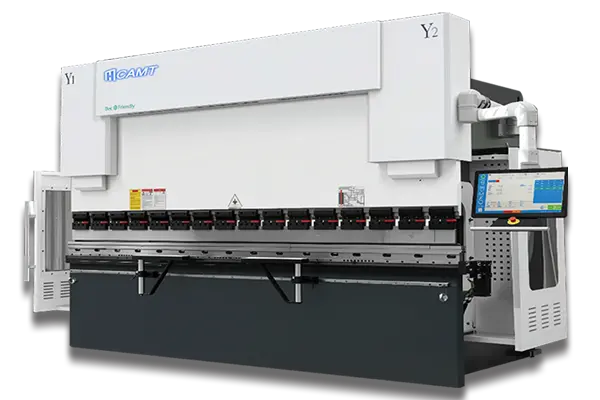
Our range separates along the lines the cost blocks do. The Economical series uses mechanical torsion-bar synchronization with an NC control in a 2 to 3-axis configuration — the band where structure and power dominate the price and the control package is deliberately kept simple. The Smart series moves to synchronized 3 to 4-axis control. The Genius series adds 4 to 6 axes with motorized backgauge positioning and multi-point crowning, which is where the control block starts to carry real weight in the invoice. Above that sit the Apex hybrid 6 to 8-axis, the EPB servo-electric, tandem and heavy-duty configurations, each of which changes the power and drive block as much as the control block. Tonnage and dimension tables are on the press brake overview, and the tooling interface question is covered in the press brake tooling guide.
How we quote, so you can compare us against anyone else: we price against your part list, not against a model number. The quote comes back with the axis configuration, the controller model and its axis letters, the tooling scope, the guarding arrangement, the delivery term and the validity period stated separately, and acceptance is a trial bend on your part measured along the full length. If a supplier will not price against your parts, the number they give you is not about your work. Send the list through the contact page and ask for those headings back in writing.
This is one screen of a longer buying process. The press brake buying guide runs from part mix and tonnage through to the purchase order.
Frequently Asked Questions