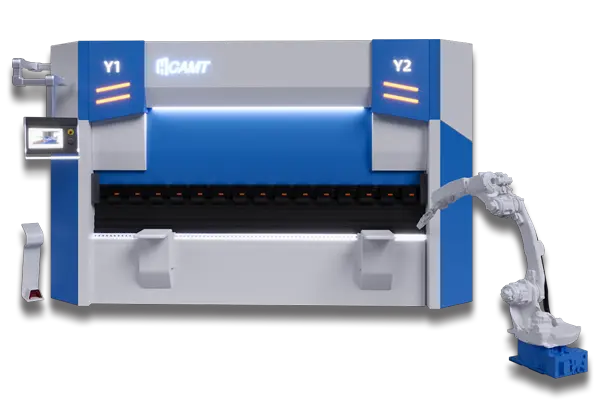
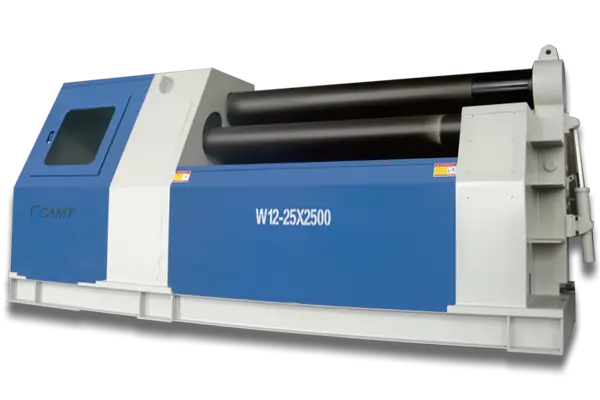
Choosing between an NC press brake, a CNC press brake, and a torsion-bar press brake can significantly affect your sheet metal fabrication costs, bending accuracy, and long-term production efficiency.
At first glance, these machines may look similar. They all use a ram, punch, die, hydraulic system, and backgauge to form sheet metal. However, their synchronization mechanisms, control capabilities, positioning accuracy, and operating flexibility can be quite different.
For a workshop producing simple brackets and standard bends, an NC torsion-bar press brake may provide all the performance it needs. But if your production involves frequent job changes, complex profiles, multiple bending steps, or tighter dimensional tolerances, investing in an electro-hydraulic CNC press brake may deliver better long-term value.
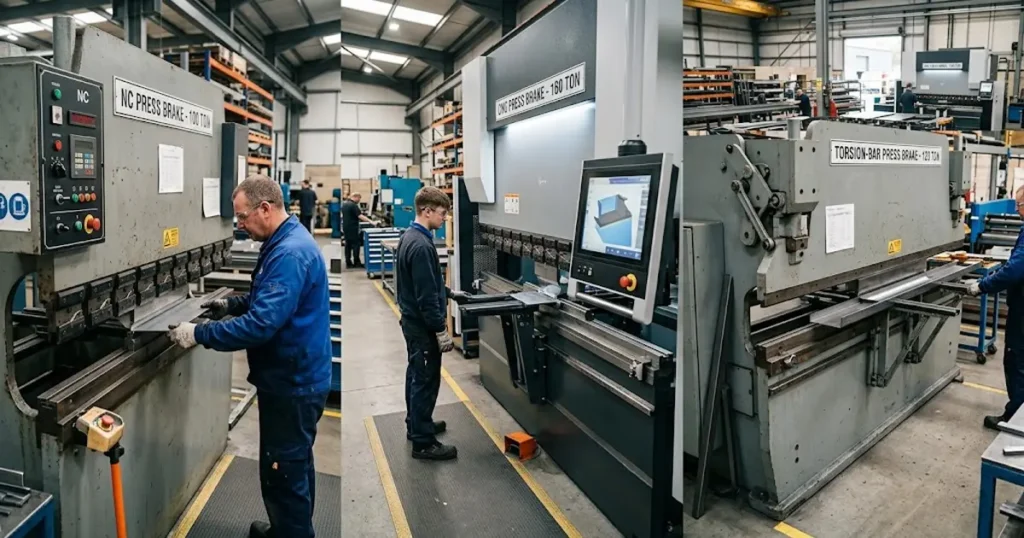
1. What NC, CNC, and Torsion-Bar Mean in a Press Brake
A press brake has two separate jobs: push the tool into the sheet to a precise depth, and keep both ends of the ram doing the same thing at the same moment. The control solves the first. The synchronization architecture solves the second.
NC means the control executes stored numeric instructions. CNC means a computer supervises multiple axes, calculates sequences, simulates the part and stores libraries. A torsion bar is not a control at all — it is a steel shaft across the machine with a lever arm at each end tied to the ram. No sensor, no program, no opinion. It simply resists any difference between the two sides.
| Term | What it specifies | What it decides on the floor | What it does not tell you |
|---|---|---|---|
| NC | Control level: numeric positioning of a limited axis set | Job entry, programs stored, whether angle is converted to depth | How the ram is kept parallel |
| CNC | Control level: multi-axis supervision, graphics, libraries, simulation | Setup time on a new part; who works out the sequence | Whether the frame is synchronized |
| Torsion bar | Mechanical synchronization: both ends of the ram tied by a shaft | Behaviour under eccentric load; what a lengthwise angle split means | What the control can do; backgauge axis count |
Because the two dimensions are independent, four configurations are sold. Only two are common, which is exactly why a label is not enough:
| Torsion-bar synchronization | Electro-hydraulic Y1/Y2 synchronization | |
|---|---|---|
| Basic numeric (NC) control | The conventional NC press brake: lowest cost per tonne, mechanical parallelism, angle closed by the operator. This is our Economical 2–3 axis machine | Rare but real: closed-loop frame driven by a basic numeric control — load-independent level without the programming features |
| Advanced (CNC) control | Exists, and is often sold as a "CNC press brake". A graphic control on a torsion-bar frame buys programming speed, not load-independent parallelism | The standard electro-hydraulic CNC press brake: Y1/Y2 closed loop, multi-axis backgauge, graphics, libraries |
2. How a Torsion-Bar Press Brake Synchronizes the Ram
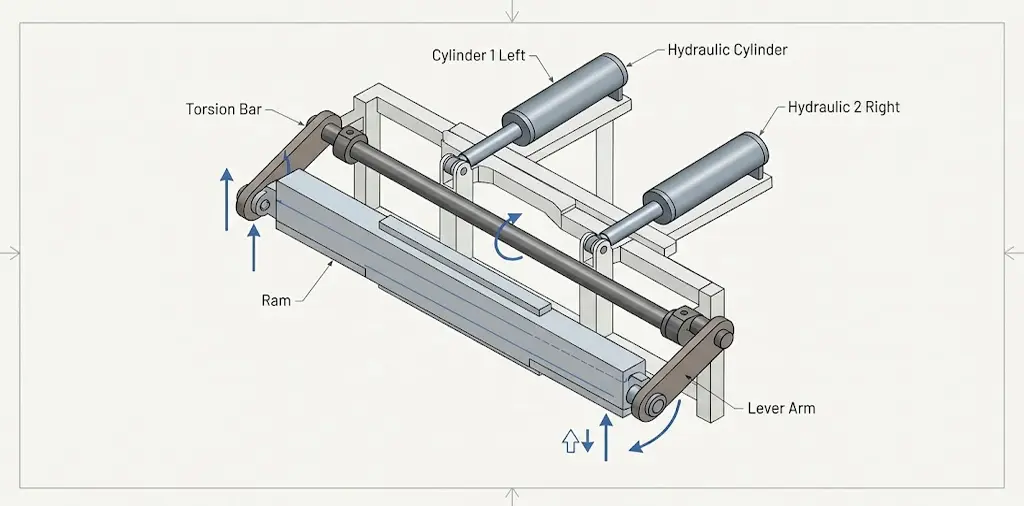
Two hydraulic cylinders lift the ram. The torsion bar runs across the machine, with a lever arm at each end connected to the ram. If one cylinder travels faster than the other, the lever arms try to rotate the bar in opposite directions, the bar twists, and torsional stiffness pushes back. The correction is elastic and immediate, because it is a property of the steel, not a decision by a controller.
Sheet Metal Industries describes the two architectures in these terms: on a torsion-bar machine “the descent of the two cylinders was synchronized by a system of levers connected to a torsion bar,” while on a synchronized machine “the two cylinders are independent and moved by the action of dedicated valves.”
Where a torsion-bar machine performs well
- It holds level without power, calibration or tuning. A bar set correctly at installation keeps the ends together for years — no scale to clean, no loop to re-tune.
- It is cheap to own. No second feedback channel, no second proportional valve set, no servo loop to keep in adjustment.
- It is stiff enough for centred work. Load a part across the middle of the bed at moderate tonnage and the ends stay together, and the angle repeats.
What a torsion bar cannot do
This is the part left out of most comparisons, and it matters more than the label on the control.
It resists a difference. It cannot correct an absolute error. The bar keeps the two ends level relative to each other. It has no idea whether that common level is correct. If the lever arms, the ram or the frame settle out of level — after installation, a collision, or years of one-sided work — the ram runs beautifully parallel and permanently tilted. Every part comes out with one end at a different angle, and the bar faithfully preserves that error stroke after stroke. The fix is re-levelling, not a new program and not a new control.
It carries eccentric load as torsion. Bend near one end of the bed and one cylinder takes far more force than the other; the bar absorbs the imbalance by twisting. Sustained off-centre work at high tonnage is how bars and lever joints take a permanent set. That is the engineering reason behind the oldest rule in the shop — keep the work centred — and it is a rule about the machine, not the part.
Depth and angle stay open-loop on the material. The control commands a depth; the material decides what angle that depth produces. Springback varies with grade, thickness and grain direction, so the operator closes the loop by trial: bend, measure, adjust. A modern NC control helps by converting an angle into a depth and storing the correction, but the judgement is still a person’s.
None of this makes the architecture bad. It defines where it works: repeat work, centred loads, moderate tonnage, and a shop that would rather maintain less and spend less.
3. How an Electro-Hydraulic CNC Press Brake Controls Y1 and Y2
The synchronized machine removes the shaft and gives each side its own control authority. Each cylinder has its own valve — or, on newer designs, its own drive — and each side reports its position back to the control, which compares the two and trims them continuously. Parallelism stops being a property of a steel shaft and becomes a function of a control loop.
The measurement point explains both the strength and the maintenance burden. Modern Machine Shop, reporting on machine-tool retrofit practice, makes the point about linear scales: rotary encoders on the motor “can lose accuracy” as distances grow, because “ballscrew and thermal expansion issues often come into play,” while a linear scale used as “the measurement component” is more accurate. The logic carries over. A machine that infers ram position from what the valve was told will drift with oil temperature; a machine that measures the ram measures the ram.

What the closed loop gives you
- Parallelism under eccentric load. Within rated capacity the control corrects the difference the load creates instead of storing it in a shaft.
- Level as a setting, not a wrench job. Trim applied from the control, per side, stored with the program.
- A path to automatic correction. A closed-loop Y axis is the hardware prerequisite for angle-measurement feedback, offline programming and automation that expects the machine to hold a tolerance on its own.
What it costs you
Two feedback channels to keep clean, proportional valves to keep responsive, a loop that has to be tuned. It also adds a failure mode the bar does not have — a sync error, where the sides stop agreeing — covered in Y1/Y2 synchronization errors. For a 3–4 axis machine built this way, see the Smart series.
The same symptom, two different causes
The fastest practical test. The operator’s complaint is identical; the hardware behind it is not.
| What you see | On a torsion-bar machine | On a synchronized machine |
|---|---|---|
| One end bends at a different angle, consistently, part after part | Ram out of level, or the bar has taken a set. Re-level; check the bar after off-centre work | The two sides disagree: feedback, valve response or tuning |
| Angle varies along the length, both ends match | Bed and ram deflection — crowning, on either architecture | Same: crowning, not synchronization |
| Angle drifts through the shift as the machine warms | Depth holding, oil temperature, or the operator compensating by hand | Depth loop or thermal behaviour of the feedback |
The first row is worth memorising: it is where the two architectures fail in completely different places. Why bend angle varies along the length of the part covers the general symptom.
4. NC vs CNC Control: What Changes on the Shop Floor
A modern NC control is not a dumb terminal. The one on our torsion-bar machines stores 220 programs of 24 steps, converts an angle into a ram depth, positions the backgauge and calculates multi-step sequences. For repeat work with a fixed setup that is all a shop needs, and an operator learns it in an afternoon.
CNC adds capability in four directions, each answering a specific pain:
- More axes. Independent Y1/Y2, plus backgauge R, plus Z1/Z2 lateral positioning. Z axes let the fingers move to the next part size without re-setting stops by hand.
- Graphic programming and simulation. Draw the profile in 2D, let the control derive the sequence, watch it run in 3D before the first stroke. Collisions get caught on screen instead of in the tooling.
- Libraries. The machine knows the die, the radius and the springback behaviour instead of the operator remembering them.
- Interfaces. Angle-correction input, offline programming, and the network hooks automation needs.

The hardware behind those features is not uniform. We fit Delem, Cybelec and ESA controllers, and the range is wide: the Delem DA53T handles four axes with offline programming, the DA69T adds 3D collision detection, the ESA S675W scales to 156 axes for robotic cells. What each model supports is listed on the CNC control system page — a large touchscreen does not by itself mean the controller can do what you are assuming.
The honest summary: the CNC premium does not buy “better bends” in the abstract. It buys setup time and sequence handling. Andrew Vicente, a bending product specialist at AMADA Canada, put the order plainly in an interview with Shop Metalworking Technology: “The biggest one, right off the bat, is tooling changeovers.” He described the pattern that makes it bite — “job shops might run five parts of one job, two of another, eight of another” — and the older-machine version: “On older machines, operators often have to figure out bend sequences manually at the machine.”
If that is your production pattern, the control is where your money should go. If it is not, it is where you will overpay.
5. Where Bending Accuracy Really Comes From
Buyers attribute part quality to the control class, because that is the line on the quotation they can read. Six things decide it, and the control touches one of them directly.
| What decides the result | What it looks like when wrong | What actually fixes it | Architecture-dependent? |
|---|---|---|---|
| Ram level, left against right | One end off angle, consistently | Re-levelling; on a synchronized machine, loop diagnosis | Yes — bar vs closed loop |
| Bed and ram deflection | Angle varies along the length, ends match | Crowning system — manual, motorized or multi-point | No — an option on either |
| Depth holding | Angle drifts through the shift or after a program change | Control quality, valve response, thermal behaviour | Partly |
| Backgauge repeatability | Flange dimensions vary part to part | Backgauge configuration and axis count | No |
| Tooling condition and clamping | Die marks, inconsistent radius, creeping tools | Tooling grade and a proper clamping system | No |
| Material consistency | Batch-to-batch drift nobody can explain | Incoming inspection, single-source coils, trial bends | No |
Two rows get misdiagnosed most often. A CNC machine with no crowning and worn tooling still bends a canoe; a torsion-bar machine with motorized crowning and good tooling can hold lengthwise consistency on long parts that people assume requires closed loop. Crowning and the control are separate purchases, and crowning is the cheaper. Note also that ram positioning accuracy and finished-part angle accuracy are different numbers — material, springback, tooling and deflection sit between them.
6. How to Read a Press Brake Quotation
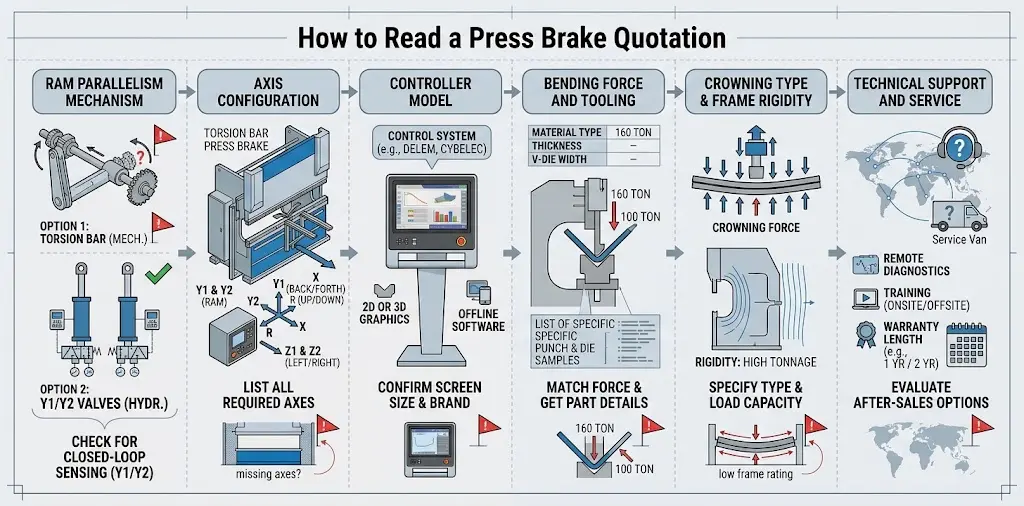
1. What holds the ram parallel? Either “torsion bar” or “Y1/Y2 closed loop, proportional valve, position feedback per side”. If the answer is “synchronized” with no feedback device named, ask again.
2. How many axes, and which ones? Written as Y1/Y2 + X + R + Z1/Z2. “4-axis” can mean Y1, Y2, X, R — or something else on another supplier’s sheet. Get the letters. X covers straight flanges; R and Z change how fast a multi-flange panel gets set up.
3. Which control, by model? Two machines from the same factory can be quoted with a basic numeric control or a graphic one, and the difference in daily usability is larger than the price gap. Confirm the axis count the controller supports, plus libraries, sequence calculation, crowning control, offline software and automation interfaces.
4. Bending force, working length and tooling. Size for your heaviest realistic job — material, tensile strength, thickness, bending length, die opening, tooling geometry — and confirm the force sits inside the permitted working range rather than buying on nominal tonnage. Then check tooling standard, maximum tooling load and clamping method.
5. Crowning type and frame rigidity. Manual, motorized or multi-point mechanical; whether it is standard or optional; how it is adjusted; what test verifies angle consistency across the working length. Then look at frame construction and worktable rigidity.
6. Support behind the machine. Commissioning, operator training, programming assistance, remote troubleshooting, spare parts. A press brake is a ten-year asset, and we provide technical support and maintenance and upgrades for exactly this reason.
Red flags: “CNC” with no axis list and no controller model. “Synchronized” with no feedback device. Crowning listed as an option on a machine sold for long parts. A seller describing the machine by its control while you are trying to compare its frame.
7. Which Press Brake Configuration Fits Your Production
Ignore the label and describe your work instead. The table maps six common patterns to what actually limits them. Only two rows hinge on the synchronization architecture; everything else in the table is an option you buy separately, whichever frame you choose.
| Your production pattern | What limits you | What to specify |
|---|---|---|
| One product family, high volume, centred parts, 2 m and under | Repeatability and low upkeep | Torsion bar, NC control, motorized crowning |
| High mix, frequent changeovers, batches under a few hundred | Setup time and sequencing | Synchronized 3–4 axis, graphic control |
| Small flanges, boxes, many backgauge positions per part | Backgauge re-setting | Synchronized 4–6 axis, motorized Z1/Z2 |
| Long parts, 3–6 m, thin gauge, angle critical end to end | Bed deflection as much as parallelism | Synchronized, multi-point crowning |
| Heavy plate, short flanges, off-centre work | Tonnage, frame stiffness, tooling load | Size tonnage first, then the control |
| Ten-year horizon with automation plans | Whether it can be integrated later | Closed-loop Y1/Y2 and an angle-correction interface from day one |
Where parts are long or plates heavy, size with the tonnage calculator before discussing the control, and look at the heavy-duty range above roughly 400 tonnes. Where the work is high-mix with short flanges, the 4–6 axis Genius with motorized Z1/Z2 is the configuration that fits.
One rule covers all of them: buy the machine that covers roughly 80% of your jobs well, not the one that covers 100% of them expensively. A machine that handles the occasional 6 m job badly and the daily 1.5 m job perfectly earns more than one specified around the exception.
Two costly mistakes
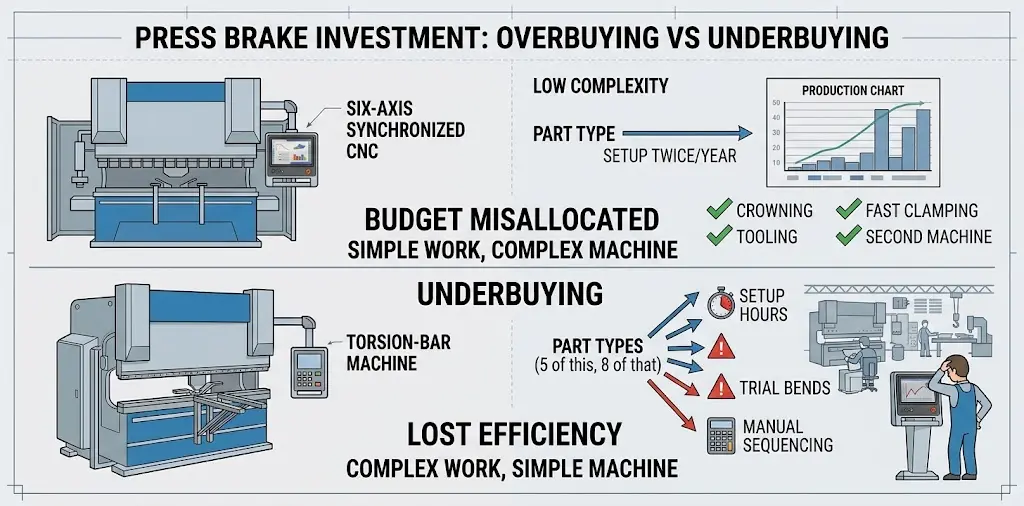
Overbuying is a six-axis synchronized machine in a shop that runs one product and changes setup twice a year. The machine is not wrong; the money is in the wrong place. The same budget spent on crowning, tooling, a clamping system that cuts changeover, or a second smaller machine usually returns more.
Underbuying is a torsion-bar machine in a shop that runs five of this and eight of that. The loss does not appear as bad parts. It appears as setup hours and trial bends, with the operator working sequences out at the machine instead of running it.
The asymmetry decides which mistake is recoverable. A control can be replaced or upgraded, and there is a retrofit path for exactly that. A torsion bar cannot be turned into a synchronized frame by fitting electronics, because the difference is the cylinders, the valves, the feedback and the frame they sit in. Buy the architecture you will need in five years; buy the control you need this year. Drive type is a separate question again — servo-electric, hydraulic and hybrid machines have different force paths and cost structures, set out in servo-electric vs hydraulic vs hybrid press brakes — and belongs before the axis count.
8. Why Buy a Press Brake From CAMT
We build all of the configurations above, which removes the usual incentive to steer every buyer toward the most expensive machine. The recommendation starts with your parts, not our stock.
- Economical 2–3 axis torsion-bar machines — standard bending, cost-conscious production, low maintenance. This is what we quote when your work is one family of parts repeated for years, and we will say plainly that a CNC is not worth the difference.
- Smart 3–4 axis synchronized machines — mixed batches, frequent changeovers, a graphic control that shortens setup.
- Genius 4–6 axis CNC machines — small flanges, boxes, panels, sequence-heavy work.
- Heavy-duty and tandem configurations — thick plate, high tonnage, extra-long workpieces.
Options include Delem, Cybelec and ESA controls, multi-axis backgauges, crowning systems, and tooling and clamping solutions. The full range is on the press brake page.
Three things are worth doing before you commit:
- Send the drawing of your worst part, not your typical one. The worst part sets the axis count and the tonnage; the typical part sets the price you would like to pay.
- Ask what the machine does when the load is off-centre. The answer separates the architectures faster than any spec table.
- Ask what can be upgraded later. If the answer covers the control but not the frame, you have found the decision that has to be right the first time.
We can quote both architectures against the same drawing, with the axis list and crowning type written out line by line, so you compare two real configurations rather than two labels. Send our application team a drawing and an annual quantity, and the reply will be a configuration, not a brochure.
Final Thoughts
NC, CNC and torsion-bar press brakes serve different production patterns, and the right choice depends on matching machine capability to your workload. An NC torsion-bar machine is the economical answer for standard bending; an electro-hydraulic CNC earns its price where changeovers are frequent, sequences complex and positioning has to repeat.
Keep the terminology straight and the decision gets simpler: NC and CNC describe the control, a torsion bar describes the mechanical synchronization. Verify both on the quotation, then run a representative bending test on your own material and compare total cost of ownership, not purchase price.
Choosing between an NC torsion-bar and a CNC press brake? Send CAMT your drawings, material specifications and bending requirements, and we will propose a configuration for your production rather than the most expensive machine in the range.
This is one screen of a longer buying process. The press brake buying guide runs from part mix and tonnage through to the purchase order.