When a workpiece is too long for your existing press brake, buying a bigger machine looks like the obvious fix. But an extremely long press brake brings higher transport costs, harder installation, and heavier demands on floor space — and for many shops it sits underused.
A tandem press brake takes another approach: two machines operating together as one synchronized bending system. This guide explains how tandem configurations work, the four situations that justify one, the engineering to verify before ordering, and how to judge a tandem against a single long-bed machine.
1. What Is a Tandem Press Brake?
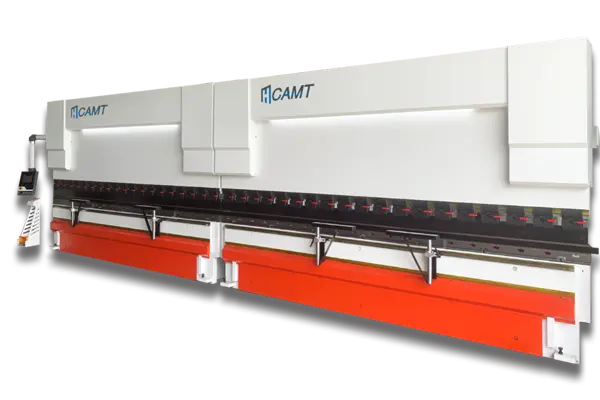
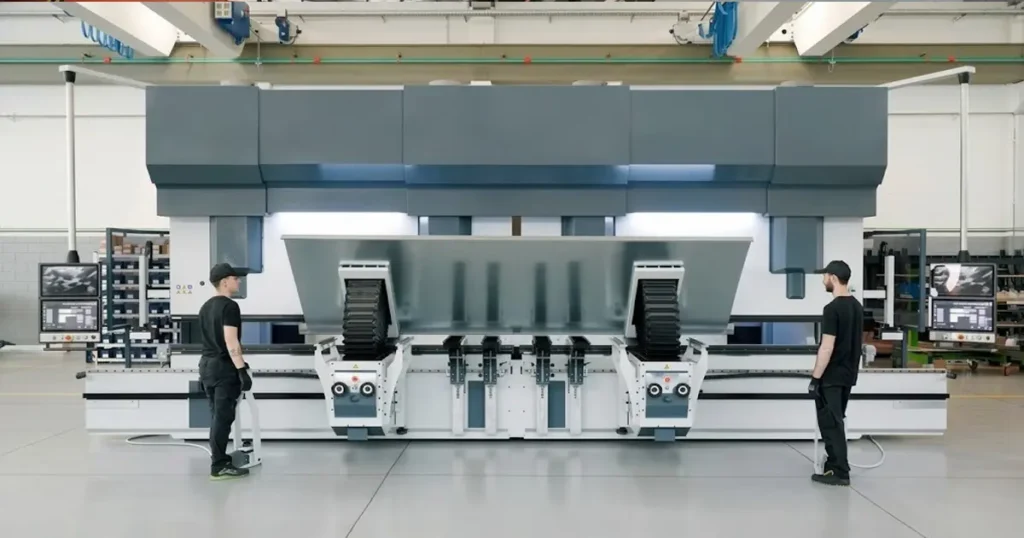
A tandem press brake connects two machines so they can bend as one extended system. Instead of one exceptionally long frame, two coordinated machines form a continuous bending zone, increasing total available length and, depending on the design, combined force.
The core components:
- Two matched machines with compatible capacities and tooling heights
- Synchronized CNC control coordinating both machines as one system
- Position feedback — linear scales or magnetic systems on each ram
- Hydraulic synchronization — proportional or servo valves regulating both rams
- Tooling and workpiece support rated for the full working length
Everything depends on synchronization. If one ram moves differently from the other, the load becomes uneven — inconsistent angles, distortion, or mechanical stress follow. A properly engineered tandem coordinates mechanical alignment, ram positioning, force distribution, and workpiece handling, not just two rams going up and down.
Tandem mode vs. independent mode
| Operating mode | How it works | Typical application |
|---|---|---|
| Tandem | Both machines bend together as one extended brake | Extra-long panels, structural sections, large profiles |
| Independent | Each machine runs separately | Two shorter jobs or different orders |
Dual-mode capability is one of the biggest advantages of tandem equipment — but it should not be assumed for every system. Confirm the control architecture, safety circuits, and operating restrictions with the manufacturer before purchasing. CAMT’s tandem press brake is engineered for both synchronized and independent operation as standard working modes.
2. When Do You Actually Need a Tandem Press Brake?
Workpiece length alone should not drive the purchase. Production frequency, material thickness, part geometry, and factory layout all matter. Four situations justify serious consideration.
2.1 Your Workpieces Exceed a Practical Single Bed
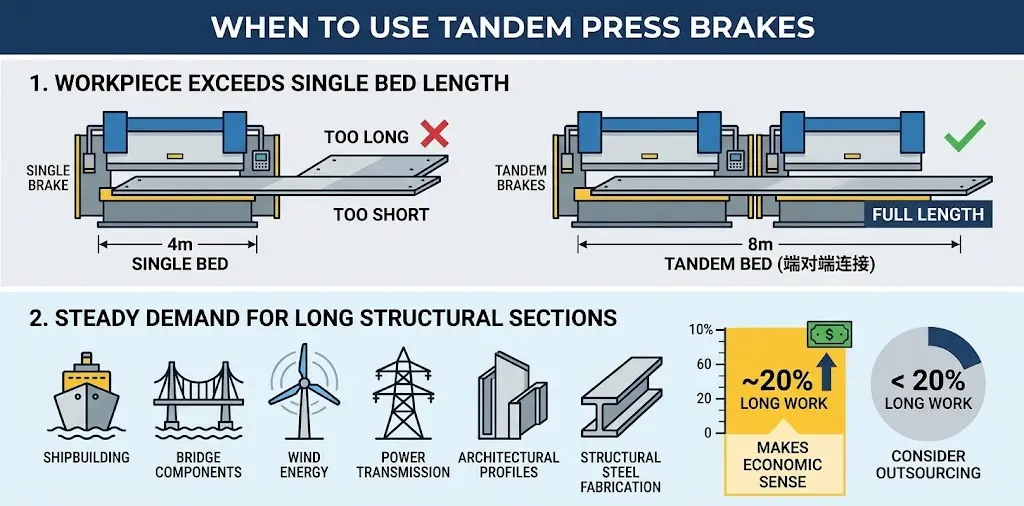
Suppose you regularly produce 8,000 mm panels but your press brake bends 4,000 mm. The workarounds — splitting parts and welding them, outsourcing, repositioning, or rejecting orders — add cost, hurt dimensional consistency, and slow delivery.
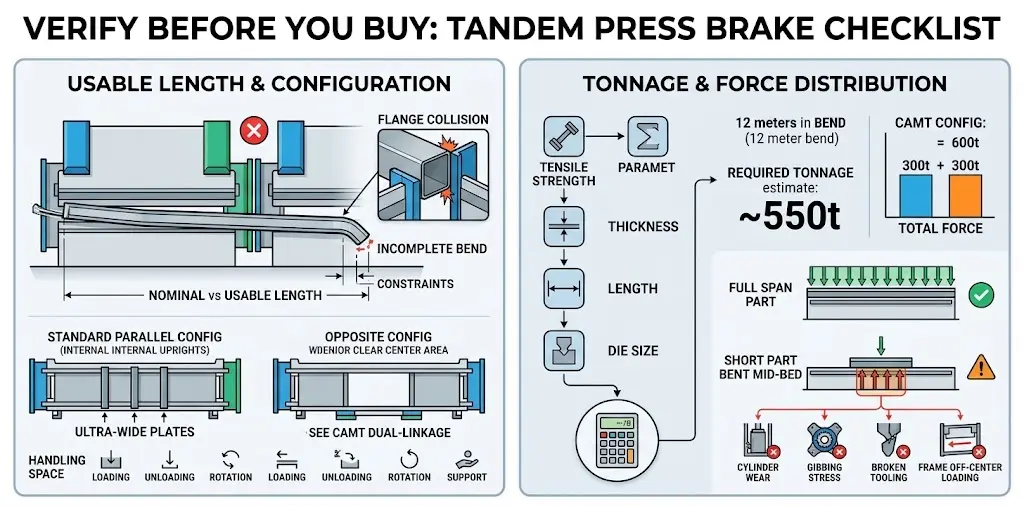
Two 4,000 mm machines in tandem provide roughly 8,000 mm of combined nominal length. The actual usable length depends on the machine layout, side-frame positions, and tooling configuration, so confirm it from the manufacturer’s drawings rather than the brochure.
Do not size a tandem on overall length alone: flange dimensions, bend sequence, throat depth, daylight, stroke, and handling space all decide whether a part can actually be formed.
2.2 Long Structural Work Is a Steady Share of Your Orders
Certain industries live beyond the reach of conventional beds: shipbuilding panels, bridge and infrastructure sections, wind-energy and power-transmission components, long architectural profiles, structural steel fabrication.
The working threshold that comes up in conversation with tandem builders is simple: when long-part bending represents about 20% of a shop’s bending activity, a tandem starts to make economic sense. Below that, one long job a quarter rarely pays for two machines — outsourcing wins.
Bringing long work in-house has a quality payoff too: forming heavy sections in one or two pieces instead of three or four produces a stronger final part than multisection weldments — fewer welds, less straightening, better fit-up. And if your business is growing into larger orders, a tandem lets you accept work you currently turn away.
2.3 You Need Capacity Without One Giant Machine
A very long, high-tonnage single brake is expensive to transport, install, and maintain. Two standard machines ship separately, often avoid special foundations, and fit buildings where an oversized frame will not — crane height alone disqualifies many single long-bed installations.
But do not assume tandem is always cheaper. Two machines also mean two sets of hydraulics, electrics, and maintenance. Compare complete, application-specific quotations covering purchase price, synchronization equipment, transport, installation, foundation and floor-loading, electrical and hydraulic infrastructure, tooling, and long-term operating costs.

2.4 You Want Utilization, Not Just Length
With a properly configured tandem, both machines handle the 8-meter panels together and run separately on 3-meter work — so you are not dedicating a giant machine to every order. One unit can keep producing while the other is down for maintenance.
The caveat is scheduling: if long components occupy both machines all day, independent capacity exists only on paper. Match the configuration to your actual order mix.
3. Tandem vs. Single Long-Bed Press Brake
| Factor | Tandem | Single long bed |
|---|---|---|
| Structure | Two synchronized machines | One extended machine |
| Bending length | Combined length of both | Fixed length of one |
| Angle consistency over full length | Very good with proven sync and commissioning | Best — continuous bed and crowning |
| Flexibility when long work is absent | High — splits into two brakes | None |
| Redundancy | Built in | None |
| Transport and installation | Two manageable units | Oversized load, may need special foundation |
| Maintenance | Two systems | One system |
| Best suited to | Long parts plus mixed production | Frequent long-part production as the core business |
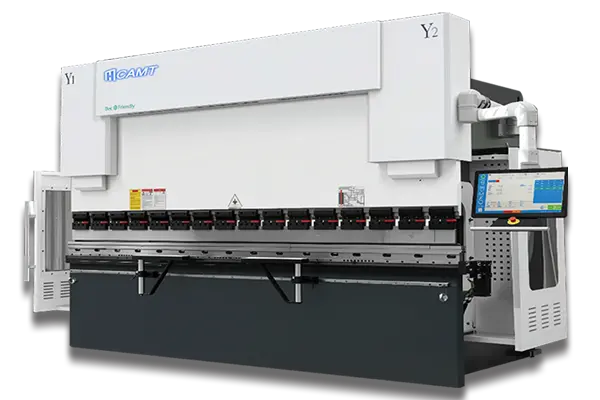
There is no universal winner. If precision across extreme lengths is your core product and long work never stops, a purpose-built long bed with continuous crowning holds angle better. If your mix is roughly 20% long work and 80% everyday bending, the tandem usually wins on utilization. And if your real constraint is tonnage on parts well under 8 meters, a heavy-duty single machine is the honest answer. The full CAMT press brake range covers all three routes, and the complete buyer’s guide walks through the selection logic in depth.
4. What to Verify Before You Buy
A system with sufficient total length can still be wrong for your parts. Six factors decide most tandem projects.
4.1 Usable Length and Configuration
Nominal combined length is not usable working length. Confirm the distance and alignment between working areas, the clearance for large flanges, and whether the full bending sequence completes without repositioning. Leave room for loading, unloading, rotating, and supporting the part.
Width matters too. In a standard end-to-end arrangement, each frame’s upright sits inside the combined bending window — deep flanges and box sections can hit them even when length fits. For genuinely wide plates, some systems bend in an opposite (face-to-face) arrangement: CAMT’s dual-linkage platform is available in both parallel and opposite configurations, extending the option to ultra-wide workpieces no single bed could grip.
4.2 Tonnage and Force Distribution
Calculate the required force from your actual material and die selection. For air bending, a common estimate is:
F ≈ 1.33 × Rm × L × t² / V
where F is force in kN, Rm tensile strength in N/mm², L bend length in mm, t thickness in mm, and V the die opening in mm. (Sources differ between 1.33 and 1.42 for the leading coefficient; treat the result as an estimate and verify against tooling data — or run your own parts through the tonnage formula and calculator.)
Worked example: a 12-meter bend in 6 mm mild steel (Rm ≈ 450 MPa) with a 48 mm V-die:
F ≈ 1.33 × 450 × 36 × 12,000 / 48 ≈ 5,390 kN ≈ 550 metric tons
Two 300-ton, 6-meter machines deliver 600 tons across the full 12 meters — a workable CAMT configuration for exactly this part.
Now the rule most buyers get wrong: full, combined tonnage applies only to parts that span the full length of both machines. A short part bent mid-bed receives single-machine force, not combined force. Applying full combined tonnage to short bends accelerates wear on cylinders, gibbing, and seals; exceeding the per-meter load limit of the tooling can crack punches and dies outright; off-center loading stresses the frame asymmetrically. If an operation would be abusive on a single machine, it will be abusive on a tandem too.
4.3 Synchronization and the Seam
This is where tandem purchases succeed or disappoint, and where marketing goes quiet. A tandem has no continuous bed and no continuous crowning: each frame deflects under load on its own, and each crowning system compensates its own half. As one tandem builder’s engineer described it, you are syncing four cylinders instead of two, getting both rams to act as one unit while the control calculates crowning for two beds carrying one part.
Even small position differences between rams produce different angles at opposite ends, angular variation along the part, twist, or extra stress on the structure. What a serious system should specify:
- CNC coordination across both machines with real-time Y1/Y2 feedback
- Closed-loop electro-hydraulic control with fast valve response
- Verified synchronization accuracy — CAMT publishes ≤ ±0.02 mm/m on 1-micron magnetic scales
- Multi-point crowning coordinated across both beds
- Documented mechanical alignment and commissioning procedures
- Safety monitoring across the entire working area
Ask every supplier how the seam is commissioned: what tolerance is verified at handover and which points along the bend are measured. A reputable builder has an answer ready; hesitation is information. Plan on programming in halves — create the program for one machine and one half of the part, verify it, then mirror it to the other frame.

4.4 Crowning and Deflection Compensation
As bend length increases, the ram and table flex under load, and without compensation the center of a long bend forms at a different angle from the ends — which is why quality-focused shops check angles at multiple points along the bend line. On a tandem, the seam is one more point where two compensation systems must hand off cleanly. Crowning does not replace synchronization; both must work together. Evaluate the crowning type, whether compensation is coordinated across both machines, and how the builder verifies angle consistency over the full length. More detail in CAMT’s crowning system guide.
4.5 Tooling, Backgauge, and Workpiece Support
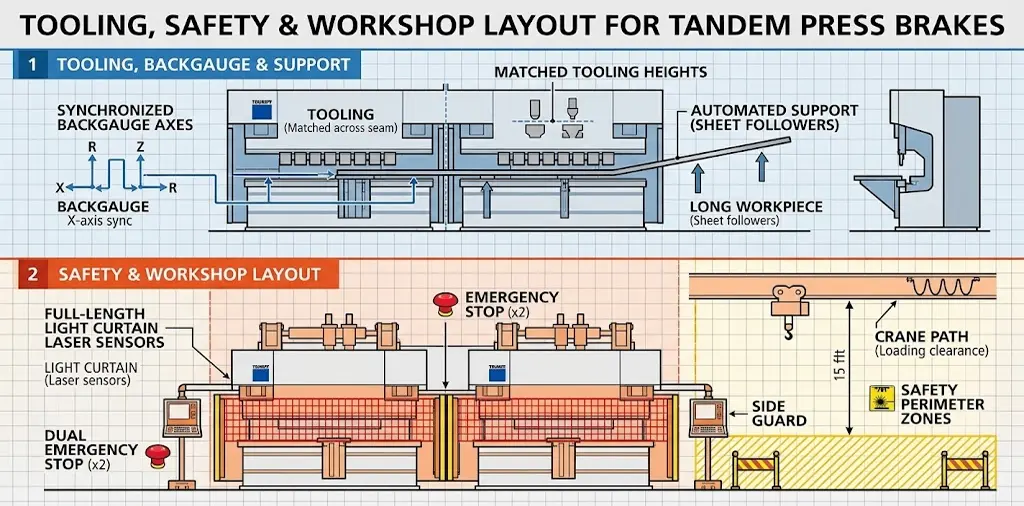
Tooling must create a consistent working surface across the combined length: matched tool heights and clamping, aligned segmentation at the joint, and load ratings checked per bend, not averaged. Review the standards in the press brake tooling guide before finalizing a configuration.
Long, heavy sheets also need positioning and support: backgauge axes sized for the part, front supports, and sheet followers that track the plate through the stroke. On a tandem the support system must bridge two frames — CAMT’s bending follower supports keep the seam section from sagging between hits and cut manual handling.
4.6 Safety and Workshop Layout
A tandem creates a much longer working zone than a standard brake, and a safety design that works for one machine cannot simply be duplicated across two. Cover light curtains and laser protection over the full length, emergency-stop accessibility at both machines, side and rear guarding, operator access between sections, crane routes, and floor loading. Machine-specific standards such as EN ISO 6909:2026 and ANSI B11.3 define the requirements for press brake safeguarding; CAMT’s safety arrangements are configured per machine layout and operating mode.
5. What Does a Tandem Press Brake Cost?
There is no fixed price: bending length, total tonnage, control and feedback complexity, hydraulic components, crowning, backgauge axes, tooling, safety equipment, and installation all move the number.
Compare quotations on total investment, not machine price:
Total Investment = Machine cost + Transport + Installation + Tooling + Training + Initial setup
Then estimate the return honestly. If you currently outsource long-part bending, the annual benefit is:
Annual Net Benefit = Outsourcing costs avoided + Additional production profit − Additional operating costs Payback period = Initial investment ÷ Annual net benefit
A tandem justified by utilization pays for itself; a tandem bought “for capacity that might come” usually does not.
6. What to Ask Before Ordering
You are buying an integrated system, not two machines. Ask:
| Question | Why it matters |
|---|---|
| Maximum usable bending length? | Confirms the machine handles your real parts |
| How is synchronization achieved, and to what accuracy? | Evaluates control and feedback engineering |
| Can both machines run independently? | Establishes dual-mode capacity |
| How is crowning coordinated across both beds? | Angle consistency over the full length |
| How is the seam commissioned and verified at handover? | The make-or-break engineering question |
| What tooling and support systems are included? | Avoids unexpected add-on costs |
| Who handles installation, alignment, and training? | Clarifies responsibility |
| What after-sales support and spare parts are available? | Minimizes downtime |
Before requesting a quotation, prepare: maximum workpiece length and width; material grades and thickness range; required angles and flange dimensions; expected production volume; whether independent operation is required; preferred CNC control; and workshop dimensions, power, and installation conditions. A manufacturer who receives this can propose the right configuration instead of the biggest machine.
7. Why CAMT for a Tandem Project?
CAMT builds tandem bending as a dual-linkage platform designed for ultra-long and ultra-wide work. Published specifications:
| Parameter | Published specification |
|---|---|
| Total bending length | 8,000–16,000 mm |
| Total bending force | 400–1,200 tons (2 × 200T to 2 × 600T) |
| Single machine length options | 4,000 / 5,000 / 6,000 / 8,000 mm |
| Throat depth | 400–600 mm |
| Stroke | 200–320 mm |
| Synchronization accuracy | ≤ ±0.02 mm/m |
| Operating modes | Independent and synchronized |
Actual specifications depend on the selected configuration and are confirmed in the final technical proposal.
The engineering package behind those numbers: closed-loop electro-hydraulic servo control with Bosch Rexroth hydraulic components, CNC-coordinated Y1/Y2 movement, GIVI magnetic position feedback at 1-micron resolution, mechanical multi-point crowning, and CNC backgauge configurations — controlled from a large-format touchscreen or a DELEM-class CNC.
A tandem project does not end at delivery. CAMT covers installation and commissioning, CNC configuration, operator training, troubleshooting, spare parts, remote support, and maintenance and upgrades — see CAMT’s technical support and after-sales services.
Have long workpieces in your pipeline? Send CAMT your part drawings, material specifications, thickness range, and production volumes, and the engineering team will evaluate the right tandem configuration against your actual application — contact us to start.
8. Frequently Asked Questions
What is the main purpose of a tandem press brake?
To bend long or oversized components that exceed the practical working length of a single machine. Two synchronized machines form one extended bending area, and most systems can also run independently for shorter work.
Does a tandem press brake double the bending force?
Only for parts that span the full length of both machines. Each frame delivers its own rated force over its own bed, so a short part bent mid-length receives single-machine force. Applying combined tonnage to short parts accelerates wear and can crash tooling — check short heavy bends against the tooling’s per-meter rating.
Can the two machines work independently?
Yes, on most modern systems. The control decouples the frames and each machine runs its own programs — which is precisely the economic case for tandem. Confirm how switching between modes works and that the safety circuits are verified in both modes.
Will the bend angle be consistent across the seam?
It can be, if the system is properly engineered and commissioned. Synchronization accuracy, crowning coordination, and mechanical alignment across the joint all matter. Ask for the verified seam tolerance at handover and inspect bends at multiple points along the full bend line — including the seam — during acceptance.
Is a tandem cheaper than one long-bed machine?
Often on installation, sometimes on purchase: two standard units transport and rig more easily, frequently avoid special foundations, and fit lower buildings. Against that, you maintain two machines, and a purpose-built long bed holds angle better over extreme lengths. Run total project cost for both routes before deciding.
Are tandem press brakes suitable for thin sheet?
Yes, provided the machines, tooling, and control suit the material range. The considerations that matter — synchronization, crowning, support — apply at any thickness; thin, long panels are actually among the most deflection-sensitive parts a tandem forms.
How do I know whether I need one?
Start with your longest workpiece, maximum thickness, required force, and how often such orders arrive. If regular orders exceed a single machine’s practical capacity and outsourcing is costing you money, a tandem deserves consideration. If most work is standard length, a conventional CNC press brake usually delivers better value.
Conclusion
A tandem press brake is not a bigger bending machine — it is an integrated system for overcoming single-machine length limits while keeping two production stations on your floor. The investment makes sense when the configuration matches your real orders: verify usable length, force distribution, synchronization and seam commissioning, crowning, tooling, and installation before signing. The best tandem is not the one with the greatest capacity; it is the one that consistently produces your parts at a reasonable total cost of ownership.