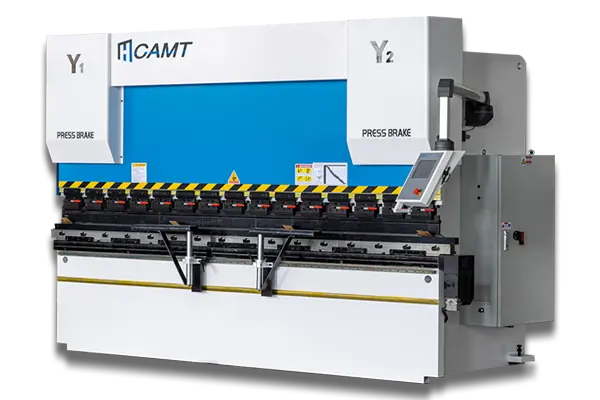
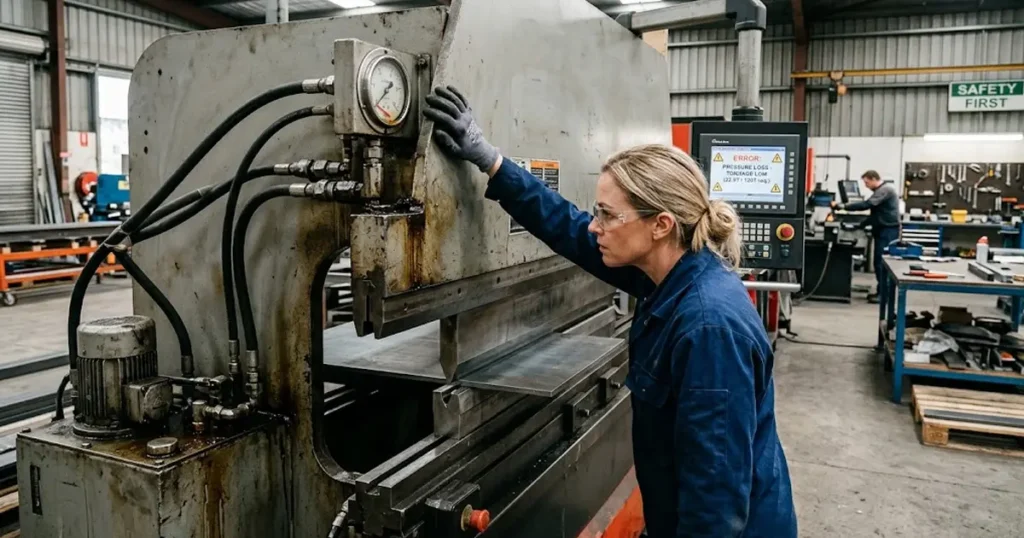
A press brake that suddenly loses hydraulic pressure or bending force can produce incorrect bend angles, struggle with previously manageable material thicknesses, or stop midway through a forming cycle. The problem may come from a worn hydraulic pump, leaking cylinder seals, a malfunctioning pressure relief valve, contaminated oil, or incorrect machine settings. Before replacing expensive components, you need to determine whether the machine is failing to generate pressure, losing pressure inside the hydraulic circuit, or simply being asked to deliver more tonnage than the job requires.
1. What Does It Mean When a Press Brake Loses Pressure or Tonnage?
Hydraulic press brakes build force by pushing oil under pressure into one or more cylinders tied to the ram. If the circuit cannot generate or hold that pressure, the machine struggles to bend. But the four phrases operators use to describe the failure are not the same problem, and each one leads somewhere different.
| What is reported | What it describes | Where to look first |
|---|---|---|
| Pressure loss | The circuit cannot build or hold its rated pressure | Pump, relief valve, suction side |
| Tonnage loss | The ram cannot deliver the force the job needs, even at normal pressure | Bending load, die opening, cylinder balance |
| Pressure fluctuation | Pressure hunts up and down through the cycle | Air in the oil, suction restriction, valve response |
| Holding failure | Pressure is reached, then decays during the stroke or dwell | Internal leakage downstream of the gauge |
The timing of the failure carries most of the diagnostic value. Pressure that never arrives is a generation problem. Pressure that arrives and then leaves is a leakage or a control problem. Pressure that is present but produces a shallow bend is usually an application problem.
How Hydraulic Pressure Becomes Bending Force
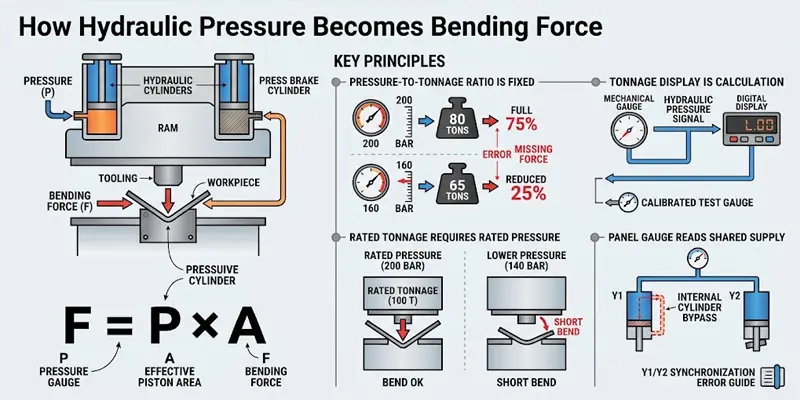
The relationship is F = P × A: force equals pressure multiplied by the effective piston area it pushes on. In workshop units, force in kN equals pressure in MPa multiplied by area in mm², divided by 1,000.
Take an illustrative machine with two cylinders of 200 cm² effective area each, rated at 200 bar. At 200 bar each cylinder produces about 400 kN, so the pair makes roughly 80 t. At 160 bar the same machine makes roughly 65 t. Nothing has failed. The pressure simply is not there.
Three consequences follow, and they matter more than any component list.
The pressure-to-tonnage ratio is fixed. Full rated pressure gives full rated tonnage; 80% of rated pressure gives 80% of rated tonnage. A gauge sitting at three-quarters of its rated value means a quarter of the force is missing, and no parameter change will invent it.
The tonnage display is not an independent witness. On most controls, the tonnage figure on screen is calculated from the same pressure signal the gauge uses. When both numbers fall together you have one measurement, not two. Only a calibrated gauge on a test port tells you whether the transducer or the hydraulics is misleading you.
Rated tonnage exists only at rated pressure. A 100 t machine makes 100 t at its specified pressure and working length. Ask it for 100 t at 70% of rated pressure and it will sit on the relief valve, producing a bend that is short by exactly the amount you would expect.
One more detail catches experienced fitters. On a two-cylinder machine the panel gauge reads the shared supply, not the force under each end of the ram. A cylinder bypassing internally can leave the gauge looking almost normal while the ram runs out of level. That is a synchronization symptom more than a pressure symptom, and the Y1/Y2 synchronization error guide is the place to start before touching the pump.
2. Common Symptoms and What They Point To
Match what you actually see against the table below before opening a panel.
| What you see | Where the fault most likely sits | First thing to check |
|---|---|---|
| Gauge never rises, or rises to a small fraction of rated | Supply side: pump not building, suction starved, relief stuck open | Oil level, pump rotation after electrical work, suction strainer |
| Gauge reaches rated at deadhead, collapses when the punch touches material | Relief valve lifting early, or leakage downstream of the gauge | Clean and inspect the relief valve; feel the block for heat after a short hold |
| Gauge holds a plausible value, ram stalls mid-stroke, bend is short | Demand exceeds capacity: die, material, length or forming method | Run the tonnage check in section 4 before anything else |
| Ram stalls on previously manageable thickness | Insufficient pressure, or a genuine increase in bending load | Compare the job with machine capacity, then check pressure under load |
| Gauge acceptable, one end of the ram weak, angles differ side to side | Cylinder imbalance or seal bypass on one side | Compare commanded and actual Y1/Y2 position under load |
| Pressure builds and then drops away | Internal leakage, relief bypass, cylinder seal failure | Take the hold reading in section 6 |
| Gauge fine, machine will not reach programmed tonnage, no hydraulic symptom | Control side: force limit in the program, transducer calibration, restored parameters | Compare panel pressure against a calibrated gauge |
| Works cold, weakens after one to three hours | Oil viscosity and internal leakage at operating temperature | Oil temperature, grade and condition |
| Pump whining, oil foaming, ram jerky | Air entering the suction line, low level, clogged strainer | Suction fittings, filter, foam in the reservoir |
| Pressure sags on fast approach, recovers at slow speed | Suction starvation, or a filter near its limit | Filter and suction circuit |
3. Why Is My Press Brake Losing Hydraulic Pressure or Tonnage?
Seven components account for most genuine hydraulic pressure loss. They are listed from the supply side outward, which is also the order a technician would test them.
3.1 Worn or Failing Hydraulic Pump
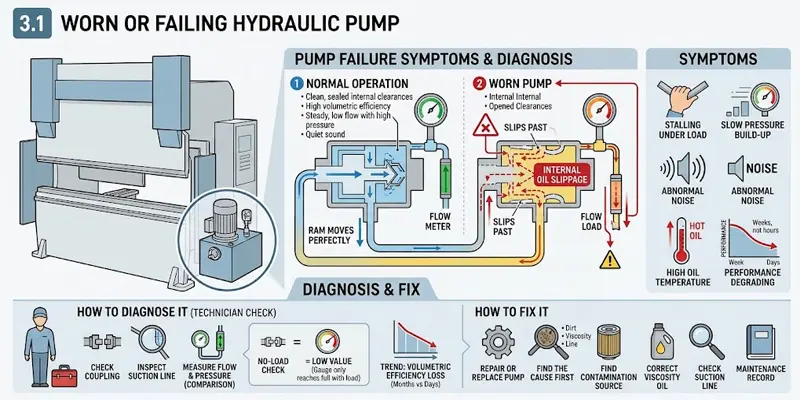
The pump supplies the flow that lets the cylinders build pressure. As it wears, internal clearances open up and more oil slips past instead of reaching the work. The ram may still cycle and the machine may still bend thin material, but output falls away exactly when pressure and flow are both demanded.
Typical symptoms: normal movement without a workpiece, stalling under load; pressure building more slowly than it used to; abnormal pump noise; oil temperature climbing through the shift; performance degrading over weeks rather than hours.
How to diagnose it: check the drive coupling and motor operation. Inspect the suction line and inlet strainer for restriction. Listen for noise or vibration that was not there before. Then have a technician measure flow and pressure under specified conditions and compare the result with the pump manufacturer’s data.
A pump that reaches pressure at no load can still fail to hold flow under working conditions, so a no-load gauge check proves very little. Time how long the machine takes to reach full deadhead pressure from a cold start, and compare it with the same figure last quarter. A pump losing volumetric efficiency shows that trend months before anyone files a complaint.
How to fix it: repair or replace the pump to its manufacturer’s specification, and find the cause of the wear first. Contaminated oil, wrong viscosity and a restricted suction line destroy replacement pumps on the same schedule as the original.
3.2 Pressure Relief Valve Set Too Low or Stuck Open
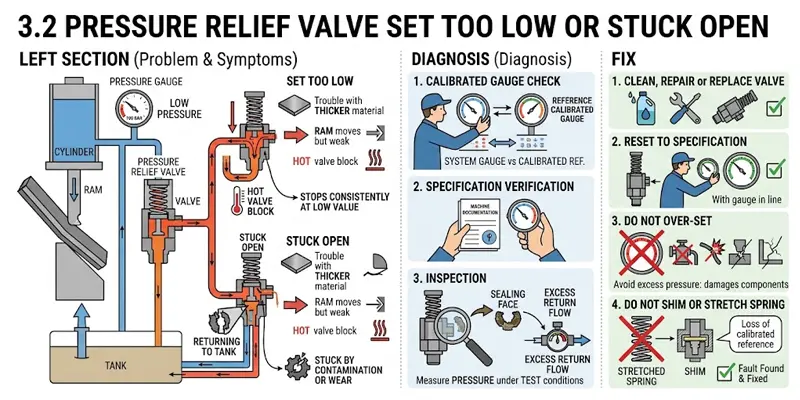
The relief valve limits system pressure by returning oil to the tank once the set point is reached. If it is misadjusted, contaminated, worn, or unable to seat, it opens before the machine reaches bending pressure and the oil takes the short path home.
Typical symptoms: pressure stopping consistently at the same low value; the ram moving but never producing full force; trouble with thicker material; the valve block running hot because oil is continuously bypassing.
How to diagnose it: verify the gauge against a calibrated reference, confirm the specified setting from the machine documentation, then inspect the valve for contamination, sticking and damaged sealing faces. Measure pressure under the manufacturer’s test conditions and check whether excess oil is returning through the relief path.
How to fix it: clean, repair or replace the valve, then reset it to specification with a gauge in line. Do not raise the setting to compensate for weak bending. Excess pressure damages pumps, cylinders, hoses and tooling, and it hides the fault instead of finding it. Do not shim or stretch the spring either, because that removes the only calibrated reference the circuit has.
3.3 Internal Leakage in Hydraulic Cylinder Seals
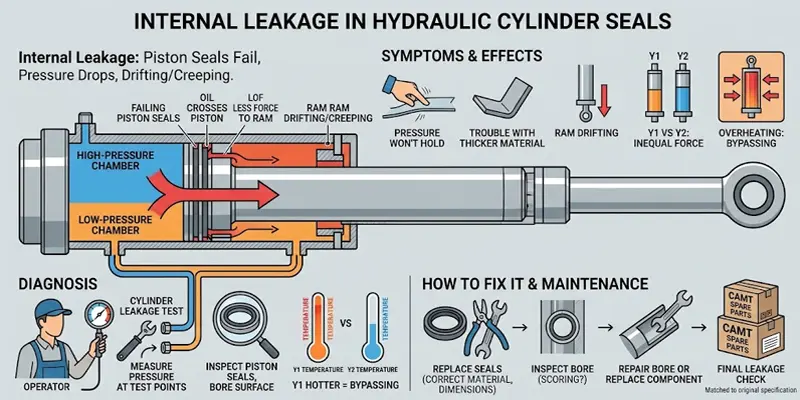
Inside each cylinder, piston seals separate the high-pressure chamber from the low-pressure one. When they harden, score or fail, oil crosses the piston instead of pushing it. The pressure difference across the piston falls and the cylinder delivers less force. Unlike an external leak, nothing appears on the floor.
Typical symptoms: pressure that will not hold during a bend; the ram drifting or creeping; performance degrading as oil temperature rises; one cylinder behaving differently from the other; the ram unable to hold position under load.
How to diagnose it: compare pressure at the appropriate test points and run the cylinder leakage test specified by the machine builder. Inspect piston seals, rod seal and wiper, bore surface and internal bypass, and compare Y1 against Y2. If one cylinder runs noticeably hotter than its neighbour, it is bypassing and doing less work than the other.
How to fix it: replace the seals with the correct material and dimensions. If the bore or piston is scored, machining or component replacement comes first, because new seals in a damaged bore fail within weeks. CAMT supplies hydraulic spare parts and consumables matched to the original machine specification.
3.4 Low Oil Level or Air Entering the System
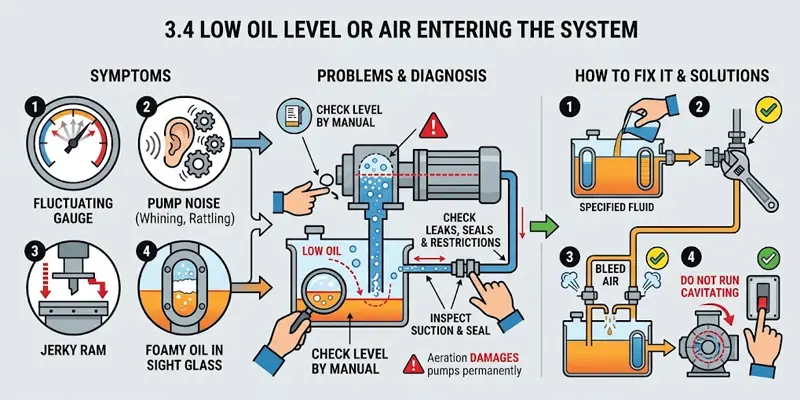
A starved pump cannot build pressure, and aerated oil cannot transmit force consistently because gas compresses while oil does not. Both conditions feel like a weak machine, and both are cheap to check.
Typical symptoms: fluctuating gauge readings; whining or rattling pump noise; jerky ram movement; foamy oil in the sight glass; inconsistent bend results.
How to diagnose it: check the reservoir level by the procedure in the manual, then inspect suction connections, suction hoses and seals, return-line arrangement, oil appearance and any restriction in the suction circuit. A low level is usually evidence of an external leak or a filling error rather than a reason to top up and carry on.
How to fix it: restore the level with the specified fluid, repair the air-entry point and follow the prescribed bleeding procedure. Do not keep running a cavitating pump. Aeration damages pumps quickly and the damage is permanent.
3.5 Contaminated or Incorrect Hydraulic Oil
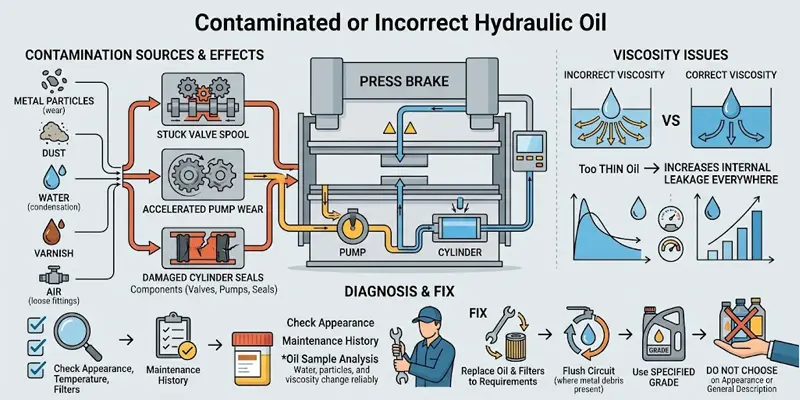
Oil transmits pressure, lubricates moving parts, carries heat away and keeps valve spools free. When it degrades, all four jobs get worse at once.
Metal particles from wear, dust, water from condensation, varnish from degraded oil and air from loose fittings each cause their own damage. Contamination sticks valve spools, accelerates pump wear and damages cylinder seals. Viscosity matters just as much: oil that is too thin for the operating temperature increases internal leakage everywhere in the circuit.
How to diagnose it: check oil appearance, operating temperature, filter condition and maintenance history. On a machine with recurring hydraulic faults, oil sample analysis identifies water, particle count and viscosity change far more reliably than appearance does.
How to fix it: replace oil and filters to the maintenance requirements, flush the circuit where wear has introduced metal debris, and use the specified grade. Do not choose a fluid on appearance or on a general viscosity description.
3.6 Malfunctioning Proportional or Directional Control Valves
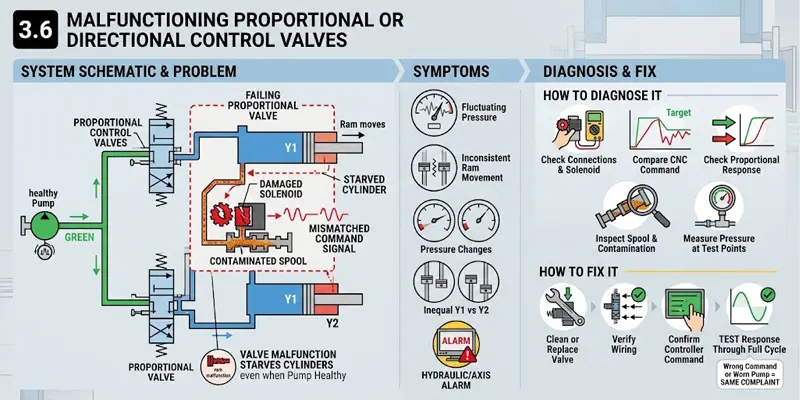
Modern CNC press brakes regulate flow, pressure and ram position with proportional and directional valves. A contaminated spool, a failed solenoid, or a valve that cannot follow its command signal will starve the cylinders even when the pump is healthy.
Typical symptoms: pressure fluctuating during the working stroke; inconsistent ram movement; pressure changing between identical cycles; one side behaving differently; hydraulic or axis alarms on the control.
How to diagnose it: check electrical connections and solenoid condition, read the CNC pressure command against the diagnostic signal, watch proportional valve response, inspect spool movement and contamination, and confirm pressure at the appropriate test points.
How to fix it: clean or replace the defective valve, verify the wiring, and confirm the controller is issuing the correct command. Then test pressure response through a full cycle before releasing the machine to production.
The lesson is worth stating plainly: not every pressure problem on a CNC press brake is a pump problem. A wrong command and a worn pump produce the same complaint.
3.7 External Hydraulic Leaks
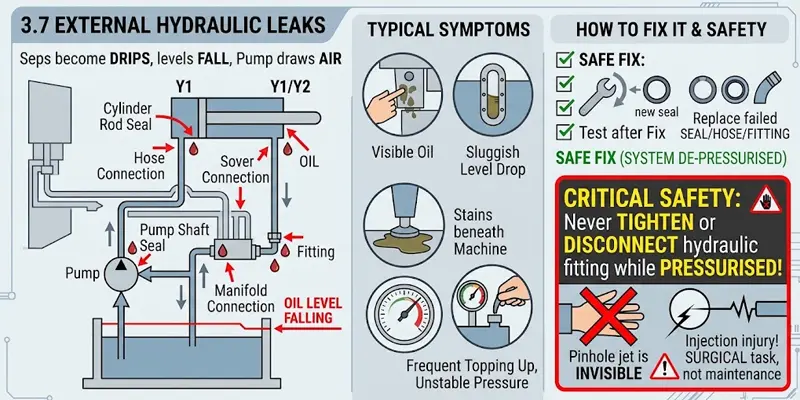
External leaks are the easiest to find and the easiest to ignore. A seep at a fitting becomes a drip, the reservoir level falls, and eventually the pump draws air.
Look at hose connections, pipe fittings, cylinder rod seals, manifold connections, pump shaft seals and tubing joints.
Typical symptoms: visible oil, a slowly falling reservoir level, stains beneath the machine, unstable pressure, frequent topping up.
How to fix it: replace the failed seal, hose or fitting. Never tighten or disconnect a hydraulic fitting while the system is pressurised. A pinhole jet at working pressure is invisible and will inject oil through skin, which is a surgical injury rather than a maintenance task.
4. Check the Job Before You Blame the Hydraulics
Forming tonnage is a calculation, not a symptom. It depends on five inputs: material thickness, bend length, die opening, tensile strength and forming method.
Steve Benson’s shop-floor version of the calculation, published in The Fabricator, is the one most North American operators use:
Tonnage per foot = (575 × Mt² / V) × (UTS / 60,000)
Mt is thickness in inches, V is die opening in inches, UTS is tensile strength in psi. Multiply the result by the bend length in feet. His worked example of half-inch mild steel at 58,000 psi over a 4 in. die returns 34.74 tons per foot, so six feet of that bend needs 208 tons. On a 200-ton machine the ram stalls, the gauge pins at the relief setting, and the failure looks exactly like a hydraulic fault. Shorten the same job to four feet and it needs 139 tons, which that machine makes without strain.
Three inputs cause most of the surprises, and none of them looks dramatic on a drawing.
Thickness is squared. Double the thickness and the force roughly quadruples. Going from 0.5 to 0.75 in. does not raise difficulty by 50%; it raises it by about 125%. This is the arithmetic behind a machine that bends 3/16 in. sheet all day and then stalls dead on half-inch plate of the same width.
Die opening sits in the denominator. Force is inversely proportional to V, so a narrower die costs force in direct proportion. Moving from an 8× to a 6× opening, a normal move when a drawing calls for a tighter inside radius, raises the force requirement by about a third. A reground die, or a borrowed narrower die because the right one was in another machine, produces a genuine tonnage shortfall on a perfectly healthy hydraulic system.
Tensile strength is the input most often guessed. Stainless at 120,000 psi needs roughly twice the force of mild steel at 60,000 psi in the same geometry; aluminium at 30,000 psi needs about half. If the job was quoted against mild steel and is now running 304, the machine is not weak. The assumption was.
Metric users meet the same calculation as P ≈ k × σb × S² × L / V, with stress in MPa, dimensions in millimetres and k between roughly 1.3 and 1.6 depending on the published source. Run one metre of 3 mm mild steel over a 24 mm die through both conventions and you get about 23 t and about 30 t for the same bend. Neither figure is a certificate. The check exists to catch factor-of-two and factor-of-three errors, which is the error class that generates most tonnage complaints.
Two limits apply to the answer, and they are different limits. One is the machine’s rated tonnage. The other is the absolute load limit of the tooling, meaning how much force that punch and die will take before they deform. Forming tonnage has to sit below both with margin to spare, because tensile strength varies from coil to coil and the calculation is an estimate. The consequences are not theoretical: Benson describes punches bent or destroyed, rams upset by exceeding the centreline load limit, dies cracked, and precision-ground tooling that threw fragments when it let go.
If the check says the job needs 230 t and the machine is rated 200 t, the honest fixes are a wider die opening, splitting the bend into two passes, a different machine, or a conversation with the customer about the radius. A new pump will not add a single ton.
5. How to Diagnose a Press Brake That Cannot Reach Full Tonnage
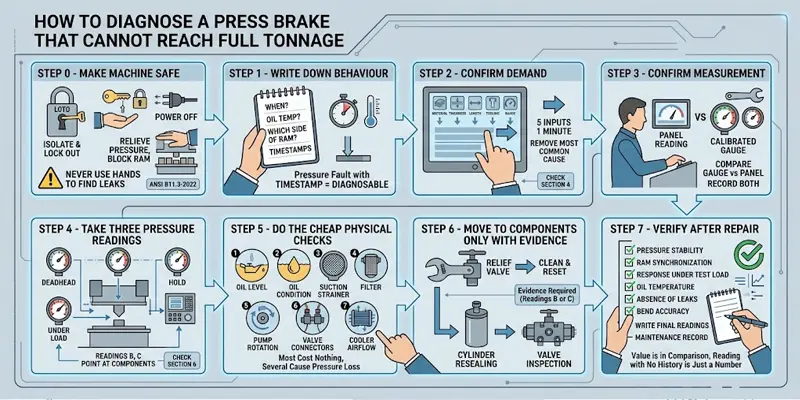
Replacing parts on the strength of a symptom is the most expensive way to work. Follow the sequence.
Step 0 — Make the machine safe. Isolate and lock out every energy source, including power to the pump motor. Relieve stored pressure and block the ram mechanically before reaching into the die space, because a ram that has lost hydraulic pressure can descend under its own weight. Never trace a suspected leak with your hand. In North America, ANSI B11.3-2022 is the machine-specific safety standard for power press brakes, covering point-of-operation safeguarding, control systems and emergency stop, and it is worth knowing what the machine is required to do before disabling any of it to run a test.
Step 1 — Write down the behaviour. When it happens, at what oil temperature, on which job, on which side of the ram. A pressure fault with a timestamp is diagnosable; “it feels weak” is not.
Step 2 — Confirm the demand. Run the check in section 4. Five inputs, one minute, and it removes the most common cause outright.
Step 3 — Confirm the measurement. Compare a calibrated gauge against the panel reading and record both. This step catches a drifting transducer before it costs a pump.
Step 4 — Take three pressure readings. Deadhead, under load, and hold. Section 6 sets out how to take them and what each one isolates.
Step 5 — Do the cheap physical checks. Oil level and condition, suction strainer, filter, pump rotation after any electrical work, valve connectors seated, cooler airflow. Most of these cost nothing, and several of them produce a genuine loss of full pressure.
Step 6 — Move to components only with evidence. Relief valve cleaning and reset first, because it is accessible and frequently the answer. Valve inspection and cylinder resealing after that, and only when readings B or C point at them.
Step 7 — Verify after repair. Do not release the machine on the strength of one successful test cycle. Confirm pressure stability through the working stroke, ram synchronization, response under a controlled test load, oil temperature, absence of external leakage and bend accuracy on a scrap workpiece. Write the final readings into the maintenance record. Their value is in the comparison, and a reading with no history is just a number.
6. The Three-Reading Test: Deadhead, Under Load, Hold
Pressure testing is only useful when each reading answers one question. Take all three at the same oil temperature, with a calibrated gauge on a test port rather than the panel display, and write them down.
| Reading | How to take it | What it isolates |
|---|---|---|
| A — Deadhead | Pump at full flow against a closed circuit, no bending load, ram stationary at top | Pump output and relief setting, with nothing else in the circuit |
| B — Under load | Pressure at the moment the ram reaches full programmed force on a real bend | The whole circuit at working pressure: valve response, leakage, cylinder condition |
| C — Hold | Pressure held at the bottom of the stroke, ram stationary, for 30 to 60 seconds | Internal leakage downstream of the gauge: valve seats, piston seals, holding valves |
Three numbers, taken in that order, divide the circuit into three zones: whether the pump can make pressure at all, whether that pressure survives contact with the workpiece, and whether it stays once flow stops.
| Finding | Most likely cause | Next action |
|---|---|---|
| A low, B low, C holds | Pump not producing rated flow, or relief set below specification | Verify rotation and suction condition, then reset the relief against the data plate |
| A normal, B drops sharply on contact | Relief valve lifting early: contamination on the seat, weak spring, wrong adjustment | Clean, inspect the seat, reset with a gauge in line |
| A and B normal, C decays | Piston seal bypass, or a holding valve not seating | Isolate each cylinder in turn; the one that will not hold is the one to open |
| A, B and C normal, bend still short | Demand side, tooling deflection, or ram and bed condition | Re-run the tonnage check, then inspect tooling wear and ram parallelism |
| Pump noisy, oil foaming, pressure hunting | Air in the suction line, low level, clogged strainer | Stop and fix the suction side before running another shift |
| Pressure falls as oil temperature climbs | Viscosity-driven leakage; grade or condition wrong for the duty | Check grade against measured temperature, then check contamination |
| Panel pressure disagrees with the test gauge | Transducer drift, or a calibration lost after a controller swap | Recalibrate before chasing a hydraulic fault that does not exist |
| Pressure acceptable but one cylinder runs hot | That cylinder is bypassing and doing less work | Treat as a seal problem on that side, not a system pressure problem |
Reading C is the one most shops skip, and it is the one that separates a pump problem from a seal problem. A machine that reaches full pressure and then bleeds it away while standing still has a leak, and because nothing appears on the floor it gets blamed on the pump.
Reading A deserves a habit rather than a single measurement. Record how long the machine takes to reach full deadhead pressure from cold, and compare it with the same figure three months ago. Hydraulic failures are rarely sudden; seal wear, internal pump leakage and valve spool wear all leave a signature in pressure data before they stop production, which is why trends find faults a single test misses.
If pressure is good but the ram will not return, will not hold position or moves in jerks, the fault has left the pressure circuit and moved into the valve and motion circuit. The ram drifting and slow return guide covers that set of symptoms.
7. When It Only Happens With Hot Oil
A machine that is strong at nine and weak by half past eleven is not failing at random. Hot oil is thin oil, and thin oil passes more easily through every clearance in the pump, the valve block and the piston seals. Volumetric efficiency falls as temperature rises, and the pressure available at the ram falls with it.
The two effects then feed each other. A relief valve lifting early turns pump flow into heat instead of force, so the oil gets hotter, more oil bypasses, and the machine gets weaker still. Within two hours everyone is convinced the pump is finished when the real fault is a contaminated relief seat plus oil running hotter than its grade was chosen for.
Answer three questions in this order before condemning a component.
- What is the oil temperature at the moment tonnage falls away, measured rather than estimated?
- Is the grade matched to that temperature, and to the coldest start the machine sees?
- Is the oil still the oil it was, or has it lost its viscosity index, taken on water, or carried enough particle contamination to hold a valve off its seat?
A machine that only loses tonnage when hot is a temperature and oil-condition problem first, and a hydraulic hardware problem second. Pouring in thicker oil to compensate usually moves the failure to the suction side and makes cold starts worse.
8. How to Prevent Pressure Loss, and When to Repair or Replace
Prevention here means record-keeping plus a small number of checks that cost nothing.
Daily, Weekly and Periodic Checks
Daily: oil level, visible leaks at hoses and cylinders, unusual pump noise, smooth ram movement, and any new alarm.
Weekly: hose and connection condition, filter indicators, the oil temperature trend, and any change in bend results for a program that used to run clean.
Periodic: oil and filter replacement at the specified intervals, pump performance and valve response, cylinder seal condition, gauge and transducer accuracy, oil cleanliness, and a review of stored CNC pressure settings.
The maintenance checklist sets out the intervals that keep these readings stable, and CAMT’s maintenance and upgrade service covers scheduled work including fluid analysis and valve response checks for shops that would rather find the trend than the stoppage.
Repair or Replace?
Not every pressure fault needs a hydraulic overhaul. The right decision depends on the component’s condition and on why it failed.
| Component | Repair is reasonable when | Replacement is necessary when |
|---|---|---|
| Hydraulic pump | Wear is limited and specification can be restored | Internal damage is extensive, or output cannot be recovered |
| Relief valve | Contamination or a minor sealing fault can be corrected | Body, spool or spring is damaged |
| Cylinder seals | Leakage is seal-related and bore and rod remain serviceable | Bore or piston is scored or out of tolerance |
| Hoses and fittings | A connection can be remade to an approved procedure | Reinforcement is damaged or the hose has aged |
| Proportional valve | Contamination or a replaceable electrical part causes the fault | Internal damage prevents repeatable operation |
In every row, the question before the question is why the part failed. A pump replaced because of contaminated oil fails again on the same schedule, and a seal replaced in a scored bore lasts weeks.
When ordering, confirm machine model, component specification, pressure rating, connection type and compatibility with the existing circuit. An incorrectly specified pump or seal resolves the symptom and introduces a new fault.
9. If There Is No Hydraulic Oil to Lose
Everything above assumes a hydraulic circuit. A servo-electric press brake has none, so the diagnostic tree changes completely.
On the EPB series full-servo electric press brake, force travels from the servo motor through a reducer and a ball screw to the ram. There is no oil, no relief valve, no reservoir and no pressure gauge in the hydraulic sense. A machine of that design that will not make tonnage is telling you one of five things:
- The job is beyond its rated capacity, which the same tonnage check will reveal.
- The drive is torque-limited or has tripped on overload, which appears as an alarm rather than a pressure drop.
- The ball screw, linear guide or lubrication has degraded, adding friction the drive must overcome.
- A force or position limit is programmed into the job, or the ram is being stopped by slow-speed and mute settings rather than by load.
- A drive or encoder fault is preventing the commanded motion from completing.
Hybrid machines sit between the two designs. They have a hydraulic circuit, but the pump is servo-driven and builds pressure on demand rather than holding it continuously, so a pump that fails to ramp up looks like no pressure at all even though nothing has burst. When a hybrid fault is intermittent, check whether it follows a particular speed or a particular point in the cycle before assuming a hydraulic cause.
None of this makes one design better than the other. Long beds, thick plate and heavy tonnage still point toward hydraulic press brakes; short, thin, high-mix work is where a servo-electric machine earns its place. What matters here is that the diagnosis follows the drive system. Applying a hydraulic checklist to a machine without hydraulic oil wastes the one resource you cannot buy back.
10. When to Stop, Who to Call, and What CAMT Can Do
Some symptoms should end the shift rather than start a repair.
- A visible jet, or a sudden loss of pressure accompanied by a bang.
- The ram creeping downward with anyone working beneath it.
- Oil temperature climbing while pressure falls, which usually means a large internal leak converting flow into heat.
- The relief valve lifting on every stroke at settings that used to hold.
- The same fault returning within days of a repair, which points at a root cause nobody identified.
When you call for help, the quality of what you send decides how fast the machine comes back. Have the serial number, controller model and software version, the exact alarm code, a ten-second video of the ram behaviour, the three pressure readings with the oil temperature at the time, and the oil grade with its hours in service. That package is enough for a remote engineer to read pressure curves and PLC status directly on machines equipped for it, and it often identifies the fault before anyone travels.
CAMT provides several press brake configurations, including synchronous CNC models, multi-axis machines, tandem systems and heavy-duty presses, so a job that sits permanently near the top of one machine’s tonnage range has somewhere to go. CAMT’s press brake technical support works from the same data set described above, covering remote troubleshooting, machine diagnostics and on-site service where it is needed, and the press brake troubleshooting guide covers the faults that look like pressure loss but are not.
If you have no record of when the machine last held full pressure, that is the first thing worth fixing. A laminated card on the panel with the deadhead reading and its date is a better diagnostic instrument than most of the tools in the cabinet.
11. Frequently Asked Questions
Why does my press brake show full pressure but not enough tonnage?
Because pressure and tonnage are the same measurement in different units, full pressure with insufficient force almost always means the job needs more tonnage than the machine can produce at that die opening, material and bend length. Half-inch plate needs roughly four times the force of quarter-inch plate of the same width, so a machine that handles thin sheet comfortably can be genuinely out of its depth. Run the tonnage calculation before ordering parts.
Why does my press brake lose pressure when the hydraulic oil gets hot?
Hot oil is thinner, so it passes more readily through pump clearances, valve spools and piston seals, and the pressure available at the ram falls. A fault that appears after a couple of hours of running is usually viscosity-related internal leakage, made worse if a relief valve is lifting early and heating the oil further. Measure the temperature at the moment the fault appears and check the grade against that number rather than against the climate.
Can I turn up the relief valve to get more tonnage?
No. The relief setting defines the maximum pressure the circuit was designed to contain. Raising it to chase a tonnage shortfall adds load to the pump, the seals and the tooling without addressing why pressure is being lost. If the machine cannot reach rated pressure at its specified setting, oil is bypassing somewhere, and that is the fault to find.
How do I tell whether the pump or the relief valve is at fault?
Take a deadhead reading with no bending load, a reading under load, and a hold reading. If deadhead is low, the pump or the relief setting is the suspect. If deadhead is normal and pressure collapses on contact, the relief valve is lifting early or oil is leaking downstream. If both are normal and pressure bleeds away during the hold, the fault is a piston seal or a holding valve.
Why does my ram drift down when the machine is not bending?
Drift comes from internal leakage across piston seals, or from a directional, check or holding valve that is not seating. Because a drifting ram is a crushing hazard for anyone in the die space, the machine should be inspected before further operation, and the ram blocked mechanically whenever work is done beneath it.
Do servo-electric press brakes lose pressure?
Not in the hydraulic sense, because there is no hydraulic circuit. A servo-electric machine that stops making force is limited by motor torque, drive alarms, ball screw and guide condition, or a programmed force limit, all of which are diagnosed from the control and the mechanical drive rather than from a gauge.