A press brake ram that drifts downward, returns slowly, or moves unevenly is showing a hydraulic, control, or mechanical fault — and the three symptoms rarely share a cause. Drift is a holding problem. Slow return is a flow problem. Jerky movement is a stability problem. Identifying which one you have, and at which point in the cycle it appears, removes most of the machine from suspicion before you open a panel.
Work through these five distinctions first. In most shops the answer is already in the sentence the operator used to describe the problem.
- Sinks while idle, pump stopped → holding path: counterbalance or pilot-operated check valve, or a rod seal leaking to atmosphere. Rarely the piston seal.
- Sinks while the pump runs, no command given → a spool passing pressure to the service ports.
- Returns slowly, smoothly, the same every cycle → flow starvation: filter, suction, pump, return-side relief.
- Judders at the reversal but is smooth elsewhere → air, dry or contaminated gibs, or a valve hesitating at the slow-down point.
- Only one side misbehaves → that cylinder, its valve, or its feedback, not the shared supply.
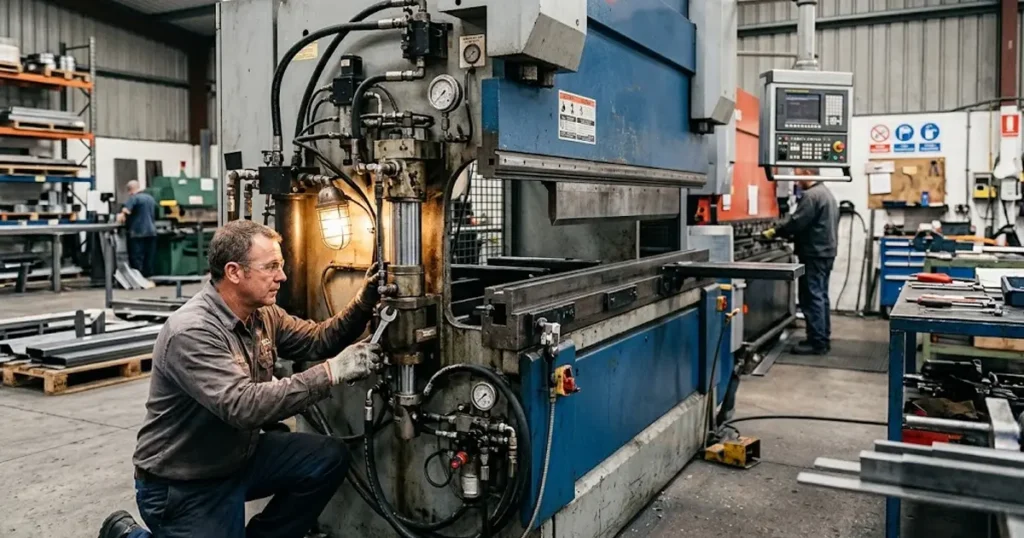
1. Identify the Symptom Before You Touch a Component
Before replacing hydraulic parts or changing CNC parameters, pin down when the ram misbehaves. A symptom that appears in one stage of the cycle and not the others has already excluded most of the circuit.
| What you observe | When it happens | What it implicates | First check |
|---|---|---|---|
| Ram sinks with pump stopped | Idle, minutes to hours | Load-holding valve, rod seal, spool leakage | Cap both cylinder ports with gauges, watch trapped pressure |
| Ram sinks with pump running, no command | Idle, pressurised | Closed-centre spool passing oil; pilot line live when it should not be | Read both port gauges — pressure present means the valve is passing |
| Ram settles after a heavy bend, then holds | Minutes after tonnage | Oil compression relaxing, not a leak | Re-measure after ten minutes; if it stops, it is not a leak |
| Ram has settled overnight after a hot shift | Between shifts | Thermal contraction of the oil | Compare against the position marked at end of shift |
| Ram will not leave bottom dead centre | At reversal | Return command, valve not shifting, return-side relief | Diagnostic screen, manual override, relief setting |
| Slow return, every cycle, same speed | Return, full stroke | Pump flow, suction restriction, filter backpressure | Gauge at pump outlet and at the cylinder port |
| Slow return for the first half hour | Return, cold oil | Viscosity and warm-up | Repeat the test at operating temperature |
| Judder at the reversal | Each cycle at BDC | Air, guide friction, valve deadband | Bleed, then lubricate the gibs, then repeat |
| Judder at the slow-down point | Approach, before contact | Slow-down setting, valve gain, scale noise | Move the slow-down point and see if the judder follows |
| One side leads or lags throughout | All stages | Cylinder or valve imbalance, feedback | Treat as a synchronization fault |
Two observations carry as much weight as the stage. Symmetry: both sides identical means the cause sits upstream — supply, holding valve, oil, command; one side alone means that cylinder, valve or scale. Temperature: a fault that changes between a cold machine and one that has run four hours is viscosity at one end and internal leakage at the other — two different repairs.
2. What Is Actually Holding Your Press Brake Ram
“Press brake” covers machines whose rams are held up by completely different hardware, and a procedure written for one can be useless on another. A full-electric machine has no oil to check at all.
| Architecture | How the ram is held and moved | Failure signature | What not to chase |
|---|---|---|---|
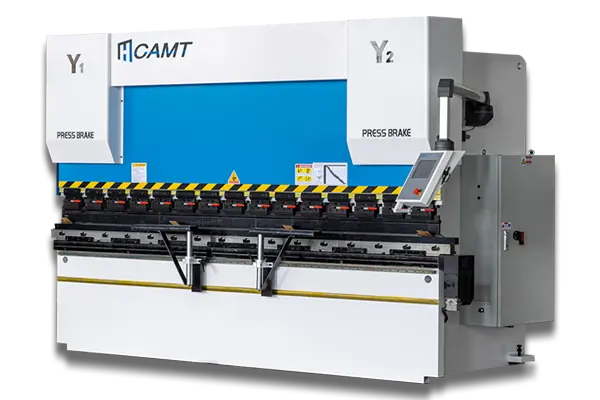
| Torsion bar, mechanically synchronized (Economical series) | Two cylinders from one valve group, linked by a torsion bar; NC positions the pair | Drift affects both sides and traces to the shared valve group; judder can come from torsion bar preload or a dry gib | Per-side servo tuning — there is no independent per-side loop |
| Electro-hydraulic servo, closed loop per side (Smart, Genius, Apex series) | Each cylinder has its own valve and feedback; the control compares both sides continuously | One-side drift points at that cylinder, valve or scale; both-side drift at supply, holding valve or oil | Linkage adjustment — synchronization is electronic |
| Full-electric drive (EPB series) | Servo motor, reducer and ball screw drive the ram; no hydraulic oil | Slow sinking traces to screw and nut wear or lost holding torque; judder to lubrication or drive tuning | Counterbalance valves, aeration, relief settings — none exist on the machine |
The last column is the useful one. On a mechanically synchronized machine, cleaning proportional valves is work on a circuit that may not be the problem. On a full-electric machine, an hour spent checking oil level is an hour lost: the ram is held by a screw thread and motor torque, so creep means wear, lubrication, or a drive that is no longer holding position.
3. Ram Drifting Down at Rest
A stationary ram that loses height is releasing oil from a closed volume — or losing volume for a reason that is not a leak. Four things explain almost every case.
3.1 The valve, not the cylinder
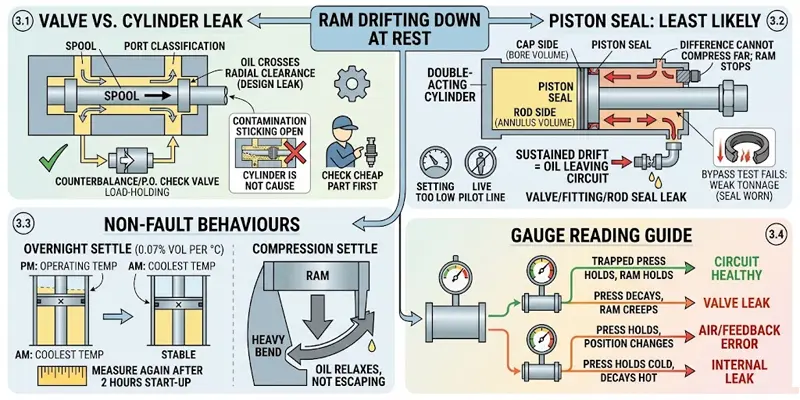
A spool-type directional valve cannot be leak-free: the spool needs radial clearance to slide, and oil crosses that clearance even with the port closed. This is design, not defect — which is why load-holding circuits use poppets. In a widely read Power & Motion column on why spool valves are not leak free, a hydraulics engineer reports seeing roughly 30% to 50% of the pump-line pressure trapped in the actuator lines when he plugs them with gauges on a closed-centre spool. That is pressure available to push a suspended ram down.
Counterbalance and pilot-operated check valves are what actually hold the ram. When one fails it usually sticks open, and the load creeps down steadily. Contamination holding the poppet or spool off its seat is the usual mechanism. Power & Motion’s guide to how counterbalance valves work and are set names the field consequence directly: the drifting gets blamed on piston seals, the cylinder is repaired, and the fault survives the repair because it was never in the cylinder. Check the cheap part first.
3.2 The piston seal is the least likely cause of drift
This is counterintuitive, and it saves a lot of unnecessary cylinder work. On a double-acting cylinder with both ports sealed, oil bypassing the piston seal has nowhere to go. For the rod to retract an inch, the cap side must give up a full bore volume while the rod side gains only the annulus volume — a smaller figure, because the rod occupies part of that space. The difference cannot compress far; pressure simply rises until the rod area carries the load, and the ram stops after a very short distance.
Sustained drift therefore means oil is leaving the circuit altogether: through a valve, a fitting, or the rod seal to the floor. A bypassing seal does announce itself, just not this way — it shows up as lost force or speed under load, heat, and a failure to hold in a bypass test. If drift comes with weak tonnage, the seal belongs on the list. Drift on its own does not put it there. Where the seal is worn, fit the correct seal kit; if the barrel, piston or rod is damaged, the cylinder needs repair or replacement.
Two things to rule out before either: a counterbalance set too low for the actual load, and a pilot line that is live when it should not be.
3.3 Two behaviours that are not faults
Overnight settle. Mineral oil contracts as it cools, on the order of 0.07% of volume per degree. A cylinder that ran at operating temperature all afternoon holds slightly more oil than the same cylinder the next morning; when it cools, the ram settles to take up the difference. The signature is a fixed amount of settlement followed by complete stability. A leaking valve keeps leaking, so it does not behave that way. Mark the position at end of shift and measure again two hours after start-up — if the two readings match, nothing is wrong.
Compression settle. A small drop immediately after a heavy bend, which then stops, is oil relaxing, not escaping.
3.4 Reading the gauges
Two pressure gauges on the cylinder ports, plus a dial indicator or a mark on the ram, separate the remaining cases in about twenty minutes.
- Trapped pressure holds, ram holds → holding circuit healthy; earlier movement was thermal or a measurement error.
- Pressure decays while the ram creeps → oil is leaving the circuit: load-holding valve or spool leakage. Clean or replace the cartridge, then re-check the spool.
- Pressure holds but position changes → air compressing, or a feedback error. Bleed, then confirm real movement with the indicator.
- Pressure holds cold and decays hot → internal leakage growing as viscosity drops. Schedule the repair.
4. The Ram Is Not Returning, or Returns Slowly

Check the command before the hardware. The control has to decide the return stroke, which needs a completion signal — position reached, pressure reached, dwell expired — and a return output that reaches the valve. A foot pedal with a stuck contact holds a “down” signal that blocks “up”. An interlock or light curtain in the wrong state prevents the stroke rather than slowing it. A pressure transducer that never reports the bend complete leaves the ram sitting at bottom dead centre. If the return output is not active on the diagnostic screen, no amount of hydraulic work will produce a stroke.
Then check flow. A worn pump delivers less flow at pressure, and the return stroke shows it first because the ram and tooling have to be lifted against the circuit. A restricted suction strainer, a clogged return filter creating backpressure, oil too cold to fill the pump, or a return-side relief set low all produce the same slow, smooth return. Gauge the pump outlet and the cylinder port under the same command: a large difference across the circuit is restriction, a low reading at both is a weak pump. Pressure alone cannot clear a pump — it can make rated pressure at low flow and still starve the ram.
Then check timing. Slow return for the first twenty or thirty minutes is a warm-up signature; slow return only after four hours is the opposite — leakage that grows as the oil thins. Neither is fixed by turning up the pressure.
One distinction decides the direction of the whole investigation: does the ram fail to rise, or does it rise and sag back? A ram that climbs, hesitates and settles is fighting a holding circuit, not a pump.
5. Jerky or Uneven Movement
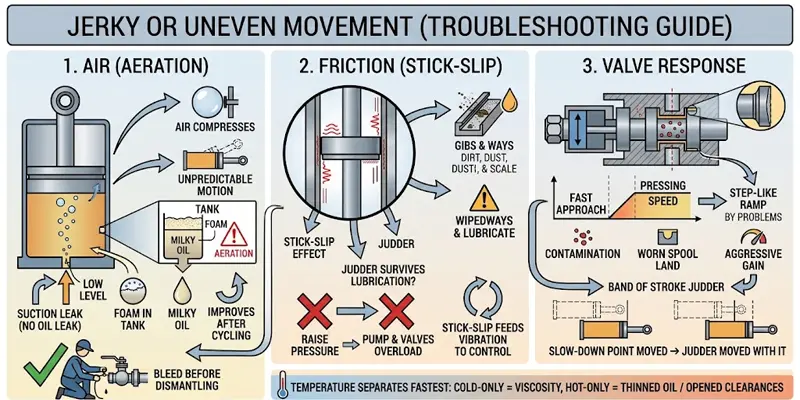
Three unrelated mechanisms feel almost identical through the frame.
Air. Air is compressible in a system built around an incompressible fluid; foam lowers the oil’s bulk modulus and motion becomes unpredictable. As Fluid Power World’s explanation of aeration puts it, actuators may move in jumps and spurts as bubbles compress and expand. Air enters through a suction-side leak that shows no oil because the line is under vacuum, through a low reservoir level, or through return oil discharging above the surface. It also arrives through careless bleeding after maintenance — the cheapest cause to rule out, so bleed before dismantling anything. Foam in the tank, milky oil, and improvement after cycling full strokes all point here.
Friction. The ram slides on gibs and ways. Dry, contaminated (laser scale and grinding dust are the usual culprits) or over-tight surfaces do not slide — they grab and release. That stick-slip feeds vibration into the position feedback, where the control reads it as a hydraulic or synchronization problem. Wipe the ways, apply the specified lubricant, repeat. A judder that survives lubrication is not stick-slip, and raising pressure to overcome a mechanical bind only overloads the pump, valves and structure.
Valve response. Between fast approach and pressing speed the valve crosses a small part of its stroke. Contamination, a worn spool land, or an aggressive gain turns that ramp into a step. The signature is judder confined to one band of the stroke; move the slow-down point and the judder moves with it.
Temperature separates the three fastest: cold-only is viscosity, hot-only is thinned oil and opened-up clearances.
6. Six Steps to Run Before You Call Anyone

Safety first. A drifting ram is stored energy that can come down on hands. Lower it to the bed or onto rated support blocks and isolate the machine before reaching under the upper tool. The full isolation sequence is in section 7.
- Record the abnormality in stage terms. Idle, reversal or travel; one side or both; hot or cold; before or after maintenance. Five minutes with the operator beats an hour with a gauge.
- Check oil level and condition. Low level, foam, discolouration, wrong grade, water. If the level is low, find out why before topping up.
- Inspect external connections and the suction side. Cylinder ports, hoses, valve blocks, fittings, reservoir. No external oil does not mean no internal leak, so this step removes candidates rather than proving one.
- Run the holding test. Ram 50 mm above the bed, no load, pump stopped: mark, wait ten minutes, measure. Repeat with the pump running and no command. The difference between the two tells you whether the problem sits in the holding circuit or in the valve’s centre condition.
- Test the reversal. Command a return from BDC with no workpiece. A relief squealing on the return stroke means the circuit is pushing against a restriction, not that the pump is weak.
- Check friction and feedback. Lubricate the gibs and repeat; then review alarms, scale readings and Y1/Y2 deviation history. A machine that has been logging deviation warnings for a month has already told you where to look.
Filters, pump flow and valve performance need pressure and flow measurement against the hydraulic diagram — a technician’s job, and the readings are worth recording rather than guessing at.
7. When to Stop the Machine
Some of these symptoms are more than an efficiency problem. Stop production and follow your isolation procedure if you see:
- Uncontrolled or accelerating ram descent
- Sudden, unpredictable movement
- Loss of left-right synchronization
- Severe hydraulic leakage, or abnormal pressure spikes
- Repeated hydraulic or CNC safety alarms
- Mechanical impact or severe vibration
Before any maintenance: isolate and lock out the power; release or isolate stored hydraulic pressure per the machine’s procedure — the requirement to relieve, restrain and render stored energy safe, and to verify isolation before work starts, is explicit in OSHA 29 CFR 1910.147(d)(5); fit approved mechanical supports; verify the ram cannot move; and allow only qualified personnel to work on pressurised components. Guarding and control requirements sit in the current press brake standard, EN ISO 6909:2026, and none of them replace a physical block under the ram. Never loosen a fitting, remove a valve block, or disconnect a cylinder line with the system pressurised — high-pressure oil can penetrate skin and cause serious injury. Nor should anyone lean on a safety-related valve setting to mask an unexplained drift. If the holding function is unreliable, do not keep running because the machine can still complete a cycle.
8. Preventing a Repeat
- Keep the oil and filters inside specification. Correct grade and viscosity, level checked, temperature watched, no mixing of incompatible oils, oil sampled rather than judged by colour. Change filters on schedule and read the indicator — a filter that blocks early is telling you about contamination, not about the filter.
- Inspect cylinders and connections during planned stops. Rod condition, seal seepage, hose cracking, fitting tightness, mounting movement.
- Trend pump and valve behaviour. Record return speed and pressure readings; gradual change is easier to act on than a sudden failure.
- Leave the control calibrated. Adjusting pressure, speed or synchronization parameters blind makes synchronization faults worse.
- Keep the record. The log below turns a vague service call into a specific one.
| Item | Record |
|---|---|
| Hydraulic oil | Grade, level, condition, change date |
| Filters | Replacement date, restriction status |
| Pump | Noise, measured flow and pressure |
| Cylinders | Leakage, rod condition, test results |
| Valves | Switching behaviour, holding test result |
| Ram movement | Drift, return speed, smoothness, at what temperature |
The press brake maintenance checklist sets out the daily, weekly and annual items, and the maintenance and upgrade service covers the work that needs a gauge rather than a checklist. If the ram misbehaves on one side only while the other tracks normally through every stage, work it as a Y1/Y2 synchronization error — the diagnostic order is different. Faults that are not motion-related at all, such as angle, dimension, tooling marks or cracking, sit in the wider press brake troubleshooting guide.
9. When to Contact Technical Support
Call for help when internal cylinder leakage is suspected, pressure cannot be held, a proportional valve will not respond, synchronization alarms keep returning, the fault comes back shortly after a repair, or the circuit needs component-level testing.
Send these seven items with the enquiry and the engineer can usually narrow the cause before anyone travels:
- Machine model and serial number
- Hydraulic system type and pump details, if known
- Description of the abnormal movement
- Whether it affects one side or both
- Alarm codes or messages
- Oil type and maintenance history
- A short video of the movement, if it can be recorded safely
CAMT supports CNC press brakes with remote diagnosis, maintenance guidance and on-site service where available. Cartridges, seal kits and consumables come from spare parts; the service team is reachable through technical support, and machine details sit in the press brake range. Where the recurring fault is a specification problem rather than a maintenance one — a machine run permanently at the top of its tonnage — the Smart series with closed-loop control on both cylinders, or the oil-free EPB series, removes part of the failure class instead of repairing it repeatedly.
10. Frequently Asked Questions
Why is my press brake ram not returning?
Usually the return command never reaches the valve, or the valve does not shift when it does. Check the diagnostic screen for an active return output, the foot pedal for a stuck contact, and any interlock holding the stroke. If the command is there and the valve shifts, the ram is being starved of flow — filter, suction, pump or a return-side relief set too low. The bending stroke and the return stroke use different flow paths, which is why a machine can bend normally and still return badly.
Why does my ram slowly drop when the machine is off?
Most often a load-holding valve or spool that is passing oil, not a worn cylinder. On a double-acting cylinder with both ports sealed, a bypassing piston seal has nowhere to push the oil, so it cannot produce sustained drift on its own. Have the holding circuit tested before any cylinder is removed, and rule out overnight thermal settle first — that is a fixed drop which then stops.
Can low oil or air cause jerky movement?
Yes. A low level lets the pump draw air, and entrained air makes the oil partly compressible, so the ram moves in jumps. Foam in the reservoir, milky oil, or improvement after cycling full strokes all point to air. Find the entry point — usually a suction-side leak or low level — before bleeding, or it comes straight back. Contaminated valves, mechanical friction and unstable feedback produce similar symptoms.
How do I tell whether it is the pump or the proportional valve?
A pump problem affects overall flow and gets worse under demand; a valve problem produces inconsistent movement, delay or unstable synchronization while pressure still holds. You need flow and pressure measurement plus valve command and feedback data to separate them. A pump can make rated pressure at low flow and still be the reason the ram returns slowly.
Why does only one side of the ram drift or judder?
One-sided behaviour means the fault is in that side’s cylinder, valve or position feedback rather than the shared supply. Compare the two sides’ pressure, check that cylinder’s valve response, and confirm the scale reading is clean. On a machine with independent closed-loop control, that is exactly what the Y1/Y2 deviation display is for.
Is it safe to keep running with a drifting ram?
No. Uncontrolled descent can injure an operator and damage tooling. Isolate the machine, block the ram before working near it, and have the holding system inspected before returning to production. A holding valve that fails completely does not fail gradually.