A fiber laser cutting machine can start producing rough edges, excessive dross, unstable piercing, or incomplete cuts even when the cutting parameters have not changed. One often-overlooked cause is contamination or damage inside the laser cutting head.
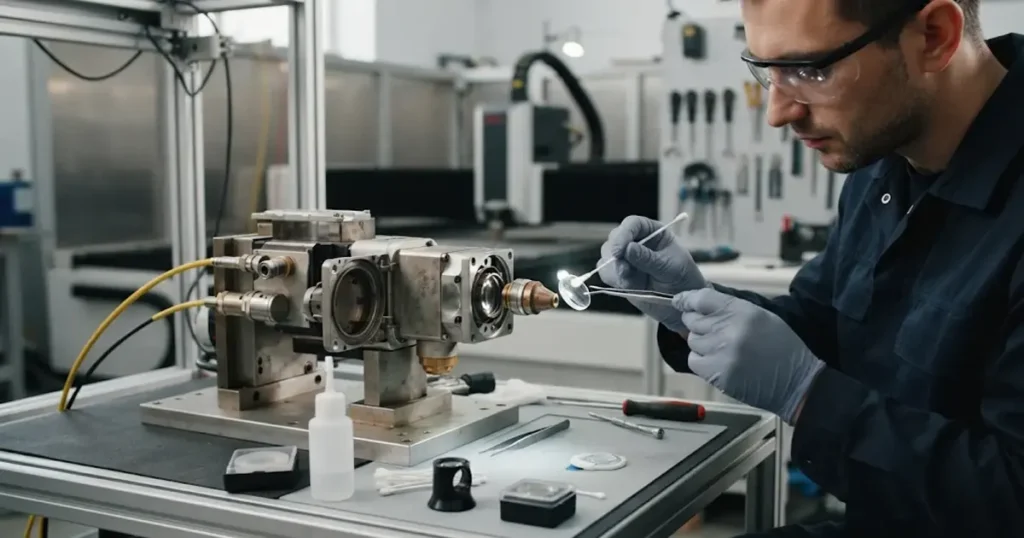
The protective window is particularly vulnerable because it sits close to the cutting area and must withstand exposure to metal spatter, smoke, dust, and process residue. If contamination is not identified early, heat absorption can damage the protective glass and potentially affect more expensive internal optical components.
Proper fiber laser cutting head maintenance is therefore not just about cleaning lenses. It involves inspecting the nozzle, checking the protective window, maintaining clean working conditions, preventing contamination, and following the correct replacement procedures.
Why a Clean Program Suddenly Cuts Badly
Three calls repeat in job shops: a program starts throwing dross, windows burn through faster than budget allows, and an operator who wipes the window every morning still sees haze or scratch arcs. All three are one question — where the contamination came from.
Fraunhofer ILT treats that absorption as an engineering quantity rather than shop folklore: its opto-mechanical design services include calculation and correction of laser-induced thermal lenses. The window is not the only variable either. TWI’s laser cutting overview notes that edge quality improves with correct optical configuration and efficient assist-gas jet delivery, so a clean window on a badly set-up gas circuit still cuts badly. What sits inside the head is covered in What Are the Most Important Components of a Fiber Laser Cutting Machine?; classifying defects by cut-edge symptom belongs to Fiber Laser Cutting Troubleshooting: Dross, Burrs and Rough Edges.
Before changing a parameter, record material and batch, thickness, gas, nozzle, program, shift and date, and photograph the edge beside the approved sample. That record separates an optic problem from a gas problem three days later.
Diagnose laser optic marks to fix root causes before cleaning or replacing

| What you see | Likely entry path | Check first | Action and re-qualification |
|---|---|---|---|
| Pinpoint burns below the beam axis | Pierce flash-back up the nozzle | Pierce recipe, standoff, orifice condition | Correct the pierce sequence; verify on an adjacent coupon |
| Haze returning within one shift | Moisture or oil in gas or purge | Gas at the point of use, filter and drain log | Fix the supply before fitting another window |
| Oily droplets or rainbow film | Shop air during cleaning, lubricant mist | Consumable storage, extraction | Quarantine consumables, revise the procedure, fit a new window |
| Particles on an internal optic's top face | Dust after fiber disconnect or head opening | Who opened it, end-cap storage | Stop in-house opening; request service inspection |
| Growing dark spot or halo | Absorption heating, thermal lensing | Alarms, recent power changes | Stop cutting, replace, have inner optics inspected |
| Repeating arcs or wipe marks | Cleaning technique or a reused wipe | Wipe log, who last cleaned | Discard consumables, retrain, replace if the coated face is damaged |
A top-face mark on an internal optic is a handling event, not a cutting event — Heston’s 2014 sources say most major optics problems come from improper handling. A growing dark spot means the optic is absorbing: continuing to cut turns a sacrificial part into a focusing-lens repair. If the machine offers an optical or temperature alarm, stop and investigate under the manual.
What Operators May Open, and How to Shut Down Safely
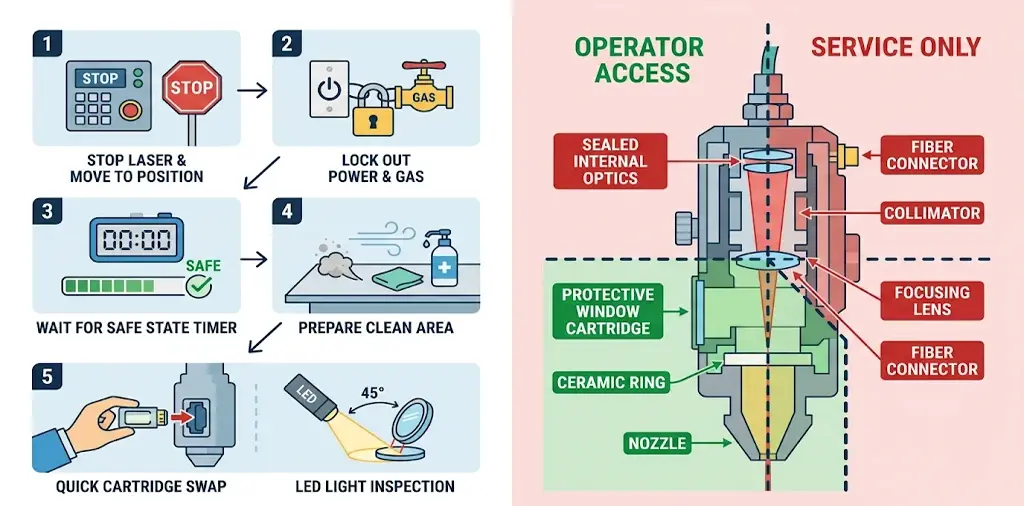
The installed head manual governs everything below: Raytools and WSX cartridges, seals and access sequences differ, so no generic checklist overrides it. Make the machine safe and expose only what the manual authorizes.
- Stop the program, move to the designated maintenance position, and shut down the laser source and machine per the manual.
- Isolate and lock out the relevant electrical, gas and energy supplies where the maintenance procedure requires it.
- Wait for the specified safe condition. Do not rely solely on the CNC display showing that cutting has stopped.
- Clean around the holder; work in a clean, dry, low-dust area away from grinding, welding fumes and compressed-air outlets.
- Open only the cartridge or cover the manual authorizes, and keep that exposure short.
Inspect in good light first. In a 2025 The FABRICATOR article, consultant Amado Andujo describes shining an LED at a 45-degree angle onto the optic and reading the reflection: clean surfaces reflect brightly, dirty ones look dull. The same article warns that straight shop air, carrying water and oil, is a poor way to blow off a lens. Heston’s report, quoting Robert Borgstrom of Precitec, recommends two cartridges so a sealed spare goes in immediately, no fresh slide parked on a bench, horizontal head disconnect where possible, and a clean end-cap storage place.
Draw the authorization line in writing. Safe access to the window, nozzle and ceramic ring, plus inspection and logging, can sit with trained operators; sealed modules, collimator or focusing lens, fiber disconnect, beam alignment and focus-zero work go to authorized service. A head opened outside that boundary is a service event. Laser safety is a standards question: ISO 11553-1 and the ANSI Z136 family set the general direction, and reflective materials, high-pressure gas lines, cylinder storage and fume and fire risk from coated sheet all need written confirmation from the equipment supplier and the site safety officer. We do not assert compliance on a customer’s behalf. Keep this sequence inside operator training, not on a laminated sheet.
Clean intact coatings once with proper tools; replace damaged optics
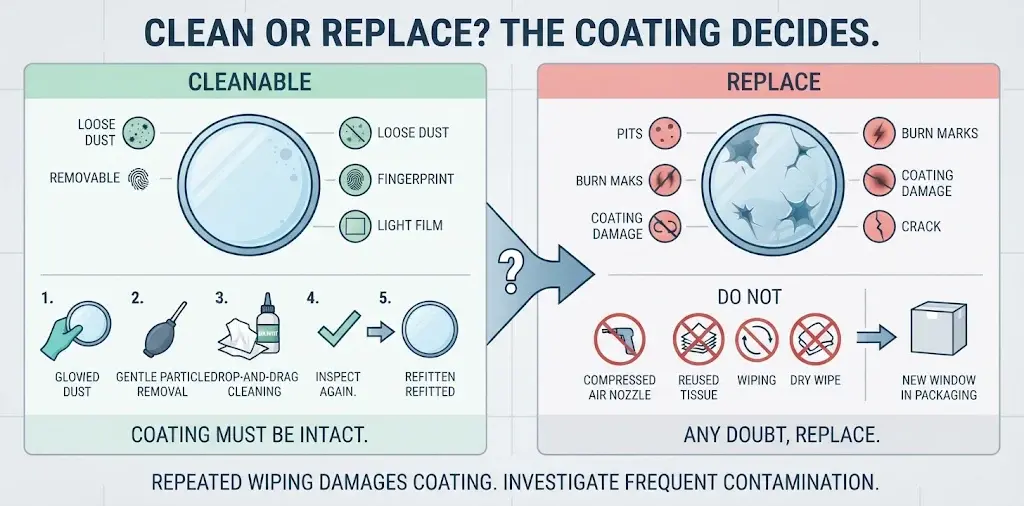
Split the decision in two: is the contaminant removable, and is the coating intact? Loose dust, a fingerprint or a light film on an undamaged coating may be cleanable; pits, burn marks, coating damage, a crack, a mark surviving one approved pass, or any doubt mean replacement.
- Handle the window by its edge with powder-free gloves; inspect both faces, the holder, seals and O-rings under good light.
- Remove loose particles only by the optical cleaning method approved for that assembly. Never use workshop compressed air.
- Use the solvent, tissue and movement specified for that coating. Apply fresh material for each pass; never reuse a wipe, dry wipe or rub in circles.
- Let it dry per the procedure and inspect again before refitting.
- If contamination survives one approved pass, replace the window; repeated wiping damages the coating without restoring it.
There is no universal solvent or wipe. TWI’s technical FAQ on cleaning laser optics describes drop-and-drag with lens tissue for hard-coated fused silica, handling by the edge, never reusing tissue, and separates soft and dielectric coatings needing non-contact methods. It ties frequency to the environment, not a calendar. “One solvent, one wipe, every morning” is a way to scratch a durable coating.
Every swap exposes the cavity and every wipe risks the coating. If cleaning frequency rises while window life falls, stop cleaning more and investigate the entry path. Keep wipes and solvents sealed away from the shop floor — a kit beside the machine is a contamination source. Fit the specified optic from a traceable lot in dust-free packaging, so agree the consumable list with your spare parts and consumables supplier before the machine arrives.
Control gas, pierces, extraction, cooling, and recipes to protect optics

A fresh window starts a new clock, set by what comes through the gas line, what extraction removes, how violent the pierces are, what is on the incoming sheet, and how the head is supported and cooled.
Gas cleanliness at a compressor outlet is not cleanliness at the point of use. Particle, water and oil classes must be met at the point of use at full flow, with a sampling point, a test method and a re-check after every filter change; put those in the written specification, not an operator’s judgement. The 2025 FABRICATOR article makes the same point about pressure: source pressure is not nozzle-front pressure, and tanks, vaporizers, regulators, plumbing, valves and the orifice must be sized for the volume drawn. Several machines sharing one supply make that harder. Gas selection is covered in Laser Cutting Assist Gas: Oxygen vs Nitrogen vs Compressed Air.
Before breakthrough, molten metal has nowhere to go but up. The 2014 report notes that excessive gas flow during a pierce drives spatter onto the nozzle and cover slide, and that frequent slide changes on a hole-intensive nest are a signal to refine the pierce, not to buy better windows. Use the staged or pulsed pierce and the standoff from the 2025 article, and stop immediately when the cut is lost. Inspect the nozzle for ovality, spatter and impact damage; spatter on the ceramic seating surface changes the capacitive height signal, so the head dives or lifts — unstable standoff looks like a focus problem and is often misdiagnosed as a dirty lens. Re-seat and center after any change or collision, then verify height following on a controlled part.
Maintain extraction filters and clear residue by the approved procedure; fine dust from galvanized or coated sheet gets everywhere. Record the incoming batch and surface state with each finding: a life drop that lines up with a new coil is a material question, not an optics question. Check coolant level, temperature, flow, alarms and leakage per the chiller manual, use only the approved fluid, and investigate recurring cooling alarms. Support warped sheet and verify collision protection; after any impact, re-check the nozzle, ceramic ring and holder. Keep pierce and cutting recipes under revision control with a backup so a “better pierce” tried on one shift can be reversed — a parameter library and backup discipline, not a maintenance chore. For the full machine-level schedule this task sits inside, see fiber laser cutting machine maintenance.
Replace laser windows based on pierce count and condition, not calendar date

A window on a nest full of small holes sees different exposure from one cutting long contours; neither is described honestly by “replace every week”. Build a baseline from your own readings: log installation and removal time, laser-on hours, pierce count, material, thickness, gas route, head openings including cleaning, the finding, removal reason and coupon result. Compare like with like — same material family, thickness band, gas route, similar piercing density.
Normalize by exposure, not by date. If one week returns 1,200 pierces per window and the next 4,800 on the same 3 mm carbon steel and gas route, the windows age at nearly the same rate per pierce — the second week ran a hole-dense nest. A calendar rule would call that a bad batch of consumables and start an unnecessary supplier dispute. No industry average belongs here.
Four readings follow. If life falls while head openings rise, the intervention is the suspect. If life falls with openings stable and piercing density unchanged, check gas, extraction and seals. If life falls only on one material batch, the sheet is the suspect. If a fresh window fails to reproduce the approved coupon at unchanged exposure, stop replacing consumables and escalate. Routine shift checks and scheduled whole-machine inspections belong to the machine’s maintenance plan; this baseline governs only the optics. That is also where beam and focus recalibration becomes a maintenance and upgrades task with a defined scope instead of open-ended tuning.
When a Fresh Window Fails Again: Escalate With Evidence
Stop replacing parts and escalate on evidence: repeated failure at unchanged exposure, particles on an internal optic, a dark spot that grows during cutting, a fresh window that cannot reproduce the approved coupon, or any alarm referencing the optical path. A head opened beyond the authorization line is a service event even if cutting looks normal afterward.
Send a package, not a description of the symptom. Include the machine model and serial number, source power and head model, window part number and replacement history, material type and thickness, assist gas and pressure at the head, cutting and piercing parameters, alarm codes and laser-on hours, and photographs of the removed window and any damaged nozzle or ceramic ring. With those eight items, remote review of alarms, parameters and maintenance history usually settles whether the machine, the process or the consumable is at fault before anyone travels — the practical scope of technical support.
What to Specify Before You Buy — and Where to Get Help
If a new window fails at the same exposure after gas, extraction, piercing, nozzle, cooling and handling are cleared, what remains is machine configuration and current state — head design, gas circuit capacity, height following and the parameter library. We will not claim that any model is immune to contamination, that a window will last a stated number of hours, or that a given edge-quality class is achievable; those are measured on your material and the configuration you ordered, with a signed first-off sample.
Put maintenance access in the purchasing specification. On a fiber laser cutting machine enquiry, ask how the cartridge is swapped, whether a sealed spare is supplied, what purge and sealing the head uses, how the gas circuit is verified at the point of use, how extraction handles coated-sheet dust, which optical tasks are dealer-only, and who signs off after an optical intervention. An open-type single-table machine gives direct head access for daily checks; an enclosed exchange-table machine contains dust but changes how you reach the head. Neither removes the need for §3’s written procedure.
For an existing machine: spare parts and optical consumables are identified by head model and part number; remote support reviews the log, alarm codes and parameters; scheduled maintenance covers gas verification, nozzle and height checks and optical inspection within an agreed written scope. Contact our team with the window log, three coupons and the batch details, not a description of the symptom. If the real loss is waiting for a spare or an inspection decision, no purchase fixes it.