Most fiber laser maintenance problems do not arrive as a breakdown. They arrive as an edge that gets slowly worse, a pierce that fails at one corner of the nest, or a Monday sheet that will not cut through with the program that ran clean on Friday. A checklist is useful only if it turns that drift into comparable readings, so a nozzle or window is replaced before a sheet is scrapped. Below is a printable daily, weekly, monthly and annual routine, a way to trace a bad edge to the part responsible, and a method for setting your own replacement thresholds. Intervals are starting points, not specifications; replace them with your own laser-on hours. Shops running a press brake alongside the laser can keep the same daily, weekly and annual log with our press brake maintenance checklist.
Essential daily operator checks for fiber laser cutting machines
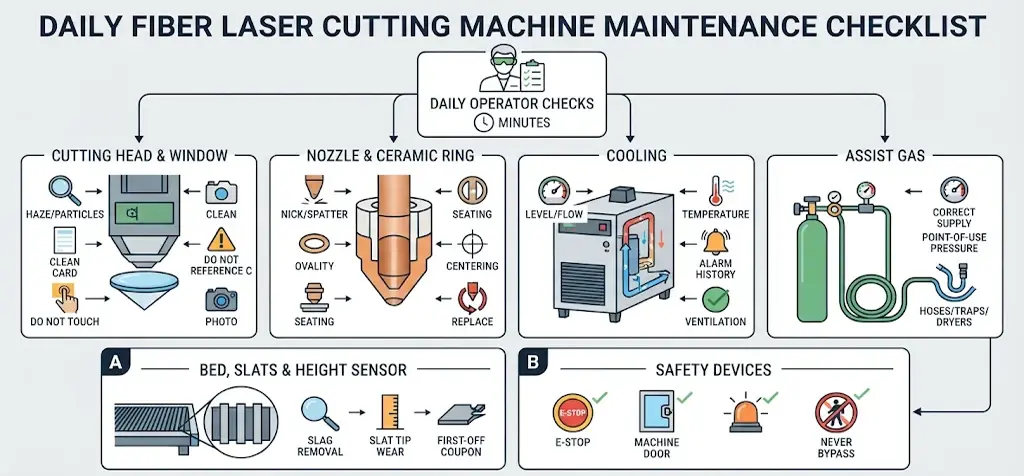
Shift checks take minutes and belong to the operator.
Cutting head and protective window. Inspect in good light against a clean reference, following the head manufacturer’s procedure. Look for haze, particles, discoloration, burn marks or coating damage. Never touch an optical surface with bare fingers or a shop wipe, and do not open a sealed assembly unless you are trained and authorized. Record the window ID, hours installed, a photo and the action taken.
Nozzle and ceramic ring. Check the tip for nicks, spatter and ovality, confirm the nozzle is seated and that its type matches the program, and verify centering when required. Replace a damaged nozzle rather than finishing the shift with it.
Cooling. Check coolant level, temperature stability, flow, alarm history, leaks and clear ventilation — not just that the chiller powers on.
Assist gas. Confirm the correct supply, verify pressure while gas flows at the point of use, and inspect accessible hoses, traps, dryers and drains. A static regulator reading says little about what reaches the kerf.
Bed, slats and height sensor. Remove accessible slag only in the required safe state, check the tooth tips under the nest, and cut one first-off coupon.
Safety devices. Verify emergency stops, doors, interlocks and warning indicators by the manufacturer’s procedure. Never bypass a guard to finish a cleaning task.
Weekly, Monthly and Annual Checks by Component
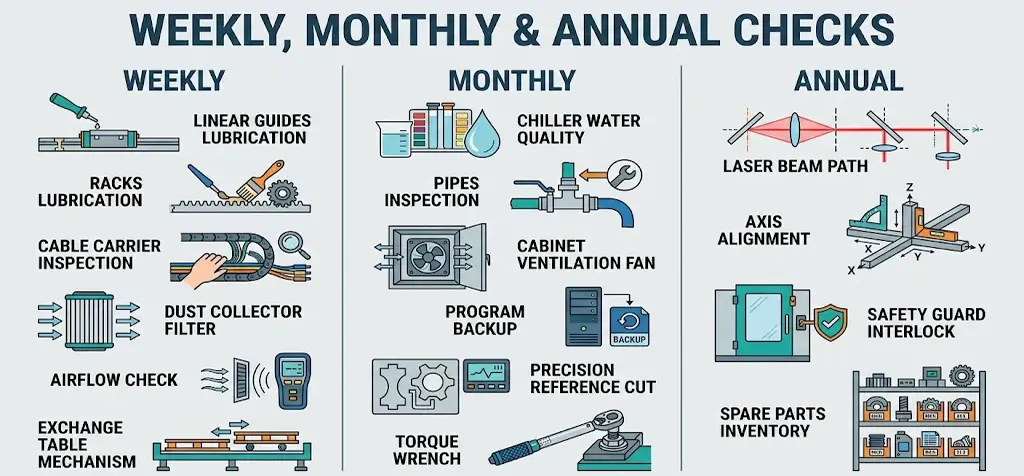
Calendar intervals here are starting points; set them from your operating hours, job mix and workshop conditions.
Weekly or at your laser-on-hour threshold. Clean accessible guides and racks, check lubricant level and delivery indicators, and use only the specified lubricant — excess oil attracts dust. Inspect cable carriers for cracks, abraded insulation, kinked hoses and torn bellows; damaged electrical cable is qualified-person work. Check dust collector filter indicators, duct restriction, airflow, the collection bin and fan noise. On exchange-table machines, check table guides, positioning sensors, stops and fasteners, then run one approved exchange cycle.
Monthly. Check water quality against the chiller specification, accessible filters, pipes for aging or corrosion, and the temperature and flow record. Use only the specified coolant or treated water; do not substitute tap water or automotive antifreeze without written manufacturer approval. Check cabinet ventilation and fans externally; internal cleaning and electrical work require isolation by qualified personnel. Review alarm history, back up programs and the parameter library, then cut a reference part from a fixed program and material and compare dimensions, hole position, kerf and edge against your baseline. Have qualified staff check mounting points and transmission parts for looseness, vibration and wear, using specified torque values.
Annually or with a supplier visit. Group beam-path and output checks, axis positioning, guide alignment, guarding and interlock verification, electrical inspection and calibration into one planned stop, and review consumable usage and spares at the same visit. A two-shift thick-plate shop needs these checks sooner than a one-shift thin-sheet shop.
The Maintenance Checklist by Frequency
| When | Check | Signal that fails the check | Record |
|---|---|---|---|
| Start of every shift | Nozzle tip, roundness, spatter, centering; ceramic ring and head seal | A nicked or off-center nozzle disturbs gas flow before it disturbs the program | Nozzle ID, centering result, operator |
| Start of every shift | Protective window in good light against a clean reference | Haze, discoloration, burn marks; a window can look clean and still change transmission | Window ID, hours installed, photo, action |
| Start of every shift | Gas at the point of use while flowing; chiller flow, temperature stability, level, alarms; extraction airflow | Static gauge pressure is not pressure at the kerf; moisture and oil mist travel with the gas | Supply state, cylinder ID, alarm codes |
| Start of every shift | Slats and sheet support under the nest; height sensor; one first-off coupon | Slag at the tooth tips lifts the sheet and changes its Z position | Coupon ID, edge and dross reading, pierce result |
| Every material, gas or cylinder change | Gas route, dryer and filtration, purge, plate surface state | Rust, oil, coating and moisture change both fume load and contamination risk | Grade, heat, thickness, surface, coupon ID |
| Weekly or at your laser-on-hour threshold | Slag tray, slat rotation and wear, filters, rails and lubrication, cabinet fans, cable carriers, exchange-table guides | Accumulation that shifts support height or restricts airflow | Cleaning count, slats moved, parts used, next trigger |
| Monthly | Coolant condition and filters, cabinet ventilation, mounting points, alarm history, program backup, reference cut | Dimensional deviation against the stored baseline; recurring control errors | Trend reading, alarm export, backup version |
| After any collision, head removal, optic change or software service | Nozzle centering, focus zero, height following, beam alignment, parameter-library backup | An intervention that moves the head invalidates the previous baseline | Signed sample, coupon pair, who authorized the work |
Every row is a trigger, not a fixed interval. A machine cutting static nests over the same slats all night wears them faster than a mixed nest, and cleaning late is harder than cleaning often.
Trace cutting defects to maintenance items before changing settings
When the edge changes, resist opening the parameter library. Changing speed, power or focus before you record the symptom destroys the only evidence that separates a consumable fault from a machine fault. Work down this table first; definitions of kerf, dross and focus are in the laser cutting terms glossary.

| Symptom | Check first | Reading that discriminates | Log |
|---|---|---|---|
| One-sided burr or a pierce that fails at one corner | Nozzle tip, centering, ceramic ring, protective window | Single spot versus whole sheet; a before-and-after coupon with one part changed | Part ID, coupon pair, centering result |
| Edge slowly worse across every part, all week | Slats, gas filtration and moisture, coolant condition, extraction, alarm history | Trend coupon against the stored baseline; gas state while flowing, not at rest | Trend reading, cleaning count, supply changes |
| Problem appears only after a cylinder, generator or shift change | Gas route, dryer, purge, handover notes | Adjacent coupons from the same parent sheet on both sides of the change | Cylinder ID, purge record, operator |
| Automation lifts the sheet together with the slats | Slag buildup and slat tips under the cut path | Nest layout against the slat grid; support height before and after cleaning | Nesting change, slat rotation or replacement |
A maintenance fault has a history; a parameter fault has an event. With the coupon pair, supply record and alarm log, diagnosis usually takes one call. Without them, the argument becomes opinion and the machine stays down while everyone tests a theory.
Set Your Own Replacement Thresholds
“How many hours does a nozzle last?” has no published answer that survives contact with your job mix. Build your own discard line from three readings, all taken with the same material, thickness, gas route and program.
| Reading | How to capture it | What it separates | Decision it drives |
|---|---|---|---|
| Baseline | Fit a new nozzle or window, cut one approved coupon, photograph the edge, log pierce time, cut time and gas state | What "good" looks like on this machine, in this condition | Stored as the reference for every later comparison |
| Trend | Repeat that same coupon at a fixed point in every shift, without changing the program | Gradual, whole-sheet drift from consumables, cooling, gas quality or calibration | Schedule the intervention before the trigger reading appears |
| Trigger | Note the first signal: one-sided burr, failed pierce, rising cut time, repeated alarm, visible window damage | Sudden, local faults from a collision, a contaminated part or a supply change | Replace, re-center, re-zero and re-sample immediately |
After any optic or nozzle change, center the nozzle, confirm focus zero and height following, then cut and archive a coupon from the same program. Never compensate with extra power; that erases the comparison. spare parts and consumables should cover the items your first month of coupons shows you actually consume, including the seals and ceramic parts people forget until a window will not seat. Keep spares packaged and dry — an unprotected spare optic is not a spare. If windows keep failing, changing them faster is not a fix: repeated contamination points at the gas supply, a head seal, the piercing strategy or the extraction path. Escalate it with the readings in hand. The optic and nozzle procedure itself is detailed in fiber laser cutting head maintenance.
Maintain cooling, gas, and extraction together as one integrated system
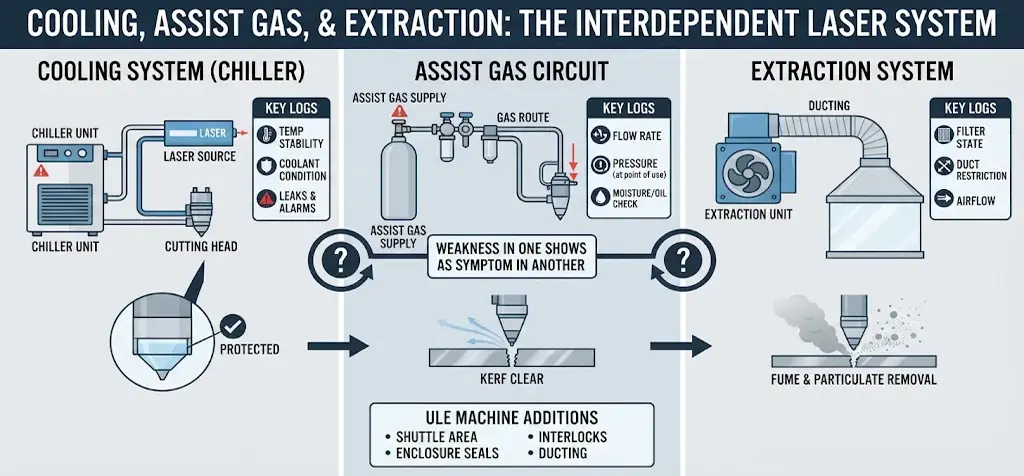
Shops maintain these as three separate chores, then wonder why a freshly cleaned window fogs again. The chiller protects the source and head; the gas circuit keeps the kerf clear; extraction removes fume and particulate that would otherwise settle back into the cutting area. A weakness in one shows up as a symptom in another.
Log flow, temperature stability, coolant condition, filter state, leaks and alarms — not “the chiller is on.” Verify pressure at the point of use while gas flows, and check traps, regulators and lines for moisture, oil and leaks. Compressed-air classes, oxygen-service cleanliness, cylinder storage and high-pressure pipework are specification questions to settle in writing with the equipment supplier; we do not assert compliance for your plant. Treat filter cartridges, duct restriction and airflow as measured items. Galvanised, coated, copper and brass work brings fume and fire questions for the equipment supplier and your site EHS function. On the ULE enclosed exchange-table machine, add the shuttle area, enclosure seals, interlocks and extraction ducting to the weekly rows. The cooling-side routine behind those readings is in fiber laser chiller maintenance.
The Maintenance Log and the Handover Package
A checklist without a log is a habit; with a log, it is evidence. Keep the same fields every time: machine identity; date, shift and operator; material grade, batch, thickness and surface state; gas route and supply state; part IDs and hours installed; program version; symptom and edge photo; coupon readings; action and post-action coupon; alarm export, calibration record, open items and next review trigger. Back up the parameter library on a fixed schedule and after every service event; software support and parameter backup is part of maintenance because a lost recipe set looks exactly like a machine that has forgotten how to cut.
When you escalate, send a package rather than a description.
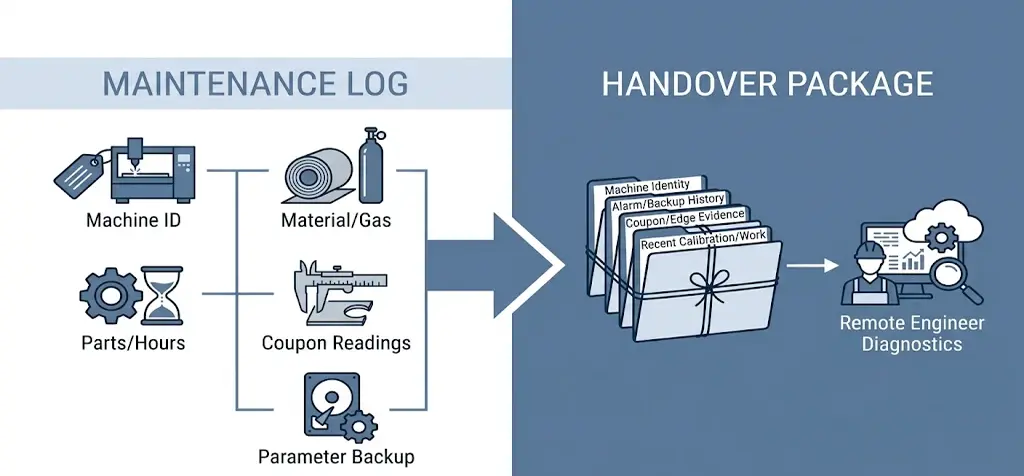
| Field | What to send | What it lets the engineer do |
|---|---|---|
| Machine identity | Serial number, configuration, controller and software version | Match alarm codes to the right firmware and option set |
| History | Exported alarm log, parameter-library backup, consumable replacement record | Separate a recurring fault from a one-off event |
| Evidence | Before-and-after coupon photos, edge photos from safe positions | See whether the fault is local or across the whole sheet |
| Recent work | Last calibration record, parts replaced, post-action coupon | Rule out work already done and check whether it shifted the baseline |
With that in hand, remote diagnostics and error-log analysis can separate a software fault from a hardware fault before a site visit is booked. scheduled preventive maintenance and calibration can then be built around your laser-on-hour thresholds, grouping beam-path checks, calibration and guarding inspection into one planned stop. One honest boundary: time waiting for drawings, inspection or material release is not a maintenance problem.
How Machine Design Changes Where You Inspect
Wear mechanisms do not change with the frame; access points do. the ULF open-type single-table machine gives direct access to the table and head for the shift check. An enclosed exchange-table design moves the work toward the shuttle, seals, interlocks and extraction ducting. Tube cutting adds chuck jaws, support rollers and a different slag path, so the ULT pipe and tube laser needs rows for chuck wear, tube support and profile alignment. Write those rows into the same log, and bring your own coupon standard to any comparison in the fiber laser cutting machine range: the useful question is which parts your operators can inspect at shift start.
We will not give you a universal nozzle life, cleaning interval or cut-quality class, because none can be measured on your material and configuration. A correctly configured machine reduces the risk of drift; the checklist keeps it low. To convert this routine into a plant-specific plan, contact our team with your machine serial number, material mix and current alarm log.