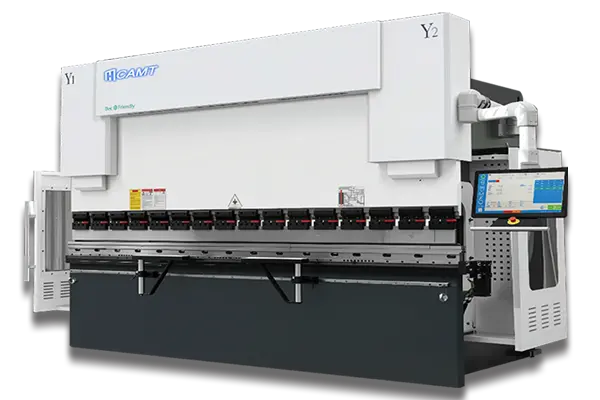
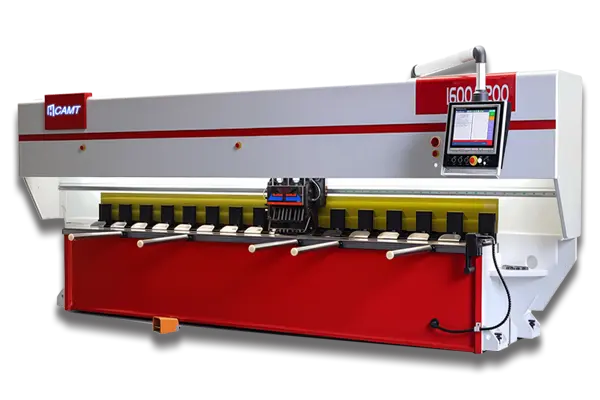
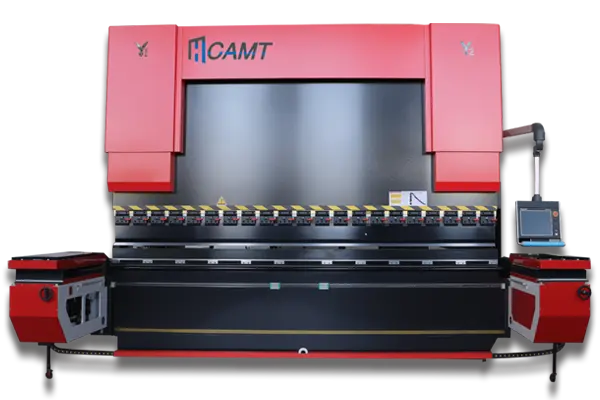
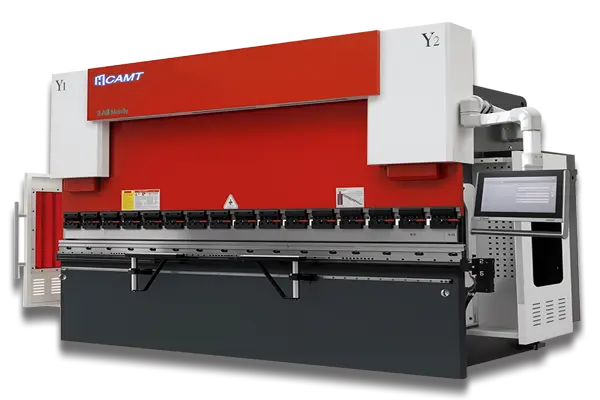
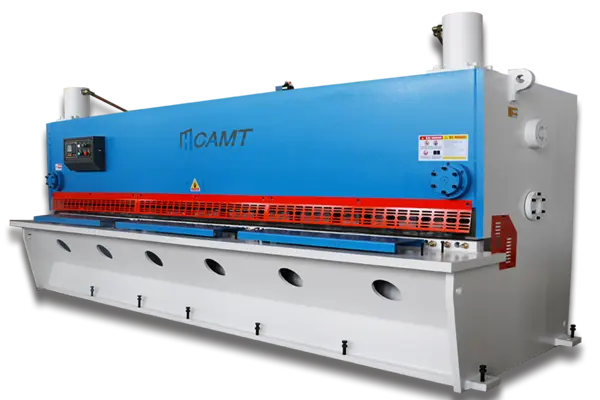
Buying a press brake from China can be a cost-effective way to expand your sheet metal fabrication capacity, upgrade existing equipment, or improve production efficiency. Chinese manufacturers offer a wide range of options, including NC press brakes, CNC hydraulic press brakes, hybrid servo models, electric press brakes, and heavy-duty bending systems.
However, purchasing industrial machinery internationally involves more than comparing quotations. Differences in machine configurations, component brands, manufacturing standards, export arrangements, and after-sales support can make two seemingly similar machines very different in actual performance and long-term operating costs.
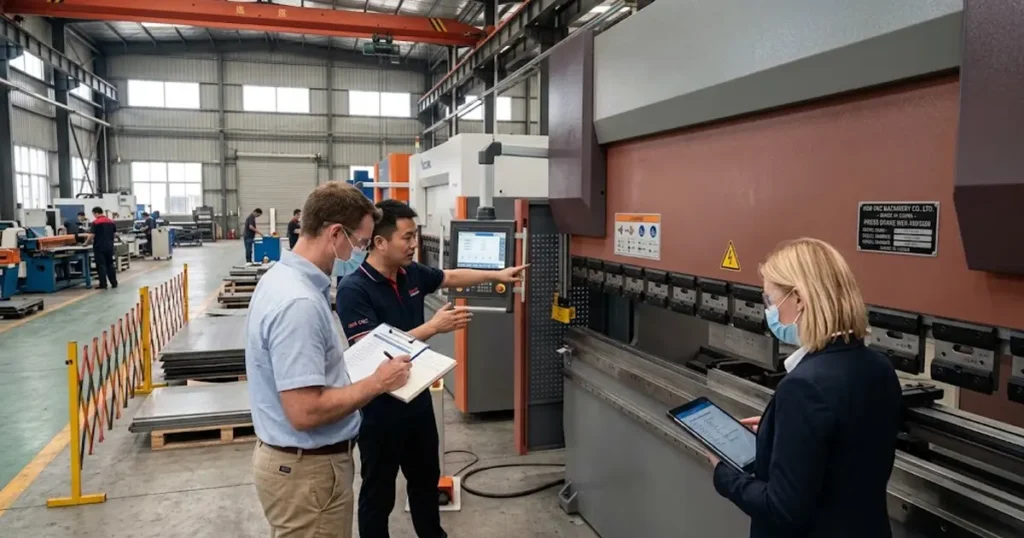
1. Verify the Manufacturer Before You Discuss the Machine
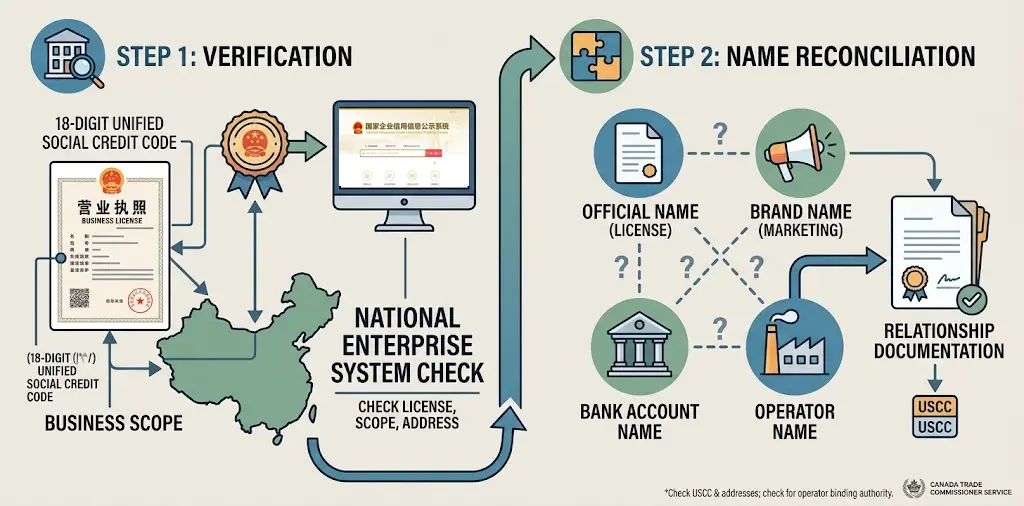
Start with the paperwork. Ask for the Chinese legal name — the business licence name, not the English brand — the 18-digit Unified Social Credit Code, the registered address, the manufacturing address, and the business scope. Then check it yourself through the National Enterprise Credit Information Publicity System run by China’s State Administration for Market Regulation. Canada’s Trade Commissioner Service publishes a non-commercial due-diligence guide listing exactly what to confirm there, including whether the individual negotiating with you can bind the company (Trade Commissioner Service, Conducting due diligence in China).
Next, reconcile four names. A mismatch is not automatically fraud — export trading arms are normal — but the relationship must be documented:
| Question | What a good answer looks like |
|---|---|
| Who signs the contract? | A legal entity matching the licence and the invoice. An individual signing "for the factory" without a company seal is not a counterparty. |
| Who invoices? | The same entity, or a named affiliate whose role is in the contract. |
| Who receives the money? | The same entity again. A personal account, or a beneficiary unrelated to both, stops the deal until explained in writing. |
| Who supports the machine? | Named, with an escalation path: factory engineer, regional partner, or distributor. |
Before requesting a quotation:
- ☐ Registration checked against the public record, not a scanned licence image.
- ☐ Factory address verified against the registered address, differences explained.
- ☐ Live video tour arranged if you cannot travel — welding, stress-relief, machining, assembly, testing.
- ☐ In-house engineering and quality inspection confirmed, with names.
- ☐ Export references requested: machines running in your market, and for how long.
A licence proves the company exists and may trade within its printed scope — nothing more. Four questions separate a builder from a forwarder:
- What is the maximum tonnage this specific tooling can take, at the V opening you quoted me?
- What is the machine’s gross weight, and where are the lifting points?
- How many pages is the electrical schematic, and do I receive it?
- Which components are bought in, and from whom — valve block, pump, linear scales, backgauge servo?
A trader forwards all four and waits. A manufacturer answers the first from a tooling chart and the third from a drawing register. CAMT, for example, builds CNC press brakes, fiber laser cutters and shearing equipment in its own plant; the about page sets out the processes behind that claim so you can audit them.
2. Turn the Quotation Into an Annex You Can Reject Against
A quotation is a sales document. A purchase-order annex is an inspection criterion. The gap between them is where most disappointment is manufactured.
The mechanism is “or equivalent”. Every “DELEM or equivalent control”, “branded hydraulic valves” or “safety light curtain” reserves the right to substitute — sometimes with a two-axis controller where you specified four. The fix is mechanical: for every line that could be substituted, the annex names a model, a quantity and a minimum performance figure.
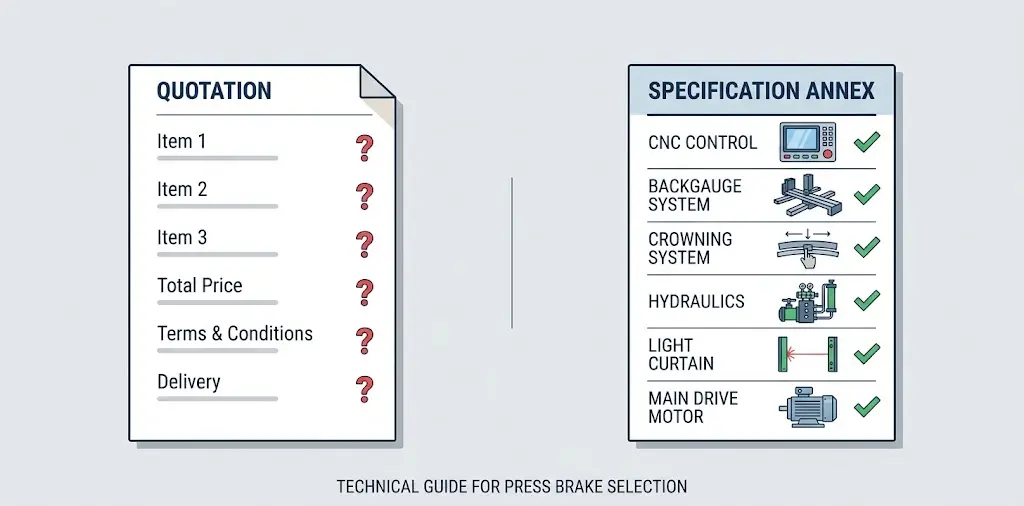
| Line item | What the quotation usually says | What the annex must say |
|---|---|---|
| CNC control | "DELEM CNC system" | Model and software version, controlled axes, licensed software options, offline-programming seat included or not |
| Backgauge | "Motorised backgauge, X and R" | Axis count, stroke, guide type, positioning figure and its measuring conditions |
| Crowning | "Crowning system" | Type — mechanical multi-point, hydraulic or none — points, CNC-controlled or not |
| Tooling | "Standard tooling included" | Punch and die dimensions, segment lengths, material and hardness, tonnage limit per metre |
| Clamping | "Quick clamp" | Mechanical or hydraulic; tooling interface — European, American, or a named system |
| Linear scales | "High-precision scales" | Brand, type and resolution |
| Hydraulics | "Rexroth/Bosch valves" | Actual make and model of proportional valve and pump; oil cooler capacity |
| Guarding | "Light curtain" | Type, resolution, monitored height, control response on interruption |
| Electrical | "380V/50Hz" | Voltage, phase and frequency as installed in your building, cabinet IP rating, transformer in scope or not |
| Documentation | "Manual" | Language, plus: operating manual, electrical and hydraulic schematics, parameter backup, spare-parts list with part numbers |
Two rules make the table work. The annex and the acceptance sheet are the same document — number the lines once; Step 8 tests the same numbers. And ask the supplier to write the tolerance they will be measured against, not the one they hope to achieve: “angle spread across the full bending length, on 3 mm mild steel at 1 m intervals” written by an engineer can be argued with at the factory; “±0.5°” written by a salesperson cannot.
Where the annex touches control architecture, our pages on CNC control systems, backgauge selection and crowning systems describe the practical differences, and the tooling guide covers the tooling figures.
3. Define the Specification: Type, Controller and Tooling
Selection method deserves its own article — our buyer’s guide covers sizing from your own parts — but you still need to name the technology, because “CNC press brake” hides more than it reveals:
| Machine type | Where it fits | Typical match in our range |
|---|---|---|
| NC / torsion-bar | Cost-sensitive workshops, standard parts | Economical 2–3 axis |
| CNC hydraulic, 3–4 axis | Mixed-batch production, programmable backgauge | Smart 3–4 axis |
| CNC hydraulic, 4–6 axis | Complex parts, more backgauge axes | Genius 4–6 axis |
| Hybrid servo | High cycle counts, lower energy per bend | Apex 6–8 axis hybrid |
| Servo-electric | Precision thin-to-medium sheet, no oil circuit | EPB servo-electric |
| Tandem / heavy-duty | Extra-long workpieces; thick plate | Tandem dual-linkage / Heavy-duty |

Two configuration points decide most of the day-to-day difference between machines that look identical on a quotation. The controller: a brand name is not a specification, and DELEM, ESA and Cybelec each span several tiers — pin the exact model, licensed options and axis count. The tooling interface: confirm compatibility by actual dimensions and clamping geometry, not by the words “European style”, and confirm whether a working starter set is included. Our clamping systems and tool storage pages show what a complete package looks like; for a deeper technology comparison, see servo-electric vs hydraulic vs hybrid press brakes.
4. Ask What the Machine Cannot Do
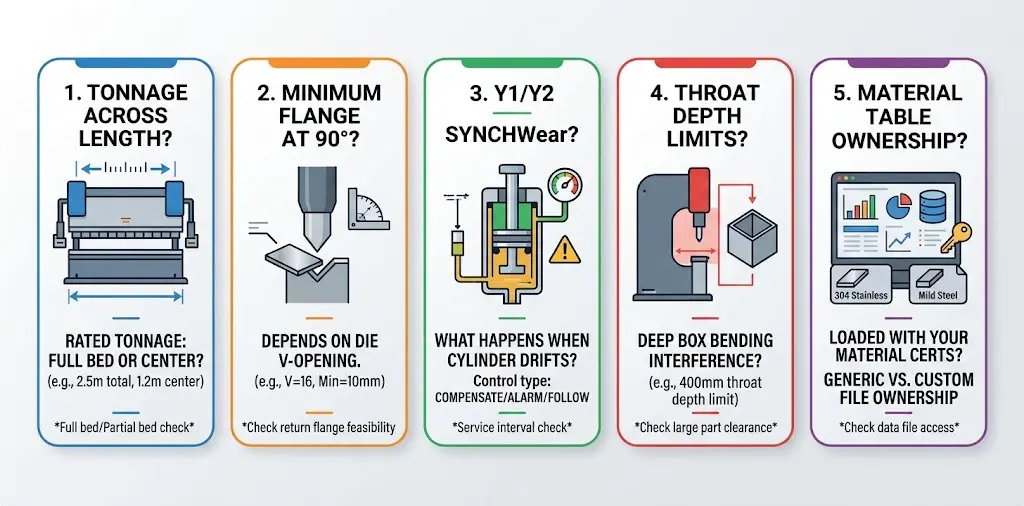
The useful conversation is about limits, because limits are where engineering lives and where a quotation is either honest or vague.
At what length is the rated tonnage available? A nominal tonnage without a length is half a specification. Ask whether the figure applies across the full bed or only a central portion, and at what V opening — the answer decides whether your 2.5 m part is bent whole or in two setups. To size from your own parts, start with the tonnage calculator.
What is the minimum flange this tooling can form at 90°? It depends on the die opening and shoulder geometry, and it decides whether a return flange on a box is possible at all. Get the figure for the die you are buying — and if your parts include deep boxes near the frame, read how to bend deep boxes without tooling interference before fixing the throat depth.
What happens to Y1/Y2 synchronisation as the machine wears? Ask what the control does when one cylinder drifts — compensate, alarm, or simply follow — and what the seal and valve service interval is. Every hydraulic machine wears; the question is whether the wear announces itself or hides inside the angle. Our maintenance and upgrades page describes that cycle.
How deep is the throat, and what does it stop me doing? The dimension most often ignored at quotation stage and most resented in year two.
Which material table ships with the controller — and will you load mine? A generic mild-steel table is not a bending strategy for 304 stainless. Ask whether the supplier will build one from your material certificates, and whether you own the file.
A supplier who answers these five in numbers has an engineering department. One who answers in adjectives has a brochure.
5. Read the Compliance Paperwork for the Country It Is Going To

The machine must be compliant where it is installed, not where it was built — which is why the factory’s compliance file and your inspector’s checklist are written against different documents.
Ask for the Declaration of Conformity itself, not a certificate image. Read which regulation it cites, which harmonised standards and versions, who signed it, and whether a notified body was involved — where one was, its four-digit number normally appears beside the CE mark.
Check the safety standard version. EN 12622 has been withdrawn and replaced by EN ISO 6909:2026, covering hydraulic, hydraulic-servo, screw-drive servo and belt-drive servo press brakes. A declaration citing only EN 12622 is answering a question that no longer exists.
Watch the regulatory handover date. Regulation (EU) 2023/1230 applies from 20 January 2027 and replaces Machinery Directive 2006/42/EC, which remains applicable until then (EUR-Lex, Machinery safety requirements). A machine ordered in 2026 and cleared in 2027 can sit exactly on this line — name the applicable instrument and the date of placing on the market in the contract.
Separate the electrical question from the CE question. Voltage, phase, frequency and earthing must match your building; for North America, panel listing by a recognised testing laboratory and OSHA workplace requirements are distinct items on top of CE.
Settle in writing:
- ☐ Which safety devices are included, assessed against which standard version.
- ☐ Front and rear safeguarding specified, not “as standard”.
- ☐ Electrical configuration matched to your supply; transformer in or out of scope.
- ☐ Who supplies the conformity documents, and who pays for local-compliance modifications.
Our safety arrangements page sets out the guarding options.
6. Compare Quotations on Landed Cost, Not Price
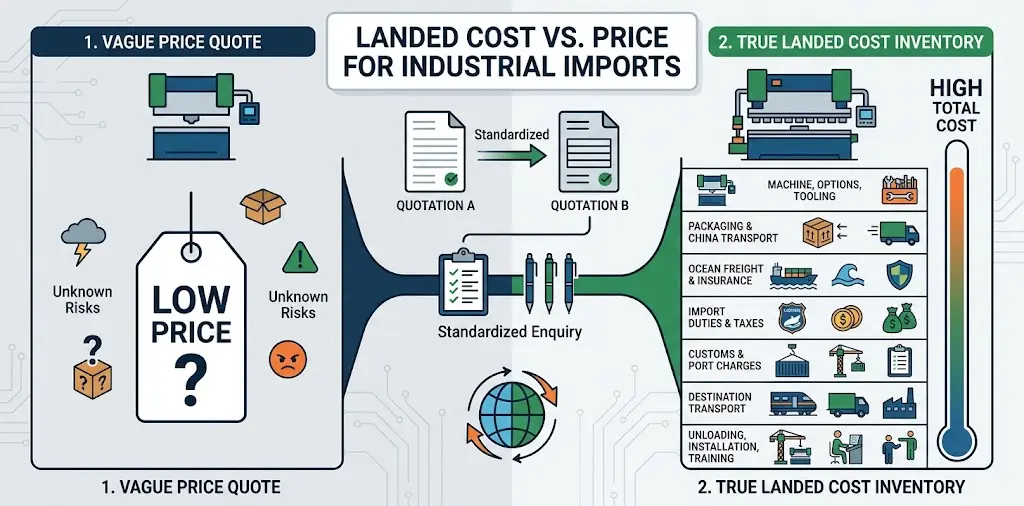
Three quotations do not compare themselves. Send every supplier the same standardized RFQ — the annex table in Step 2 is that RFQ — then rebuild each quote as a landed cost, because the machine price is only part of the investment:
- Machine price, options and tooling
- Export packaging, inland transport and documentation in China
- Ocean freight and marine insurance
- Import duties and taxes
- Customs clearance, port and destination charges
- Inland transport to your factory
- Unloading, installation, commissioning and operator training
Ask for pricing under a named Incoterm — that single word decides who owns the machine when it is sitting on a quay in a storm. The ICC’s Incoterms 2020 rules allocate cost, risk and obligations between the parties (ICC, Incoterms 2020), and four cover almost every press brake enquiry:
- EXW puts nearly everything on you, including loading — for a six-tonne machine, a crane in a country where you have no supplier relationship.
- FOB gets the machine loaded and cleared for export; your risk starts on board.
- CIF looks generous and is the most misread. The seller pays cost, insurance and freight to the destination port, but risk transfers on loading — and the default insurance is the minimum Institute Cargo Clauses (C) cover. That is not what you want protecting a machine tool with a precision-ground ram; if you ship CIF, agree higher cover in writing.
- DAP/DDP move risk to your door, but check who unloads, who pays demurrage, and whether duty and clearance are genuinely included.
Finally, define the clock. Lead time from purchase order, from deposit received, and from drawing approval are three different promises, often three weeks apart.
7. Confirm Packaging, Shipping and the Document Pack

Before the order, get five numbers — they set the freight quote, and everything else in a logistics conversation is an estimate dressed as a price: crated dimensions, gross weight, centre of gravity, lifting points, and how the ram is blocked for transport.
Then confirm the packing plan:
- ☐ Container choice with door clearance, internal width and loading height actually checked, not assumed from nominal length.
- ☐ Machine secured to a transport base; moisture, corrosion and impact protection specified for a sea passage.
- ☐ Electrical cabinets and machined surfaces separately protected; accessories and tooling listed separately.
- ☐ Packing photographs before container closing, serial plate in frame.
- ☐ Loading and destination ports, and who arranges freight and insurance, named.
The document pack travels with the machine; a missing item is a three-week delay while a PDF is emailed and printed. Request as applicable: commercial invoice, packing list, bill of lading, certificate of origin, export customs documents, operating manual in your language, electrical and hydraulic diagrams, inspection and test reports, warranty documentation, and conformity documents. Check the list with your customs broker before shipment.
8. Run an Acceptance Test You Can Measure
Put the test in the purchase order, name who measures, with what instrument, and what counts as a pass. Then run it on your own material, and take the record with you.
| Test | What you do | Instrument | What to write into the order |
|---|---|---|---|
| Angle spread | Bend 10 parts from your own sheet at three positions along the bend length | Digital angle gauge, same reference face | Maximum spread across length and batch, in degrees, on a named material and thickness |
| Repeatability | 20 consecutive cycles at one setting, no adjustment | Calliper or height gauge on the flange | Flange-length spread over 20 cycles, in millimetres |
| Backgauge | Program three positions, measure each five times | Calliper against a machined stop, or gauge blocks | Deviation from commanded position at each point |
| Crowning function | Bend a long part, measure at five points, adjust, re-measure | Angle gauge at five stations | That measured spread reduces when crowning is adjusted — tests the function, not its presence on a quotation |
| Hydraulic hold | Hold at working pressure, ram loaded, ten minutes | Machine pressure gauge, visual pass on fittings | Permitted pressure drop; zero visible weep |
| Safety stop | Interrupt the guard at top of stroke, mid-stroke, and 20 mm above the die, using the manufacturer's test rod | Machine's own stop-time record | Ram stops in all three positions, performance documented |
| Electrical | Witness insulation-resistance and earth-continuity testing | Factory instrument, record copied to you | Signed records bearing the serial number |
| Documentation | Open the crate list, check every document | — | Manual in your language, schematics, parameter backup, spare-parts list, FAT record, declaration of conformity |

Two definitions matter more than any single number. Accuracy and repeatability are different quantities, and ISO 230-2:2014 defines how both are tested on numerically controlled machine tool axes, using repeated measurements at each position (ISO 230-2:2014). A sheet that says “±0.01 mm” without naming the parameter, the stroke and the conditions is not a testable claim.
And do not approve a machine on an empty-running video: a ram cycling in air proves the hydraulics hold pressure, nothing about the angle your material will hold at the ends of the bed. Agree in advance how the test ends, too — the realistic outcome is a short punch list with a corrective deadline and a named person. Refusing to ship over a 0.2° spread and a missing manual costs you a vessel slot; signing a blank acceptance costs you the argument.
9. Put Payment and Contract Terms Behind Evidence
The common structure is a deposit with the balance before shipment — normal, and also the moment when the buyer has the least leverage. Turn the balance into a checkpoint: release it against the signed acceptance record from Step 8 bearing the serial number, packing photographs showing the serial plate and transport blocking, and a bill of lading copy. “Photos of a machine” is not evidence; “photos of my machine, identified by serial number, with the FAT record attached” is.
Three further protections are worth the conversation:
- Retention until commissioning is complete and the test is repeated on your floor — negotiated before the order, while you still have alternatives.
- A letter of credit for larger orders: it moves the trust problem from two strangers to two banks, at a cost that depends on order size.
- A written rule about bank details. Any change of beneficiary is a new verification task, confirmed through a channel you already had — never the reply-to address in the message requesting the change.
The contract carries all of the above:
| Contract section | Information to include |
|---|---|
| Machine identification | Model, serial number or identification method, quantity |
| Technical annex | The numbered annex from Step 2, attached and referenced |
| Quality acceptance | FAT procedure from Step 8, test material, measurable tolerances |
| Delivery | Lead time and its start event, shipping date, named Incoterm, insurance level |
| Payment | Deposit, balance triggers, retention, milestone evidence |
| Warranty | Duration, start date, coverage, exclusions listed explicitly, claim procedure |
| Documentation | The pack from Step 7, with languages |
| Remedies | Procedure for non-conforming equipment and unresolved punch-list items |
Never release the final payment against a promise that the machine is ready.
10. Ship the First Two Years of Spares in the Crate
The cheapest moment to buy a seal kit, filter set, proportional valve, backgauge servo motor and controller backup battery is when the machine is on a pallet, packed by people who know which part numbers belong to your serial number. Eighteen months later, the same parts carry freight, customs and a lead time measured in weeks.
Ask for the recommended first-order list with part numbers, and judge it on three criteria: it covers the parts that stop the machine, it includes consumables with a shelf life, and it does not include five years of rubber that will age in a drawer. Two items outrank any spare: the parameter and programme backup in a file you own — confirm before the order that parameters, PLC programme and tooling library can be exported — and written lead times for a control board and a servo drive, with part numbers quoted. “We can supply” is not a lead time. Our spare parts and consumables page lists what belongs in a first order.
11. Handover, Training and the First Ninety Days
The machine is delivered when your operator can set it up without calling anyone, and when a local technician can work on it from the documents. Before shipment, close out the installation side:
- ☐ Foundation and floor-load requirements checked against your shop floor.
- ☐ Workshop access and lifting plan confirmed against the five shipping numbers.
- ☐ Power supply, earthing and any transformer coordinated with your electrician.
- ☐ Commissioning scope assigned: who calibrates, who witnesses, how long.
- ☐ Safety functions to be tested at handover, listed.
Training deserves the same specificity. Agree who is trained, for how many days, on which parts, and whether before or after commissioning — sessions on the factory’s demonstration parts teach the controller; sessions on your own parts teach the job. Our operator training programmes run from remote sessions to multi-day on-site work. Note, too, that the warranty exclusions you signed in Step 9 — seals, filters, tooling wear, shipping damage — are exactly why the first spare order in Step 10 exists.
Then run the first ninety days deliberately. Infant mortality shows up as a hydraulic weep at a fitting, a backgauge that drifts after warm-up, an angle that moves once the oil reaches temperature. Log three measurements weekly for the first month — angle at three positions, flange length on a repeat part, oil temperature — so any claim comes with a baseline rather than an impression. Last, get the escalation path in writing: who to contact, the response window, what “we will send an engineer” means in days. A support promise is only worth the specificity of its clock. Our technical support page publishes ours; if a supplier will not, treat that as an answer.
The Checklist on One Page
| # | Step | Pass condition | Evidence you keep |
|---|---|---|---|
| 1 | Entity | Licence, USCC, signatory, invoice and beneficiary reconciled | Registration check, signed contract, bank details confirmed independently |
| 2 | Specification | Every substitutable line names a model, quantity and performance figure | Numbered purchase-order annex |
| 3 | Type and tooling | Technology, controller model, axes and tooling interface fixed | Annex lines 1–5 completed |
| 4 | Limits | Five limit questions answered in numbers | Written answers attached to the annex |
| 5 | Compliance | Declaration read, standard version confirmed, electrical matched | Declaration, standard reference, panel listing if applicable |
| 6 | Delivery terms | Incoterm named, insurance level agreed, clock defined | Contract clause, insurance certificate |
| 7 | Shipping | Five freight numbers received; packing plan confirmed | Packing list, pre-loading photographs |
| 8 | Acceptance | All eight tests run on your material; punch list signed | FAT record with measurements |
| 9 | Payment | Balance released against evidence; retention or L/C in place | Signed FAT record, B/L copy, retention clause |
| 10 | Spares | First-order list with part numbers; backup file owned | Spare list, backup file, quoted lead times |
| 11 | Handover | Installation closed out, training on your parts, escalation named | Document pack, training record, service contact |
Why CAMT Answers This Checklist in Writing
We are a Chinese manufacturer, so every step applies to us too — including Step 1, including the part where you should not take a supplier’s word for his own capability. On the record: Nanjing Huameng Machinery Technology Co., Ltd., ISO 9001-certified with CE and SGS approval, frames stress-relief tempered at 550–650 °C and machined in a single set-up to ±0.01 mm/m; acceptance tests run on customer material at our factory or by video with the serial number in frame; remote diagnostics with an initial response inside two hours during 8:00–22:00 GMT+8, a twelve-month warranty on genuine replacement parts and a ninety-day workmanship guarantee on field repairs. What we will not do is quote a tolerance we cannot measure or leave an “or equivalent” standing in a quotation you have asked us to make specific.
Send CAMT your workpiece drawings, material specifications and production requirements to receive a configuration you can write an annex against.
Explore CAMT press brake solutions · Contact CAMT for a technical consultation