Getting a clean, consistent cut from a fiber laser cutting machine is not simply a matter of selecting the highest laser power or running at the fastest possible speed. If the cutting speed is too high, the machine may leave incomplete cuts or excessive burrs. Incorrect focus positioning can produce rough edges and inconsistent kerf widths, while unsuitable assist gas pressure can lead to dross, oxidation, and unnecessary operating costs. The compensation logic behind those offsets is set out in laser cutting kerf width.
The key to reliable laser cutting is understanding how four primary parameters—cutting speed, laser power, focus position, and assist gas—work together. This guide explains how to adjust these settings for different materials, identify common cutting defects, and establish stable processing conditions for your production requirements.

Laser parameters interconnect; external changes affect cutting quality
A recipe that worked Monday can fail Thursday with nobody having “changed the settings”: the cylinder changed, a window was cleaned, a new heat arrived.
| Parameter | What it changes | Who owns it | Re-check when |
|---|---|---|---|
| Speed | Heat per mm, striations, corners | Operator / program owner | New grade, gas, nozzle or corner rule |
| Power | Energy rate, piercing, thickness/speed window | Locked in the recipe | After optics service or a delivered-power check |
| Focus | Waist position, kerf width, top vs bottom edge | Technician (zero = calibration) | After any lens, window, nozzle or head service |
| Gas (type, purity, pressure, nozzle, standoff) | Melt ejection, edge chemistry, cost per metre | Operator per shift | Each shift, cylinder change, purity certificate |
| Material and surface | Absorption, reaction, slag viscosity, flatness | Purchasing / goods-in | Every heat, coating or storage change |

The FABRICATOR’s interview with Charles Caristan of Air Liquide notes that on modern machines beam power and profile are fixed by the machine, focus is stored in the program table, and what the operator actually adjusts is gas pressure, focus and speed. Gas flow dynamics also shift with ambient temperature and humidity, so a cold-morning nozzle setting behaves differently on a hot afternoon. Raising speed may require more power and a new gas can force a new focus, nozzle and pressure — consequences of the chain, not separate adjustments.
Diagnose the edge before you touch a dial
The cut fails at the ejection end: melt did not leave the kerf at the right time or with the right chemistry. Work backwards from the edge and stop as soon as the symptom clears.
| Symptom | Check in this order | Why not power first |
|---|---|---|
| Spiky bottom dross | Nozzle/centering → standoff → pressure at head → focus height → speed | More melt for the same jet |
| Beady bottom dross | Focus too low → pressure too high → speed | Adds melt to an overflushed wall |
| Lost penetration on a good program | Delivered power, window, alignment → thickness/batch → speed → focus | Hides degradation |
| Oxidised stainless edge | Gas type, purity, plumbing, purge → speed | Chemistry is set by gas |
| Rough striations / wide kerf | Focus zero → speed → corner rules → power curve | Gas settings fit the old kerf |
| One side looks different | Nozzle centering → height sensing → flatness → slats | Geometry fault |
| Rounded or burnt corners | Corner power rule → deceleration → lead-in | Feed never reaches programmed value |
| Good first part, bad third shift | Cylinder change, ambient, spatter, focus drift, unlogged edits | Source did not change |
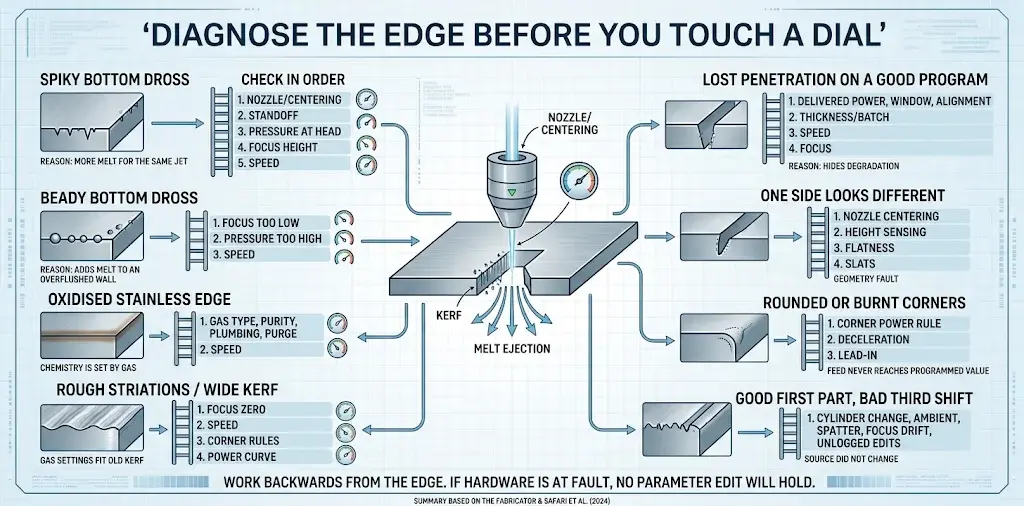
In a 2015 FABRICATOR article on assist gas troubleshooting, Mazak’s Mark Mercurio calls slowing the feed “the solution of last resort”, names focal position as the No. 1 reason materials cut differently and the first thing overlooked, and recommends tracing gas from plant delivery through plumbing into the nozzle. Caristan describes the trap: an operator sees a burr on stainless, slows down, adjusts gas to suit, and gets a larger burr — excess heat causes vaporisation that disturbs gas flow and leaves metal to re-solidify, so a slight speed increase restores ejection. He links focus too high with spikes, too low with beads. A controlled experiment agrees in direction: Safari et al. (Materials, 2024) found focal position and speed, not power, most significant for roughness and kerf width on 8 mm Hardox 400 at 4 kW — one material, one thickness, one machine, assist gas unreported, so not a universal ranking.
machine state → focus zero → speed → power. If the fault is in the hardware, no parameter edit will hold.
Speed, power and focus: one dial at a time
Speed
The usable definition: the highest speed that consistently produces the required cut quality without compromising penetration or dimensional accuracy — against the criterion written down before the trial. Over-fast signs are diagonal drag lines and incomplete penetration; over-slow signs are a wider kerf, burnt edges, rounded corners and more energy per part. Bottom dross belongs to neither list alone: it is an ejection failure (Section 3), and slowing down to cure it is a documented way to make it worse.
Change one variable at a time with a coupon per step, and state the objective — parts per hour, dross-free edge, minimum gas, or weld-ready edge — because those four have different optima. Record the program version: a corner-rule edit changes effective speed even when the feed field looks untouched. Acceleration and corner deceleration decide the speed actually achieved on thin sheet, so recipes need separate corner and small-hole rules.

Power
Power is set at purchase and locked in a program; raising the commanded value is a process change, not a diagnostic step. Check delivered power, protective window and beam alignment first — “commanded” and “delivered” are different fields. Select for the mix you run: thin sheet rewards speed control and precise motion, thick plate demands power balanced with gas pressure and piercing, mixed production should be sized for the job distribution rather than one maximum-thickness order. Our fiber laser cutting machine range is a starting point for that comparison.
When the head decelerates into a corner, straight-line power dumps heat into a small area; use the controller’s corner power or dynamic power functions so energy follows actual feed. Higher power, higher gas pressure and reflective materials such as copper or aluminium change the safety case, including back-reflection protection: confirm the configuration in writing with the machine supplier — we do not assert compliance for any site.
Focus
Under a common convention, zero puts the focal point at the surface, negative below it inside the workpiece, positive above it. Some controls invert the sign, so confirm the convention in your machine documentation before recording “+1”; an offset without the controller and software version is meaningless.
Moving the waist changes kerf width and therefore gas flow through it, reopening the gas and speed decisions (Mercurio, above). Three details break reproducibility: zero point — re-establish it per the manual after any lens, window or head service, since auto-focus height control compensates for an uneven sheet but does not repair a lost zero; drift — thermal state, nozzle spatter, a changed nozzle, slag lifting the sheet, an unlogged nudge, none of which appear in the program file; pre-check — inspect the protective window, lens, nozzle alignment and capacitive height control first, because contamination mimics a focus error. Keep calibration date, optic, sign convention and offset as four separate fields; an offset alone does not answer “where is your focus”.
Assist gas: type, purity, pressure at the head
| Gas | Energy contribution | Edge and downstream | Wrong assumption |
|---|---|---|---|
| Oxygen (reactive) | Exothermic reaction adds heat → lower pressure | Oxidised edge; cleaning before paint/weld | "Same pressure as nitrogen" |
| Nitrogen (inert) | None; beam supplies all energy, high pressure ejects | Bright oxide-free edge; real hourly cost | "More pressure is always cleaner" |
| Compressed air | Contains oxygen → reactive side; depends on air supply | Varies with drying/filtration; cheap per hour, costly downstream | "Just cheaper nitrogen" |
These are directions, not settings; the pressure difference follows from the exothermic reaction (TWI, Caristan). Excess pressure raises flow, destabilises the jet and can push stainless towards beady dross or arcing.
Oxygen suits thicker carbon steel where an oxidised edge still meets the specification. Nitrogen suits stainless, aluminium and visible parts, where purity and flow stability matter as much as pressure. Compressed air works on thin sheet only with a compressor, dryer and filtration delivering the required pressure, flow and air quality, and will not meet an oxide-free specification. Gas selection, purity and pressure are developed further in laser cutting assist gas.
Four shift checks, not recipe fields: current purity certificate; pressure at the cutting head, not at the cylinder regulator; nozzle orifice, centering and standoff; and whether plumbing was purged after idle time, since air can penetrate idle lines and contaminate the supply on restart (Caristan). Nozzles, protective windows and ceramic rings are the consumables whose condition decides whether a recipe still applies.
29 CFR 1910.101 requires visual inspection to determine that compressed-gas cylinders are in a safe condition and in-plant handling, storage and use to follow CGA Pamphlet P-1. This is a US federal general-industry rule, not a compliance certificate for your installation: machine supplier, gas supplier and local authority confirm the site-specific arrangement in writing, along with laser radiation, fumes and interlocks (ask about ISO 11553-1).Material-specific failure modes
| Material | What differs | First field to check |
|---|---|---|
| Carbon steel | Oxidation supports thick plate; mill scale changes absorption | Oxygen purity and pressure at head, then speed/power and nozzle |
| Stainless | Bright edge depends on gas integrity, not watts | Nitrogen purity and flow, nozzle, focus, height sensing, window |
| Aluminium | High conductivity and reflectivity; alloy matters more than thickness | Written supplier approval for source/head/configuration, including back-reflection protection |
| Brass and copper | Reflective; a carbon steel chart cannot be carried across | Same approval plus a coupon on the actual alloy |
If a stainless edge is oxidised, check gas purity before assuming the power is low. Grade, heat, coating and flatness belong in the record and are owned by goods-in. Three millimetres of stainless and three millimetres of carbon steel are different energy problems on the same source.
From one good cut to a reproducible parameter library
A factory library is a starting asset; after six months the valuable one is the shop’s own. Most keep it in an operator’s memory and a few scrap coupons, so a remote call starts by reconstructing what changed. Twelve fields fit on one page per material/thickness/gas combination.
| # | Field | Pins down |
|---|---|---|
| 1 | Machine serial, controller, software version | Program behaviour |
| 2 | Grade, heat/batch, mill certificate | Batch variation |
| 3 | Measured thickness and surface | Real plate |
| 4 | Gas type, purity, pressure at head, supply mode | Energy and ejection |
| 5 | Nozzle type, orifice, condition, centering, standoff, height mode | Gas jet geometry |
| 6 | Window/lens ID, last clean or replacement | Delivered energy |
| 7 | Focus zero date, sign convention, commanded offset | Waist position |
| 8 | Pierce: stages, power/frequency/duty, dwell, gas | Start of cut |
| 9 | Cut: power curve, speed, corner/small-hole rules, lead-in, tabs | Contour behaviour |
| 10 | Acceptance: dross, roughness/squareness, downstream process | What "good" means |
| 11 | Coupon ID, location, top/bottom photos | Evidence that survives turnover |
| 12 | Change log: date, operator, one variable, before/after coupon, reason, sign-off | Which edit caused what |
Change one variable at a time, keep both coupons, and never overwrite a working recipe — give the new version an ID and write down why. If all twelve fields are unchanged and the edge moved, the fault is in machine state.
The record is also the cheapest costing tool: gas cost per metre, deburring hours, scrap and rework rate, machine utilisation. A cheaper gas that adds a grinding pass is not cheaper; a higher feed that doubles rework is not faster. Ask for these four at a trial cut.
Machines
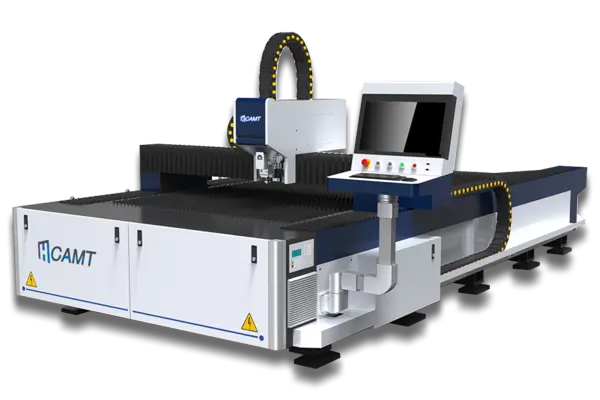
At CAMT (Nanjing Huameng Machinery Technology Co., Ltd.) three platforms bear on this discussion: the open-type ULF single-table machine listed at 1–6 kW, the enclosed ULE with twin exchange tables at 6–12 kW with a Raytools auto-focus head and CypCut control, and the ULT plate-and-tube platform at 1–6 kW. Those are configuration descriptions, not process guarantees: the family overview and model sheets do not state the same power range for every model, so read the model sheet with its revision date.
Handover and support
Operator and maintenance training covers speed, power curves, focus, gas type and pressure, nozzle centering and focus calibration. Software and control support is where program versions and recipe backups belong. Remote diagnostics and technical support reconstructs a fault from serial, error logs and parameter history. Planned calibration and guarding responsibilities belong in the same written handover.
We will not claim a machine removes the need for trial cuts, or that a factory recipe survives a new gas supplier or material batch. What we can put in writing is which recipes ship, what the trial coupon must demonstrate, and who re-calibrates focus zero after head service. Send your grade, thickness band, gas and current 12-field record to our team and we will structure the trial around the edge criterion your downstream process needs.
FAQ
Is a higher-power laser the fix when a cut suddenly gets worse?
Almost never — power is a boundary set at purchase. A sudden change points to delivered power, a contaminated window, a gas change or a new heat.
If I can only keep one record, which three fields matter?
Material grade and heat, focus zero with sign convention and calibration date, and the retained coupon with both edge photos. Those three let someone rebuild the trial instead of trusting a number.
Do I need to re-qualify a recipe after changing gas supplier?
Yes. Purity, pressure at the head and the plumbing after a tank change all move the energy balance; run one coupon and log it.
Is compressed air really cheaper than nitrogen?
The purchase price is, but add the compressor, dryer and filtration, then the deburring or rework if the oxidised edge fails your downstream requirement.
What is the fastest way to make a bad edge worse?
Change several settings at once, or reach for power and feed first. Neither gives a repeatable result or a usable support record.