Material waste in a laser cutting shop is rarely one number. Most of the money leaves through parts that were cut, rejected, and paid for twice: once as sheet, once as machine hours that cannot be recovered. Before changing a nest or replacing a machine, write a material balance for one sheet, give every loss a bucket and an owner, then fix the largest bucket your own measurements say you can move.
- Weigh five separate buckets per sheet: kerf and lead-ins, webs and skeleton, edge trim and clamp keep-out, remnants, and rejected parts.
- Treat a rejected part as a double loss: material plus every laser-on minute already spent on it.
- Treat nesting utilization as one bucket, not the whole report; a nest that maximizes area can quietly create work-in-process that nobody ordered.
Where Does the Sheet Actually Go?
For any sheet you load, the incoming area has to go somewhere:
A_in = A_parts + A_kerf + A_web + A_trim + A_remnant + A_reject
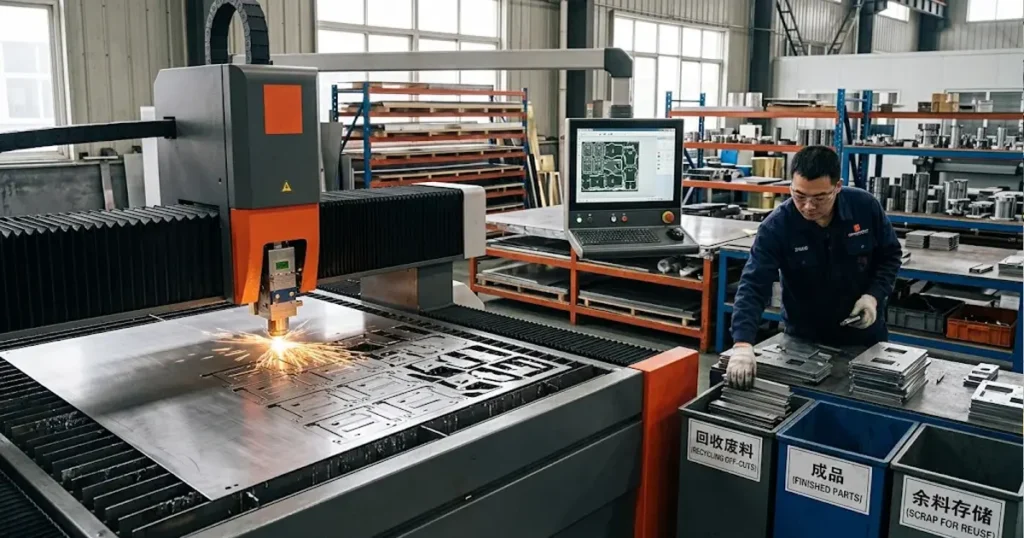
A_parts is the net area of accepted parts. The other five are the waste buckets, and each has a different owner. Kerf is the width of material the beam removes; a web is the strip of skeleton left between parts; microtabs are the tiny uncut bridges holding parts in that skeleton until the nest finishes. A utilization report normally counts the first three terms and quietly files remnants as inventory and rejects as a quality problem. That is why a shop can post a respectable utilization figure and still buy more sheet every quarter without shipping more parts. For the full vocabulary, see our laser cutting terms glossary.
Measure, do not estimate. Take cut length and kerf from your own nest report and coupon, weigh the skeleton and sorted remnants after denesting, mark no-cut zones on the nest drawing, and count rejects by part number. The six terms must add up to the sheet that went in; if they do not, a bucket is mislabeled.
| Bucket | Measure it on one sheet | Owned by | Lever | Machine purchase fixes it |
|---|---|---|---|---|
| Kerf and lead-ins | Cut length × kerf from your own coupon | Process engineer / CAM | Compensation, lead-in placement, shared edges | Only marginally |
| Webs, skeleton, microtabs | Weigh the skeleton after denesting | Nesting programmer | Spacing, common-line groups, tabs | No |
| Edge trim and clamp keep-out | Mark no-cut zones on the nest drawing | Programmer / fixture owner | Sheet format, clamping, locating | Sometimes, via envelope and clamping |
| Remnants, reusable or stranded | Weigh and tag each returned piece | Stores / planner | Remnant rules, retrieval at the next nest | Only with handling automation |
| Rejected parts | Count by part number × net area, plus laser-on minutes spent | Quality / machine state / incoming material | First-off inspection, parameter control, batch consistency | Sometimes, via machine condition |
The last column is the point. A shop whose largest bucket is stranded remnants has an identification problem, not a cutting problem; one dominated by rejects may have a parameter, consumable or incoming-batch problem. Neither is fixed by a faster laser.
Utilization is a derived figure, not the target: A_parts / A_in. Define it before reporting it — internal holes belong in A_kerf, and a reusable remnant in A_remnant, not in permanent loss. Three indicators come from the same weighing: scrap rate (discarded ÷ input), first-pass yield (parts accepted without rework ÷ parts cut), and remnant reuse rate (remnants consumed later ÷ remnants returned). Compare only jobs with the same grade, thickness, format and part family.
What Creates Each Bucket Before the Cut Starts?
Most losses are decided upstream of the laser, by people who never touch the nest.
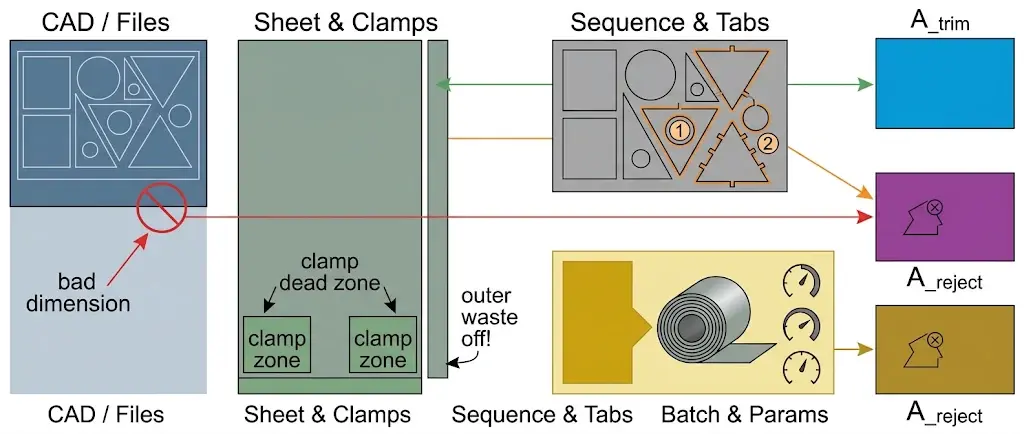
- Drawings and cutting files. Duplicate contours make the beam cut the same line twice, open contours leave parts attached, and construction geometry sent to the machine becomes an unintended cut. Check dimensions, close contours, remove non-cut geometry, and confirm kerf compensation is applied in exactly one layer — CAD, CAM post or controller. Each fault lands in A_reject.
- Sheet format and clamping. A format bought for price rather than fit leaves long unusable strips in A_trim. Locating, clamping and downdraft zones are no-cut area. Nominal working area and nestable area are different measurements; keep them separate.
- Cutting sequence. Cut internal contours before the outside profile, spread heat rather than stacking cuts in one corner, protect the skeleton, and release the outer contour last. Tight webs and undersized tabs let small parts tip or shift, turning a sound layout into A_reject. Set tab size and spacing from your own test cuts.
- Parameters and incoming batches. Log grade, heat, thickness and surface state per batch, so a bad coil is not diagnosed as a bad machine. Parameter setting is its own discipline; here it matters only as a cause of A_reject.
Nesting Is a Trade-Off, Not a Score to Maximize
Nesting means arranging parts on one sheet so more of it leaves as accepted parts. True-shape nesting fits parts by their actual outlines — rotating irregular shapes, filling gaps with small parts — instead of a rectangular grid. A 2025 article by Adam Ball, commercial director at Lantek, in Sheet Metal Industries, sets out four approaches and warns that a strategy aimed only at minimizing scrap can overproduce parts, fill the stores, or disrupt the production sequence.
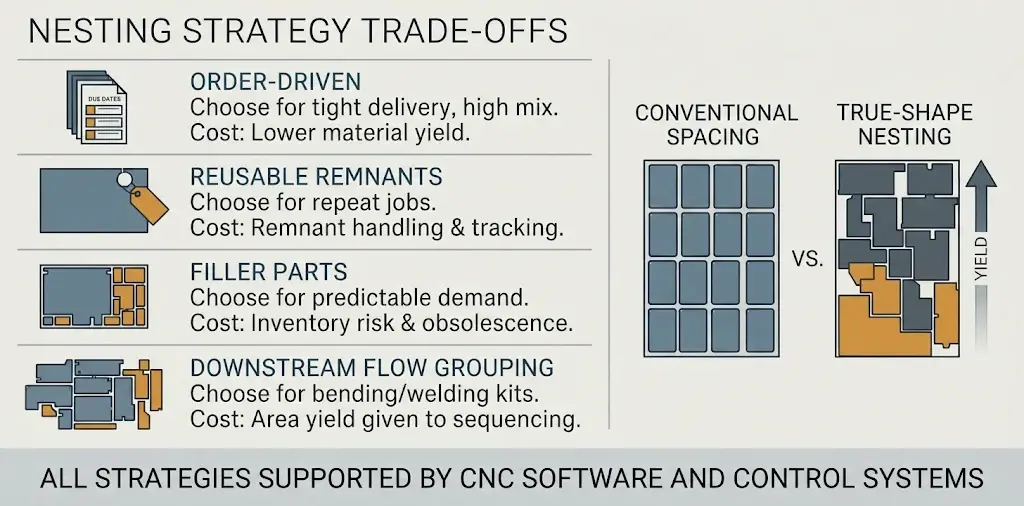
| Strategy | Choose it when | What it costs | Record needed |
|---|---|---|---|
| Order-driven | Tight delivery windows, high part mix | Lower use on individual sheets | Released orders and due dates |
| Reusable remnants | Repeat jobs, stable grades, disciplined stores | Tagging, handling, retrieval | Remnant register with location |
| Filler parts | Standard parts with predictable demand | Work-in-process and obsolescence risk | Demand forecast and part ownership |
| Downstream flow grouping | Kits arriving at bending or welding together | Some area yield given to sequencing | Kit routing per part |
Choose the strategy against the order book, not the optimizer. Where precision parts need independent edge conditions, or a geometry has insufficient support for a shared edge, conventional spacing is the better nest. Whatever the strategy, the nest is a program artifact that must survive shift changes: keep the program, its revision, its parameter library and its backup under one owner. That is the role of CNC software and control system support, covering offline programming, controller version updates and office-to-machine data flow.
Common-Line Cutting: What You Gain and What You Give Up
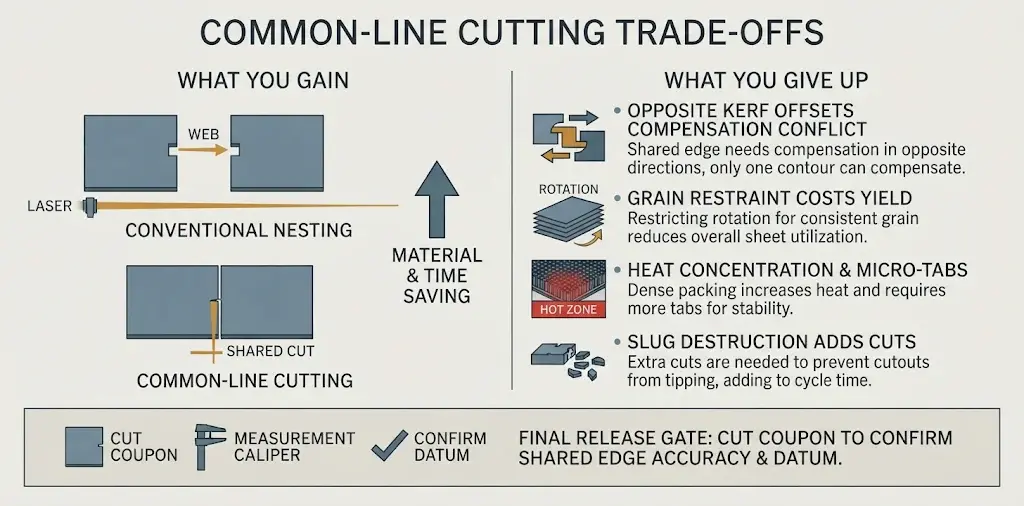
Common-line cutting uses one cut to form the edge of two adjacent parts, removing a web and shortening the cut path. Mark Schuessler, a software engineer at Hypertherm, described the main variants in a 2019 The FABRICATOR article on smart nesting: pair and quad groups, plate-edge alignment, and arrays for repeated rectangular parts. He also covers grain restraint, which restricts rotation so visible grain runs consistently, and slug destruction, which slices interior cutouts so they cannot tip into the cutting head.
Each variant attaches a condition. A shared edge is only free when both parts tolerate the same contour and edge condition. On that edge the two sides need kerf offsets in opposite directions, and only one layer may compensate — so give up the shared line, accept the stated offset on the drawing and inspection datum, or pre-offset in CAD and disable compensation on that contour. Grain restraint costs rotations, and so area yield on cosmetic panels; dense arrays concentrate heat and still need microtab support. Slug destruction adds cuts: it buys predictability, not free material.
Treat this as a release gate: cut a first-off coupon from the same parent sheet that includes the shared edge, measure both parts, and confirm the datum. If either fails, the saved web was never a saving.
Rejects Cost More Than the Sheet They Came From
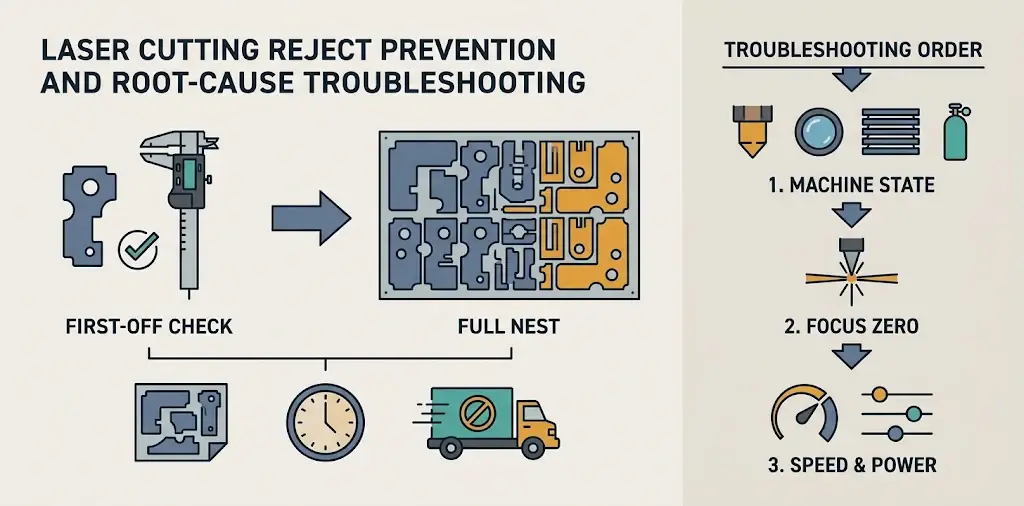
A rejected part carries the material, the piercing and contour time already spent, the downstream handling, and the delivery slot it was meant to fill. Rejected at the end of a full nest, it costs more than at first-off, because the rest of the sheet has consumed its machine hours. A 2026 Sheet Metal Industries overview of fabrication waste, published for Baker Steel Trading, lists offcuts, rework and tied-up inventory as distinct waste forms and recommends first-article inspection and maintenance logs. It is supplier-contributed, not a standard, so use the categories rather than any savings figure.
Move the first-off check before the full nest and check overall dimensions, hole and slot positions, edge condition, cut completeness and surface state. Then agree the acceptance rule in writing: which dimension, edge condition and inspection datum count. For a drifting first-off result, keep the reverse-chain order — machine state (nozzle, protective lens, height following, gas supply), then focus zero, then speed, then power. A scrap spike is an attribution problem first.
Several reject buckets appear after the nest is approved. A worn nozzle or contaminated protective lens changes the cut before anyone edits a program; slag on the slats can hold a sheet so a part tips or the skeleton moves; poor height following on an uneven sheet does the same. Inspect nozzle and lens, check centering and height following, clear the slats, and confirm beam and focus calibration before touching speed or power. Record consumable identity and laser-on hours with the reject count, so a repeat failure is tied to a maintenance interval. Genuine spare parts and consumables covers nozzle, ceramic ring and protective lens supply; maintenance and upgrades covers beam alignment, calibration and planned inspection. Operator training covers parameter setup, first-off routines and nesting practice; technical support covers remote log review, program revision and backup, and recalibration. Neither replaces a written acceptance rule; both make it repeatable across shifts. We do not assert compliance for your site: guarding, fume, high-pressure gas lines and reflective-material suitability must be confirmed in writing by the equipment supplier and your own safety officer.
Make Remnants Reusable, Not Just Smaller
A remnant is only an asset if the next nest can find it, trust it and place parts on it. Prefer a rectangular remnant over a larger irregular one: it can be measured, stacked and nested without a traced outline. Tim Heston reported in a 2021 The FABRICATOR article on remnant automation how some systems cut a skeleton-destruct sequence so a square piece returns to storage with its size and location updated; lower-volume areas use bar-coded racks and nests prepared in advance. These are specific installations, not industry defaults.
The difficulty with irregular pieces is structural, not clerical. Li Li, Zhaoyun Wu, Zhongwei Zhang and Yulan Zhang, in Coatings 13(5), article 914 (2023), split remainder reuse into two problems: arranging remainders without overlap, then finding a cutting path across the parts inside them (open-access study). Their results are simulation instances under that study’s conditions, so borrow the decomposition, not the reported gains. A shop keeping only rectangular remnants avoids the first problem.
| Register field | Why the next nest needs it | Filled by |
|---|---|---|
| Grade and heat / batch | Certification and traceability | Receiving |
| Thickness | Which parameter library applies | Receiving |
| Usable rectangle | Geometry a nest can place against | Operator |
| Flatness and surface state | Whether height following is reliable | Operator |
| Unique identifier | Links piece to stock record | Operator |
| Storage location | Retrieval before a full sheet is called | Stores |
| Parent order | Coating, grain or certification constraints | Planner |
| Date and status | Separates reusable from stranded stock | Stores, weekly |
Set a minimum reusable size from your own clamping configuration, not a published figure: a piece that cannot be held safely is scrap. If you automate nothing else, automate the rule that no piece enters the rack without its identifier and usable rectangle. Everything else can start as a clipboard.
Tube Cutting Has a Different Waste Ledger
For tube and profile work, waste is measured in length, not area. Unusable ends, chuck grip length, bevel lead-ins and first-off trial pieces consume stock before a single accepted part exists. A short end that cannot be gripped is a fixed loss that grows with changeovers, not with part count. Track offcut length per job, group jobs by grade and section, and set a written minimum grip length for the configurations you run. The ULT pipe and tube laser cutting machine is the platform for that work, including bevel cuts and optional automatic loading. How that length loss translates into hourly output is covered in laser cutting productivity.
When a Machine or Service Change Actually Pays
Take the five-bucket table to the purchasing discussion and ask three questions. Which bucket is largest after a week of measurement? Have design, incoming material and program ownership been ruled out? And what physical quantity would new equipment change: work envelope, clamping, positioning repeatability, exchange-table behaviour, or rated material range? If that quantity does not act on the largest bucket, the purchase will not move the number.
Two buckets are equipment-sensitive: rejects traced to machine condition respond to calibration and sound consumables; edge trim responds to a work envelope and clamping that suit the formats you buy. The other three belong to the nest, the order book and the remnant register. If the loss is in waiting for drawings, an undefined acceptance rule, or untagged offcuts, no purchase fixes it.
| Configuration | Suits | Physical quantity to check against your largest bucket |
|---|---|---|
| Open-type single-desktop | Mixed custom orders, small to medium workshops, remnant sheets | Access for short sheets; clamping and locating zones |
| Enclosed exchange-table | Repeat batches, multi-shift sheet production | Work envelope; exchange-table behaviour under your formats |
| Dedicated pipe and tube | Round, square and rectangular profiles | Grip length and unusable end per changeover |
An ULF open-type single-desktop machine gives a small shop access for mixed work and remnant sheets; a ULE enclosed exchange-table machine suits continuous batch production; the fiber laser cutting machine range shows available configurations. Bring material type, sheet format, part geometry, output volume and workshop layout to the specification discussion, measured against your largest bucket. We will not claim a utilization percentage, scrap rate or achievable edge class for any model — those are measured on your material and the configuration you order. The family overview is not a specification table; the model sheet for the configuration ordered, with its revision date, governs.
A One-Week Audit Before You Spend Anything
Run this on one machine, one grade and one thickness:
- Days 1–2 — close the balance. Weigh the incoming sheet, accepted parts, skeleton, returned remnants and rejects. If the six terms do not add up, find the mislabeled bucket.
- Day 3 — move inspection earlier. Release a first-off coupon before the full nest and write down the acceptance rule.
- Day 4 — give remnants an identity. Tag every piece with the eight fields and quarantine anything unidentifiable.
- Day 5 — run one change card. Baseline, held-constant conditions, a single lever, a comparable window, a fixed acceptance rule, a named reviewer and a rollback trigger.
- End of week — report three indicators. Scrap rate, first-pass yield and remnant reuse rate, compared only with similar jobs.
The output is not a percentage. It is a ranked list of buckets with owners, plus one demonstrated change, telling you whether to edit the nest, fix the register, train the shift, service the machine or start a specification conversation. If you want a sample first-off coupon, a parameter-library field list or a remnant register template, contact our engineering team. Throughput losses are a separate topic; the material balance here excludes them.