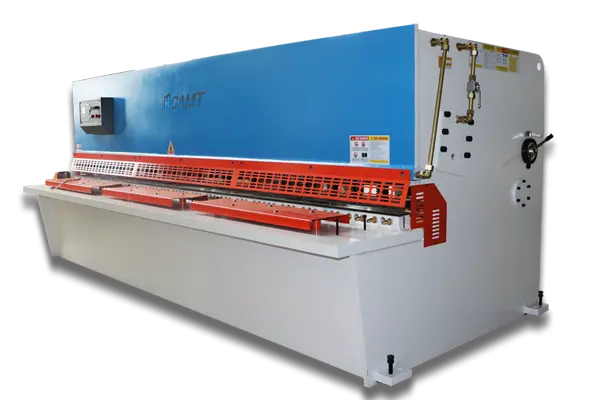
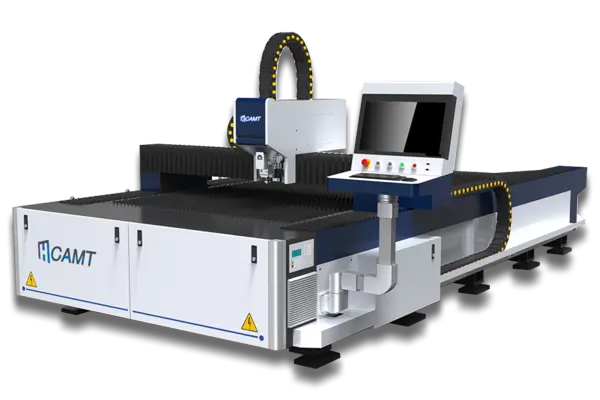
Increasing fiber laser cutting machine productivity is not simply a matter of increasing laser power or cutting speed. For metal fabrication businesses, real productivity depends on how efficiently the entire cutting process operates—from material loading and CNC programming to cutting, unloading, inspection, and machine maintenance.
To increase fiber laser cutting productivity, manufacturers should optimize cutting parameters, reduce non-cutting time, improve material utilization, maintain critical components, and select automation features that match their production volume.
Define the Measurement Before You Change Anything
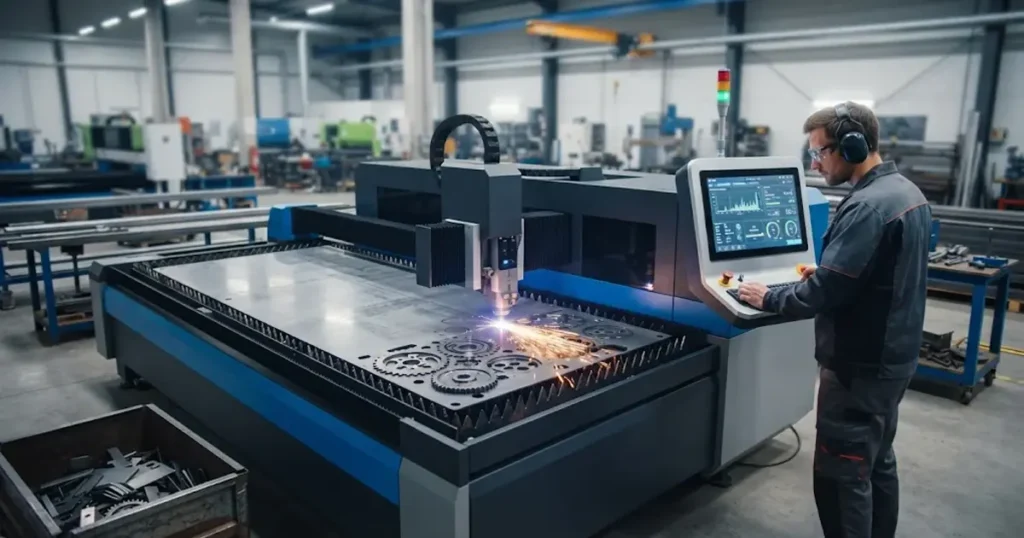
Overall equipment effectiveness is a useful starting point because it combines three things that otherwise get argued about separately: availability, performance and quality. Availability is the share of planned production time in which the machine is running; performance compares actual output with an ideal cycle time; quality is the share of parts accepted.
It only works if the inputs are pinned down first. Agree what counts as planned production time, which cycle time is the ideal one, and at what point a part is accepted — at the laser, after deburring, or after inspection. Do not let the definition move between the baseline week and the trial week.
Four records cover most of the diagnosis: beam-on minutes against paid shift minutes per sheet, accepted parts per beam-on hour, elapsed minutes between the end of one nest and the start of the next, and unplanned downtime by category. Reviewing these weekly is more useful than a daily total of parts cut, which moves with the order mix.
Find the Loss Before You Change Anything
Use one row of the table below. It forces a measurement before an adjustment and names the person who owns the fix, so a scheduling problem does not get answered with a new nozzle.
| Symptom | Measure this first | Where the loss sits | Who changes it | Field to record |
|---|---|---|---|---|
| Green light all shift, shipped parts flat | Beam-on vs shift minutes, per nest | Machine side and scheduling | Production planner | Load / cut start / unload timestamps |
| Output rises after a nozzle change, then fades | Accepted parts per beam-on hour, by shift | Machine state and consumables | Maintenance and operator | Consumable ID and laser-on hours |
| Same program, new sheet batch, worse yield | First-pass yield grouped by heat or lot | Incoming material | Purchasing and process engineer | Grade, lot, surface, flatness |
| Parts pile up at deburring or inspection | Age of the queue downstream of the laser | Post-cut flow | Process engineering and planning | Nest completion to first downstream step |
| Every job waits on a drawing or a nest | Elapsed time from order release to first cut | Front office and programming | Engineering and scheduling | Quote / drawing / nest / program times |
| Daily report looks healthy, customers still wait | Accepted parts vs parts cut, by order | Measurement definition | Quality and production | Written accept/reject rule and who applied it |
In a 2024 article on predictable throughput, Tim Heston of The FABRICATOR described the industry moving away from local efficiency — inches or strokes per minute — toward global efficiency, meaning how long jobs take to flow through the whole operation, and described a shop where lasers with excellent equipment effectiveness flooded the denesting station with parts. A machine can be locally excellent and globally irrelevant. Once one row matches your floor, hand it to the owner named there; if the loss is in how the machine is configured for loading or part removal, the fiber laser cutting machine range shows which configurations exist.
Cut non-cutting time by overlapping tasks and tracking downtime
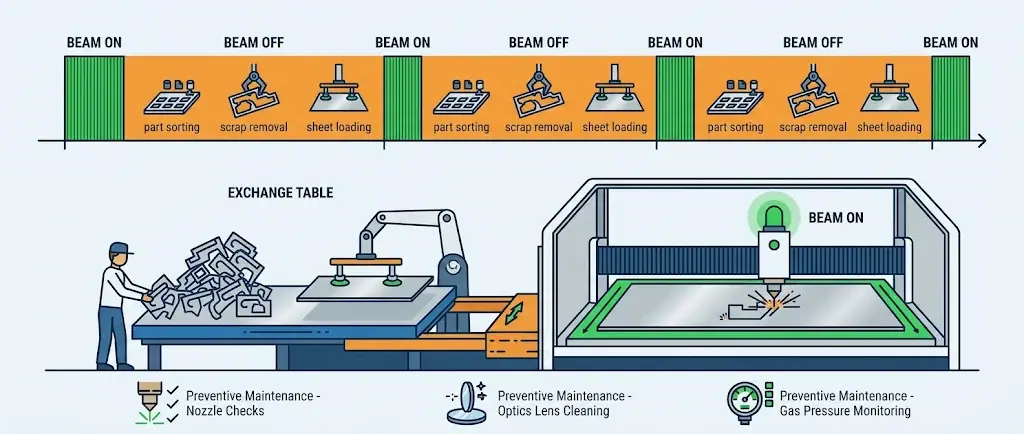
Non-cutting time is the interval between the end of one nest and the start of the next: unloading the skeleton, breaking out and sorting parts, loading a new sheet, fetching material, calling a program. Measure that interval per sheet. Faster cutting does not shrink it; in an SME report from 2019, Bruce Morey recorded Dustin Diehl of Amada America and Jeff Hahn of MC Machinery Systems noting that faster lasers shift the bottleneck downstream and that shops without automation do not get the throughput. These are 2019 interviewee judgements, not a specification for any current machine.
Overlap what can be overlapped, then simplify what cannot. An exchange-table configuration lets one table be unloaded and reloaded while the other is cutting; CAMT’s enclosed exchange-table laser cutter is built around that arrangement. Note: it does not eliminate every interruption — the gain depends on loading equipment, operator availability and job complexity. Whether the enclosure suits your guarding and floor layout is covered in our open-type versus fully enclosed comparison. Sorting is harder, because automation adds nesting constraints: small parts may need mini-nests that cannot fill gaps across the sheet. Automatic Loading and Unloading for Fiber Laser Cutting Machines: Is It Worth It?, not yet published, goes deeper.
Stopped cutting and slow cutting belong in different columns: the first removes U, the second lowers R. Build a downtime log by category — planned maintenance, consumables, faults, waiting on material, waiting on engineering — with the laser-on hour reading beside each event. A 2023 Sheet Metal Industries article supplied by automation vendor Baumalog makes the availability point directly: one operator handling both unloading and loading consumes the machine’s available time too. Treat it as a mechanism, not a result to expect.
Check the components that turn a small fault into a lost shift: nozzle condition and centering, the protective window and ceramic ring, assist gas pressure and purity measured at the machine, coolant level, flow and temperature, and the stock of consumables. Judge their condition against laser-on hours and symptoms on the cut face, not a calendar copied from a brochure; never clean optics with materials the cutting-head supplier has not specified, and do not compensate for an unstable gas supply by raising pressure beyond its specified range. Our maintenance and upgrades service covers beam and focus recalibration and machine-state checks, and spare parts and consumables covers the nozzle and protective-lens supply a shift-level routine depends on.
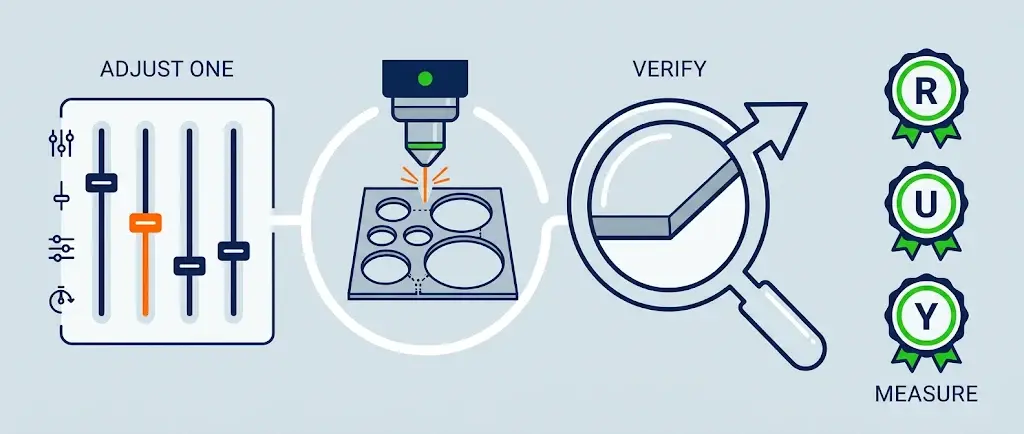
Measure first and adjust one laser parameter at a time to fix losses
Each row is one lever, bound to the ratio it repairs, the measurement that must come first, and the condition under which it should be left alone. Change one row at a time.
| Action | Repairs | Measure before | Leave it alone when |
|---|---|---|---|
| Speed, focus, nozzle and gas per material and thickness | R; can lower Y | Edge quality and first-pass yield on a trial nest | The acceptance rule is still moving |
| Piercing strategy: direct, multi-stage or controlled | R | Laser-on seconds spent piercing per sheet | Spatter is already contaminating the protective window |
| Cutting order: internal features before outer contour | R and Y | Re-cuts and part movement | Heat build-up between adjacent parts is the constraint |
| Common-line cutting | R and material yield | Total cut length per sheet | Parts distort, shift or jam at denesting |
| Micro-joints and tab strategy | U | Small-part collisions and head stoppages | Extra finishing time exceeds the time saved |
| Nozzle centering, protective window, ceramic ring | U and Y | Accepted parts per beam-on hour since the last change | The change cannot be logged against laser-on hours |
| Assist gas pressure, purity and chiller stability | Y and U | Dross, rework and temperature alarms | The supplier's specified range would be exceeded |
Start with the recommended parameters for the material and thickness, confirm them on a trial nest, inspect the upper and lower edges for dross and incomplete penetration, move speed in controlled increments, then re-run a longer lot before adopting the setting. Internal holes and small features normally precede the outer contour so the part stays stable; common-line cutting and micro-joints only pay off where thermal distortion, part movement and separation at denesting allow them. Piercing deserves a review on jobs with many small contours, where repeated pierces consume a large share of the cycle, but aggressive piercing spatters onto the protective window.
Group jobs by mix first, then match each to the right laser machine
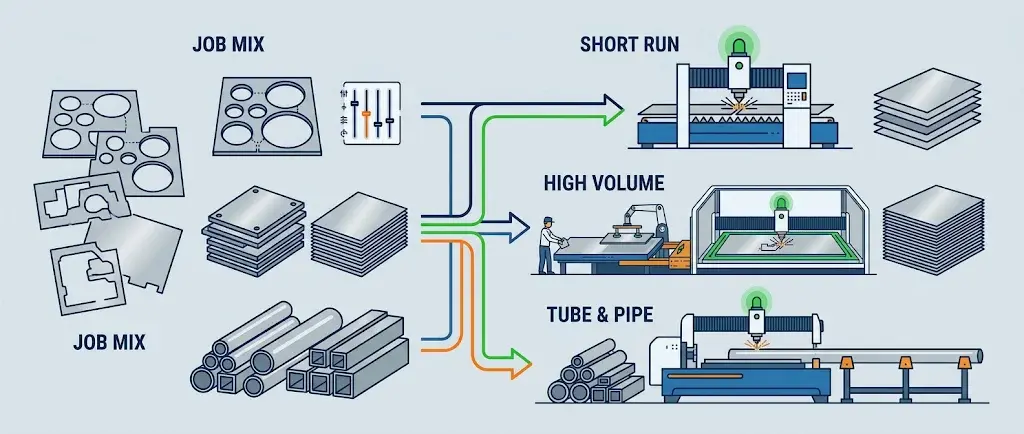
High-mix, low-volume work and high-volume, low-mix work do not fail in the same places, and routing both through whichever machine is free tends to make both worse. A shop account published by The FABRICATOR in November 2024, written by Tim Heston about General Stamping & Metalworks, describes how a review of production data led the fabricator to stop sending jobs to the first available laser, group work by thickness and volume, and keep material near its point of use. Its own description of the result — that it felt like adding another machine — is the shop’s account, not a transferable figure. The transferable part is the method: group by mix first, then assign equipment.
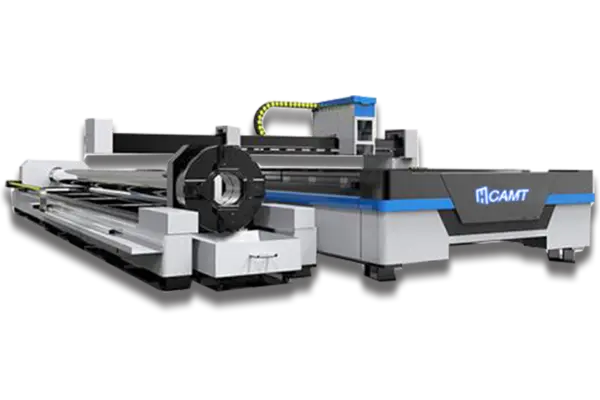
For one-off and short-run work, an open single-table layout keeps loading and access flexible. Where tube work or bevel preparation currently leaves the plant or adds a second operation, CAMT’s dedicated pipe and tube laser removes a transfer rather than accelerating a cut. If measurement shows the constraint really is the machine, use the model specification sheet for the configuration being ordered, with its revision date — a family overview is not a specification table.
Prove the Gain Is Real
Daily output totals are the least trustworthy report in the shop. A nest of small intricate parts and a nest of simple panels produce very different part counts from the same beam-on hours, so a good week can look exactly like a real improvement. Use one card per change.
| Field | What to write down | Why it matters |
|---|---|---|
| Baseline | Date, shift, program revision, part number, sheet heat or lot | Without it, two shifts are not comparable |
| Held-constant conditions | Grade and thickness, gas route, nozzle, focus zero, operator, acceptance rule | One moving turns one change into two |
| The single change | Exactly one lever: a program edit, a nozzle, a loading sequence, a routing rule | Parallel changes cannot be attributed |
| Observation window | A defined span containing a comparable mix of jobs | Order mix changes mimic gains |
| Accepted-part rule | The written criterion and who applied it | "Cut" and "accepted" diverge most when a point is being proved |
| Reviewer | The named person who signs the record | Records nobody owns get reconstructed from memory |
| Rollback trigger | The condition under which the change is reverted | A gain that cannot be reversed is a risk |
Hold the written acceptance rule steady across the comparison window: what makes a part accepted, who applies the rule, and whether parts needing deburring count on the day they are cut or the day they pass. technical support covers remote log review, parameter and program revision history, and beam and focus recalibration, which is what lets a recipe be reconstructed later. If a card cannot be filled in — nobody knows which nozzle was fitted, or the acceptance rule moved halfway through — the correct conclusion is that no gain has been demonstrated, not that the change failed.
What Not to Do in the Name of Productivity

Some apparent gains are losses with the accounting moved. Do not shorten a safety distance, raise an approach speed, pre-position parts inside a guarded zone or defeat an interlock to recover seconds. Do not count parts waiting for deburring, inspection or sorting as shipped output, do not treat parts cut as parts accepted, and do not relax an edge requirement on the drawing to make a speed trial look good. Do not write a supplier’s brochure performance figure into a purchase order as an acceptance criterion; capability has to be established on your material, your thickness and the machine you actually ordered.
Laser guarding, high-pressure gas lines, reflective materials, fume and fire, and the safeguarding of any automatic loading equipment sit with the equipment supplier and your site safety officer. ISO 11553-1 and the ANSI Z136 family state general requirements for laser processing machine and laser safety; we do not assert compliance on a customer’s behalf, and confirmation has to come from the equipment supplier in writing.
If the measured loss is waiting for drawings, material or inspection, no equipment purchase fixes it. What we can help with is the unglamorous layer: setting up the record template, training a shift to review parameters, keeping program revisions backed up, and supplying the consumables a maintenance routine depends on. If that is the layer you are missing, contact our engineering team with your beam-on and accepted-part records, and we will work from those rather than from a target number.