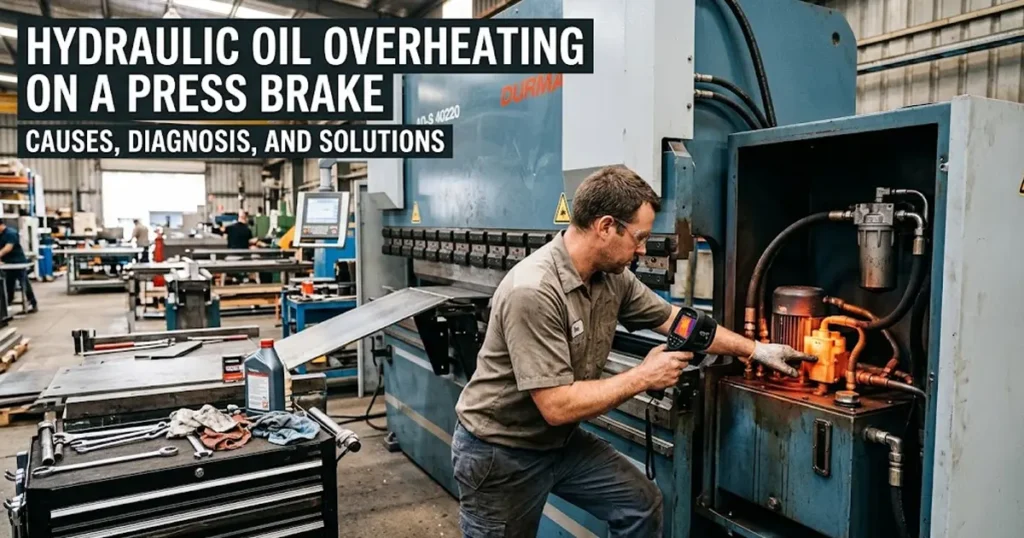
Hydraulic oil overheating on a press brake is more than a maintenance issue. It can indicate excessive pressure losses, internal leakage, insufficient cooling or incorrect operating conditions, and if it is ignored, high oil temperatures accelerate oil degradation, damage seals, reduce hydraulic efficiency and eventually produce unstable ram movement and unplanned downtime.
It helps to see the problem for what it is: a balance. Heat enters the oil whenever pressure is dropped without doing useful work, and leaves through the cooler, the tank walls and the piping. A machine that runs hot has either started making more heat or lost the ability to shed it, and those two faults have different fixes.
What Is the Normal Hydraulic Oil Temperature on a Press Brake?
Hydraulic oil naturally heats up during operation because pumps, valves, pipelines and cylinders generate heat through friction, pressure losses and circulation. A certain rise is normal, and a machine that never warms up is not necessarily a healthy one.
The problem begins when temperature keeps rising beyond the limits specified by the machine manufacturer and the oil supplier. No single figure applies to every press brake, because the acceptable range depends on viscosity grade, pump and valve design, cooling capacity, duty cycle and ambient temperature.
For reference, 82 °C (180 °F) is a widely cited upper limit for hydraulic fluid in general industrial service. Above it, the fluid itself starts to deteriorate and viscosity falls too low for reliable lubrication of pump and motor components (Alfa Laval). That makes it a real ceiling, but a poor working target, because three different limits sit below it and they protect three different things.
| Limit | What it protects | What goes wrong above it | How to confirm |
|---|---|---|---|
| Around 45 °C (113 °F) at the tank | Positioning and angle repeatability | Thinner oil leaks past clearances faster, so ram depth and angle drift through the shift | Bend the same test strip cold and again after four hours; compare angles and flange lengths |
| Around 60 °C (140 °F) | Oil life and cleanliness | Oxidation roughly doubles per 10 °C rise, so oil life roughly halves; varnish starts forming on spools (Machinery Lubrication) | Oil colour and smell, filter loading, spool sticking, oil analysis |
| 80–82 °C (176–180 °F) | The fluid itself, and everything downstream | Fluid degrades, viscosity collapses, seals and hoses are consumed | Hardened or weeping seals, oil mist at fittings, falling holding pressure |
The 82 °C and 60 °C figures are not in conflict. One is a damage ceiling for the fluid; the other is where oil ageing starts costing you money quietly. A machine running at 70 °C is inside its ceiling and outside its economy.
Important: always use the temperature alarm limits in your own press brake manual. If the machine displays an over-temperature alarm, follow the manufacturer’s shutdown procedure rather than continuing production.
Heat Generation Versus Heat Dissipation: The Balance That Decides Everything
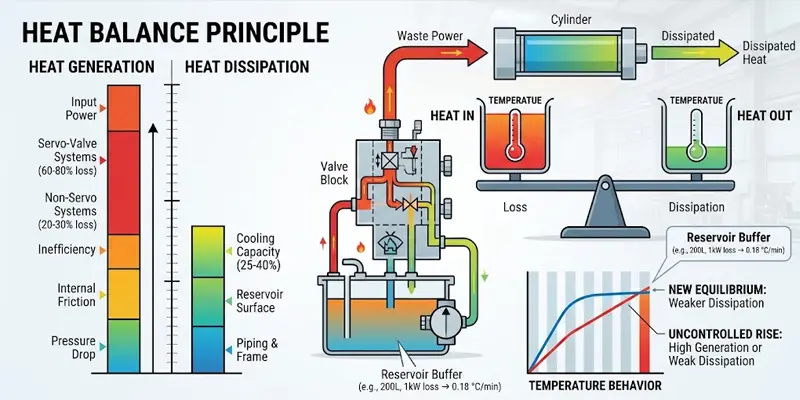
A hydraulic system’s heat load is the total power lost through inefficiency, and it overheats when that loss exceeds what the system can dissipate. The number that surprises most people is on the dissipation side: installed cooling capacity typically amounts to only 25 to 40 percent of input power (Alfa Laval). The rest has to leave through the reservoir surface, the piping and the frame, or it does not leave at all.
Now the generation side. In systems that meter flow with valves, heat loss is not a rounding error: well-designed electro-hydraulic servovalve and proportional valve systems can turn 60 to 80 percent of input horsepower into heat, against 20 to 30 percent for well-designed non-servo systems (Power & Motion). Most press brakes are valve-controlled machines, which means a large share of what you pay for at the meter is designed to leave as warmth, and the cooling system removes only part of it.
That explains why a modest new loss tips a machine over. Nothing has to fail catastrophically; a slightly fouled core, a relief valve left at a higher setting or ten degrees of extra shop temperature is enough to move the balance.
How the temperature behaves tells you which side moved:
- It keeps climbing with no plateau. Dissipation is not keeping up at any temperature, or generation is far above design. Check the cooler circuit first, then whether flow is crossing a relief at pressure.
- It climbs, then sits high and stable. The system found a new equilibrium because dissipation is weaker than it used to be: fouled core, failed fan, hot ambient, machine boxed into a corner.
- It is normal at idle and climbs only under load. Generation is duty-related: tonnage, dwell time, valve throttling, restricted return.
The reservoir is also a thermal buffer, and its size sets how fast everything happens. Mineral oil carries roughly 1.9 kJ per kg per kelvin at about 0.87 kg per litre, so a 200-litre tank holds about 174 kg and roughly 330 kJ per kelvin of rise. Since 1 kW is 1 kJ per second:
1 kW of continuous heat loss raises a 200-litre tank by about 0.18 °C per minute, or roughly 11 °C per hour.
Scale it to your own reservoir — a 400-litre tank reacts half as fast — and a thermometer becomes a way of measuring wasted power.
The Idle Heat-Rate Test
Run this before you open anything. Start with a machine that has stood overnight, note ambient and tank temperature, then run the pump in standby with no bending for 30 to 45 minutes, recording tank temperature every 5 minutes. Keep recording through normal production afterwards.
| What you observe | Rough heat load (200 L tank) | What it points to |
|---|---|---|
| 0.1–0.2 °C/min at idle | 0.5–1 kW | Normal standby loss for a valve-controlled machine; keep the record as a baseline |
| 0.4–0.6 °C/min at idle | 2–3 kW | Flow going somewhere it should not: relief bypassing, valve null offset, cooler bypass stuck open |
| Above 0.9 °C/min at idle | 5 kW and up | Full flow being dumped at pressure, or severe internal leakage |
| Climbs only while bending | Load-dependent | Tonnage audit, dwell and holding time, valve sizing |
| Climbs, then plateaus high | Balance reached | Cooler core, fan, water flow, ambient, clearance around the tank |
| One hot component, cool tank | Local | Throttling or leakage at that component, not a cooling fault |
A Thermal Map Beats a Gauge
Tank temperature is a mixed, lagging value; it can look acceptable while one valve block is cooking. An infrared survey takes ten minutes and finds the generator rather than the symptom. Published guidance holds that heat from normal leakage should not propagate more than about 2 ft (0.6 m) from the component producing it, and that a map taken when the machine is new is the reference that makes every later reading meaningful (Power & Motion).
If the pump case sits 30 °C above the tank and the pipe is still hot a metre downstream, you have found your source and the cooler is innocent. Take that map once, write the date on it, keep it with the machine records.
7 Common Causes of Hydraulic Oil Overheating
Overheating results either from excessive heat generation inside the circuit or insufficient heat dissipation through the cooling system. Work through these in the order your heat-rate test suggests, not from the top.
1. Hydraulic Oil Cooler Is Dirty or Not Working Properly
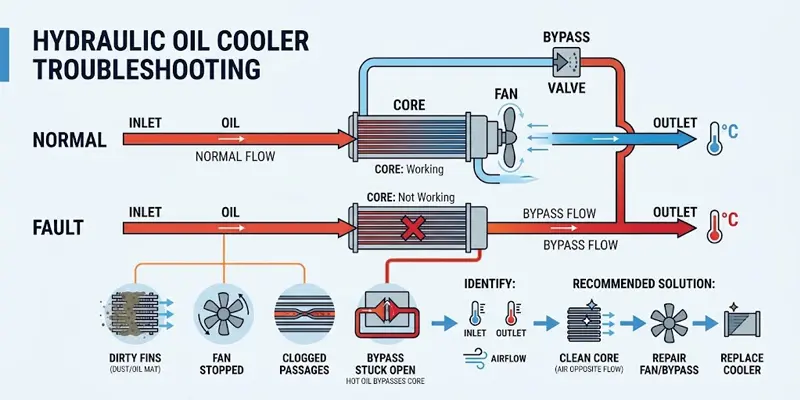
A malfunctioning cooler is the first thing to investigate when temperature rises gradually during production. Typical faults: dust and oil mist blocking the fins, a fan that has stopped or runs backwards, clogged or scaled water passages, and a thermostatic bypass stuck open so the oil never reaches the core at all.
How to identify it. Inspect the core and confirm the fan pulls air through. Then measure oil temperature at the cooler inlet and outlet under the same conditions: a working cooler shows a measurable drop, and a cooler whose outlet matches its inlet is not cooling, whatever it looks like. Check that the thermostatic bypass actually closes when the oil is hot — that valve stuck open is the most commonly missed fault in this list, because the cooler runs perfectly while the oil bypasses it.
Recommended solution. Clean the core from the air side against normal flow — oil mist plus shop dust makes a mat that water will not shift — restore airflow or water flow, and inspect the fan and bypass valve. Repair or replace a damaged or genuinely undersized cooler, but only after the heat-rate test has shown the machine is making heat at the rate it was designed to make.
2. Pressure Relief Valve Is Set Incorrectly or Leaking Internally
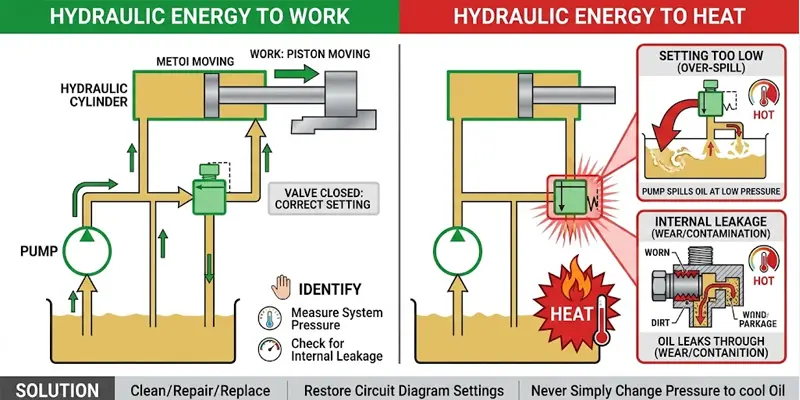
The relief valve protects the system against overpressure, and when oil passes across it under a pressure difference, hydraulic energy becomes heat instead of work.
The judgement is not “set too high” or “set too low” — it is whether flow is continuously crossing a restriction at pressure. Both directions can do it: a setting too low for the work, so the pump spills oil over the valve through much of the cycle; a setting raised for one thick job and never restored, so the machine runs at or near relief pressure every cycle; a valve held partly open by contamination, or with a worn seat; or pressure-control settings that do not match the pump’s control arrangement.
How to identify it. Heat that appears during light work or at idle points at exactly this: oil is crossing a restriction without producing work. A technician should measure system pressure, watch how the pump control behaves at the end of the stroke, and check the relief for internal leakage.
Recommended solution. Clean, repair or replace defective components and restore the pressure settings according to the circuit diagram and the manufacturer’s specification. Never raise or lower relief pressure simply to bring oil temperature down — incorrect settings compromise both machine safety and component protection.
3. Hydraulic Pump Is Worn or Producing Excessive Internal Leakage
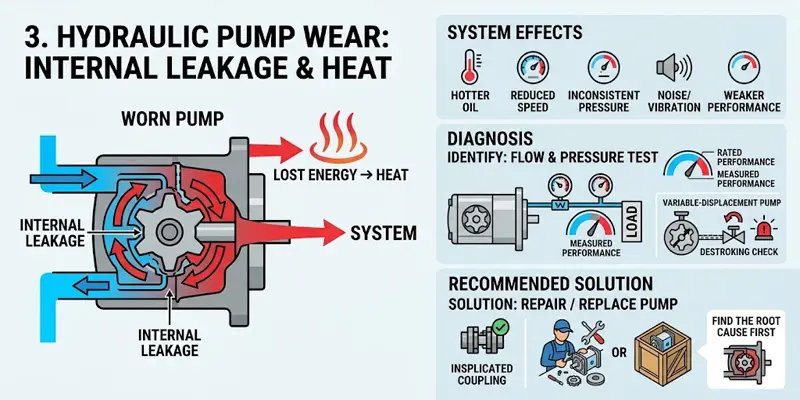
As the pump wears, internal clearances open and high-pressure oil slips back to the low-pressure side instead of reaching the cylinders; that lost energy becomes heat. Internal leakage does not necessarily produce any visible external leak.
Watch for oil running hotter as the shift goes on, reduced ram speed, inconsistent pressure, increased pump noise or vibration, weaker performance under heavy load and longer cycle times than the machine used to deliver.
How to identify it. Test pump flow and pressure under the specified conditions and compare with rated performance. On variable-displacement pumps, confirm the pump actually destrokes when the required flow or pressure is reached.
Recommended solution. Inspect the pump, assess internal wear and decide between repair and replacement, and check the motor-to-pump coupling. Replacing a pump without finding why the first one wore out usually buys a second failure.
4. Hydraulic Oil Viscosity Is Incorrect
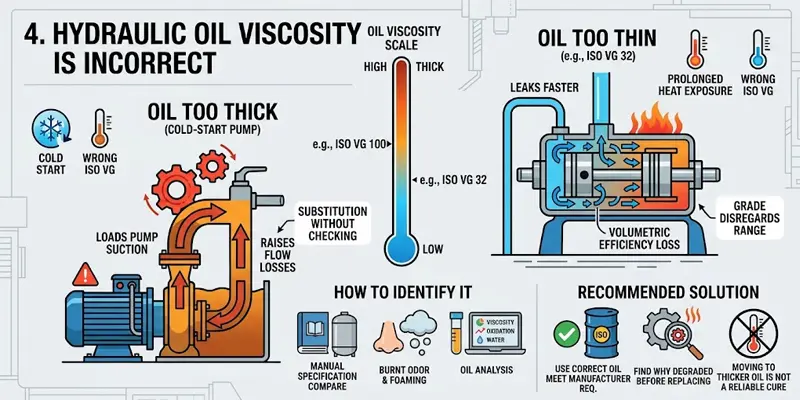
Viscosity governs lubrication, flow resistance, internal leakage and heat generation at the same time. Oil too thin for the conditions leaks faster and loses volumetric efficiency; oil too thick, especially on a cold start, loads the pump suction and raises flow losses.
Causes include the wrong ISO VG grade, mixed incompatible oils, oil degraded by prolonged heat exposure, a grade chosen without regard to the machine’s real operating temperature range, and a substitution made without checking compatibility.
How to identify it. Compare the manual’s specification with what is in the tank. Look for unusual darkening, a burnt odour, excessive foaming or abnormal viscosity change, and arrange oil analysis where you need numbers for viscosity, contamination, water content and oxidation.
Recommended solution. Use oil that meets the manufacturer’s requirements, and find out why the oil degraded before replacing it. Moving to a thicker oil is not a reliable cure for an overheating system, and it can move the problem to cold starts.
5. Hydraulic Oil Level Is Too Low
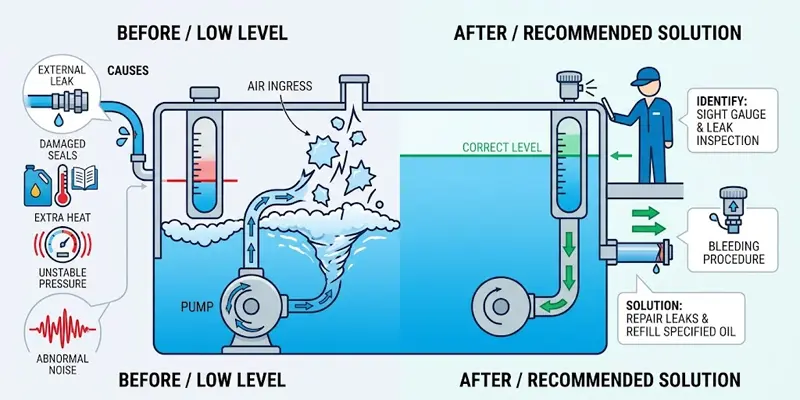
The reservoir stores the working fluid and is the system’s main passive heat sink. A low level reduces both the fluid volume available and the dwell time in the tank, and it can let the pump draw air, bringing aeration, unstable pressure and abnormal noise along with extra heat.
Causes: external leakage from hoses and fittings, damaged cylinder seals, incorrect filling after maintenance, oil lost during component replacement and missed inspections.
How to identify it. Check the level with the sight gauge using the method in the manual, with the machine in the correct position — oil distribution changes as the cylinders move. Inspect the tank, hoses, fittings and cylinders for leaks, and look for foam in the oil.
Recommended solution. Repair the leak, then refill with the specified oil. Adding oil without asking why the level dropped only postpones the next failure, and if air has entered the circuit the system may need an approved bleeding procedure.
6. Hydraulic Filters Are Clogged or the Oil Is Contaminated
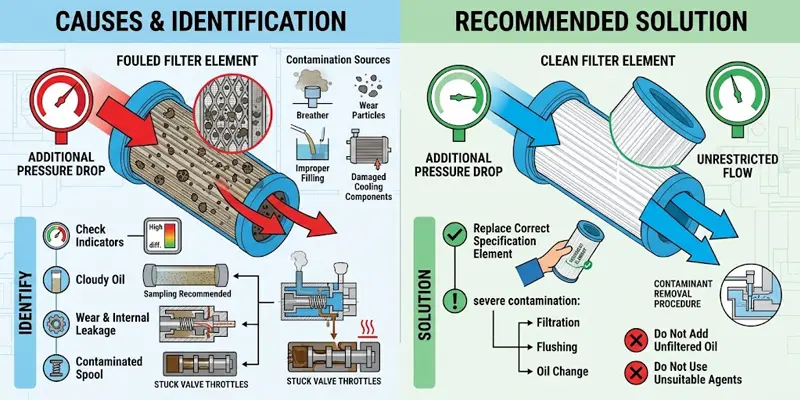
A loaded element restricts flow and adds pressure drop across the filtration circuit. Contamination also makes spools stick, accelerates wear and raises internal leakage — and varnish on a spool is itself a heat source, because a partly stuck valve throttles.
Contamination arrives through the breather, from component wear, at filling, through damaged cooling components or condensation, and from degrading seals.
How to identify it. Check filter indicators where fitted and review the maintenance history; an element at its service limit or with excessive differential pressure needs attention. Cloudy oil, visible particles or an unusual odour justify sampling.
Recommended solution. Replace elements with the correct specification. Where contamination is severe, the system may need filtration, flushing or an oil change per the manufacturer’s cleaning procedure. Do not introduce unfiltered replacement oil or an unsuitable cleaning agent.
7. Excessive Production Load and Poor Workshop Ventilation
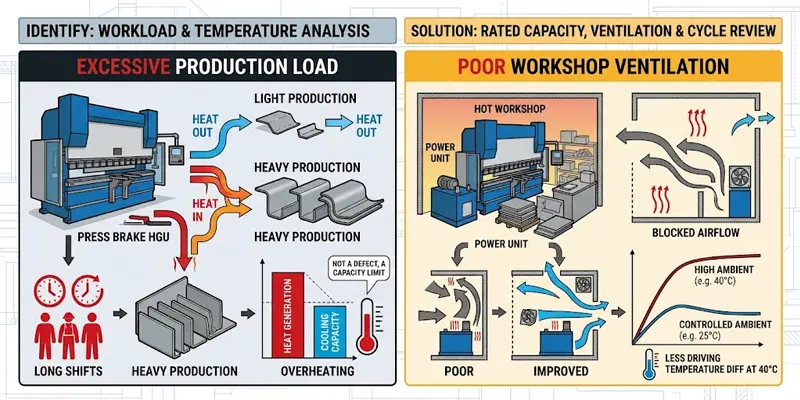
Not every hot machine is a defective machine. Sometimes the work generates more heat than the cooling system was designed to remove: continuous high-tonnage bending, frequent heavy cycles, long shifts with no cooling intervals, a hot workshop, poor clearance around the power unit and airflow blocked by nearby equipment. A press brake that behaves perfectly on short runs can exceed its oil temperature on continuous heavy bending, and that is a specification problem rather than a fault.
How to identify it. Record oil temperature across a full shift alongside the workload. Temperature that climbs during heavy production and stabilises under light work points to the combined effect of duty cycle and cooling capacity.
Recommended solution. Confirm the machine is being worked within its rated capacity, improve ventilation around the power unit, clear the airflow path and review the production cycle. If the real workload consistently exceeds the original cooling design, discuss a cooling upgrade with the manufacturer — and check the ambient rating the machine was specified against, because a cooler sized for a 25 °C shop has far less driving temperature difference available at 40 °C.
Why Some Machines Heat Oil While Standing Still
Because duty often is not the cause. A press brake spends seconds bending and minutes waiting while someone positions a part, and on a fixed-displacement pump with valve control, that waiting period is when the machine works hardest at nothing: the pump keeps delivering full flow while the ram is stationary, and the excess goes over the relief at pressure.
| Drive architecture | Heat at idle | Main heat site | Check first |
|---|---|---|---|
| Torsion-bar NC, fixed pump | High unless the pump unloads in standby | Relief valve, unloading circuit | Whether the pump really unloads, and at what pressure |
| Electro-hydraulic CNC, proportional valves | Moderate to high; closed-loop valves need constant pressure, which means constant power loss | Valve block, relief, internal leakage | Standby pressure against actual load requirement, valve null |
| Hybrid servo pump (on-demand) | Low; the pump turns only when the ram moves | Pump and motor under high duty, not standby | Cooler only if duty is genuinely continuous |
| Servo-electric | None — no hydraulic oil | Screw, nut, motor | Not an oil problem at all |
The second row explains a complaint that sounds impossible: “it gets hot when we are not even bending.” Proportional and servo valves in closed-loop motion control need a pressure source that responds instantly, so the system holds pressure between cycles; when the load calls for less than full flow, that unused energy potential goes into the oil as heat (Power & Motion). Some of that standby loss is designed in. What is not designed in is a relief setting raised for one job and left there for two years.
How to Diagnose an Overheating Press Brake Hydraulic System
Replacing components without identifying the root cause raises cost without solving the problem. The four steps below do most of the work, and the second one is where most faults are actually found.
Step 1: Confirm the Actual Oil Temperature
Do not diagnose overheating because the reservoir feels hot. Use the machine’s temperature display or a suitable contact thermometer, and record oil temperature, ambient temperature, operating time, production load, bend frequency, alarm status and whether the machine is working, idling or stopped.
If you use an infrared thermometer, remember that shiny metal surfaces give misleading readings; measure a suitable surface and compare readings taken under consistent conditions.
Step 2: Inspect the Oil and the Cooling Circuit
Check the level against the manufacturer’s requirement and look for unusually dark oil, a burnt odour, foam, visible contamination, signs of water ingress and an incorrect or mixed grade. Then check the cooler, fan, ventilation openings and electrical connections, plus water supply and exchanger condition on water-cooled units. Verify that the thermostatic valve and bypass circuit work, and measure the inlet-to-outlet difference at the cooler rather than trusting its appearance.
If the oil has deteriorated, replacing it without correcting the heat source buys temporary relief only.
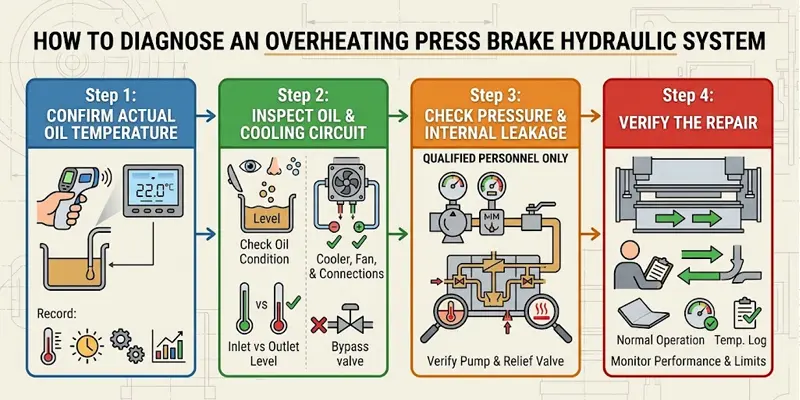
Step 3: Check Hydraulic Pressure and Internal Leakage
This stage needs qualified hydraulic personnel. Measure pump pressure and flow under the manufacturer’s specified test conditions, and inspect the relief valve, pump control and any component that could allow continuous flow at pressure or internal leakage. Pay particular attention to overheating at idle or under light work — that pattern is the clearest signal of a restriction doing nothing but heating oil.
Step 4: Verify the Repair
After correcting the fault, run the machine under controlled conditions and log the temperature again. Compare with your original readings and the manufacturer’s limits, and confirm that pressure, ram movement and bending performance are back to normal before releasing the machine to full production.
Quick Reference: Symptoms, Causes and Actions
| Observed symptom | Possible cause | Recommended action |
|---|---|---|
| Temperature rises gradually during production | Insufficient cooling capacity or excessive duty cycle | Inspect the cooler and review production conditions |
| Overheats even at idle | Relief leakage or unnecessary hydraulic flow | Check pump control and relief valve operation |
| Overheats with reduced ram speed | Worn pump or internal leakage | Test pump pressure and flow |
| Overheats and the pump becomes noisy | Low oil level, aeration, suction restriction or pump wear | Check level, suction lines and pump condition |
| Oil dark with a burnt odour | Prolonged overheating or oxidation | Find the heat source and arrange oil analysis |
| Temperature rises right after an oil change | Wrong viscosity, incompatible oil or a filling problem | Verify specification and filling procedure |
| Overheats during continuous heavy bending | High thermal load or insufficient cooling | Review tonnage, cycle frequency and cooler capacity |
| Overheats with frequent filter alarms | Filter restriction or heavy contamination | Inspect filtration and oil cleanliness |
How to Prevent Hydraulic Oil Overheating
Prevention is cheaper than a pump, a set of seals or an unplanned stoppage.
1. Keep a hydraulic inspection routine. Level, oil condition, filter indicators, connections and cooling system, on a fixed schedule rather than on the day the alarm appears.
2. Log the temperature, not just the reading. A single number tells you little; a trend tells you everything. Record at consistent intervals under comparable conditions, and treat a sudden step change as urgent.
3. Use the specified oil, and replace oil and filters on condition as well as on schedule. Never mix formulations without confirmed compatibility, and let oil analysis decide the interval where duty is demanding — an element at its differential-pressure limit is a heat source, not just a restriction.
4. Keep the cooler, the airflow and the ambient margin in view. Clean fins and openings per the maintenance instructions, maintain water flow on water-cooled units, keep the space around the power unit clear, and remember that a 10 °C hotter shop is a specification change, not an accident.
Can Hydraulic Oil Overheating Affect Bending Accuracy?
Yes, though not automatically. As oil temperature rises, viscosity falls and internal leakage grows through pumps, valves and cylinders, which affects pressure stability and hydraulic response. Depending on the machine and control, operators may notice changes in ram speed, unstable pressure across repeated cycles, delayed response, differences in cylinder synchronisation and reduced repeatability during long runs. On electro-hydraulic CNC press brakes, unstable hydraulic conditions make it harder to hold consistent Y1/Y2 movement.
Not every angle deviation is thermal. Material variation, springback, tooling condition, machine deflection and CNC compensation settings all contribute, which is why a temperature log beside an angle record is worth more than either alone. Our guide to press brake troubleshooting covers the non-hydraulic causes, and if the deviation tracks oil temperature through the shift, look at the hydraulic side first.
When Should You Contact a Press Brake Service Engineer?
Basic inspection is operator work; hydraulic repair is not. Call a qualified engineer when temperature repeatedly exceeds the manufacturer’s limit, when alarms recur, when the pump is noisy or vibrating, when pressure is unstable, when the ram moves unevenly or loses speed, when oil leaks around cylinders, hoses or valve blocks, and when cooler and routine checks have not resolved it.
Two safety points before anyone reaches for a wrench. Never loosen hydraulic fittings or remove valves while the system is pressurised, and remember that accumulators hold stored energy after the machine is switched off — isolation, depressurisation and lockout come first. Hot oil at these temperatures causes serious burns, and oil escaping at pressure can penetrate skin, which is a surgical emergency rather than a workshop injury.
When you request support, have this ready:
- Press brake model and serial number.
- Hydraulic oil brand and viscosity grade.
- Current oil temperature and alarm records.
- Ambient workshop temperature.
- Whether overheating occurs during production, at idle, or both.
- Recent oil changes, filter replacements or hydraulic repairs.
- Photos or video, plus your heat-rate readings if you have them.
Those seven items usually narrow the cause before anyone travels.
How the Right Press Brake Configuration Reduces Hydraulic Overheating
Preventing overheating starts before the machine reaches the floor. A machine specified on tonnage and bending length alone can carry an expensive thermal problem for its whole life. Six questions worth asking of any builder:
- What duty pattern was this configuration specified for?
- What are the average and peak tonnage, and how often is the machine at rated capacity?
- What is the pump arrangement — fixed displacement, pressure-compensated or on-demand servo?
- What cooler and tank volume does that produce at my summer ambient, not the catalogue’s?
- Where does the temperature sensor sit, and what does the control do when it trips?
- Does the drive log temperature history that service can read remotely?
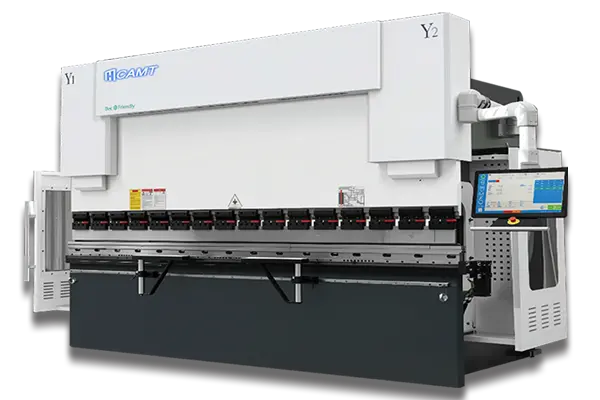
The pump arrangement matters most, because it decides how much heat is generated rather than how much has to be removed. CAMT’s Eco-Smart hybrid servo system runs the pump from a closed-loop servo motor, so oil moves when the ram moves and stops when it does not; the system is specified to hold oil under 45 °C in normal duty without an external chiller, precisely because the standby heat is never made. On a machine already running long shifts at high tonnage, that shows up as stable angles from the first part of the morning to the last part of the night shift.
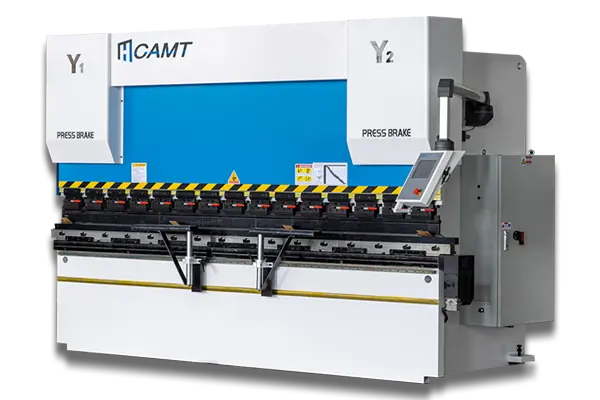
For work where a temperature problem is really a precision problem — thin gauge, tight tolerance, high mix — the Apex hybrid range pairs the on-demand servo pump with closed-loop proportional hydraulics, Bosch Rexroth valves and GIVI magnetic scales, from 40 to 600 tons over 1.6 to 6 m. The full range, including torsion-bar, hybrid and servo-electric machines, is on the press brake pages.
For machines already in service, maintenance and upgrade retrofits constant-speed hydraulic systems to hybrid servo drives, including third-party brands, and publishes a 10–15 °C lower oil temperature and near-zero idle power draw as the expected result. Seals, cooler components and filter elements come from genuine spare parts, and where the temperature record is ambiguous, technical support can read controller and drive logs remotely and often tell from a trend whether you are chasing a cooler, a valve or a pump. If you would rather describe the problem than compare specifications, send us the details.
This check sits inside a wider calendar. The press brake maintenance checklist sets the daily, weekly and annual intervals that surround it.
Frequently Asked Questions About Press Brake Hydraulic Oil Overheating
1. Why does my press brake hydraulic oil get hot after a few hours?
The usual explanations are insufficient cooling, excessive load, internal leakage and incorrect relief valve operation. If temperature rises gradually through a shift, log it beside the workload — that comparison separates “making too much heat” from “failing to shed it”, and the two have different fixes.
2. Can a press brake overheat even when it is not bending?
Yes, and it is common. Continuous flow across a relief valve, incorrect pump control settings or internal leakage all generate heat at idle. On a fixed-displacement machine, standby is often the highest-heat part of the cycle, because the pump keeps delivering full flow while nothing moves.
3. What is the maximum safe temperature for press brake hydraulic oil?
There is no universal maximum. About 82 °C (180 °F) is a widely cited ceiling for hydraulic fluid in general industrial service, above which the fluid deteriorates and viscosity becomes too low for reliable lubrication. Many press brakes are less tolerant, and the oil-life limit sits far lower: around 60 °C, where every additional 10 °C roughly halves oil life. Follow your machine’s specified limit, and treat sensor location as part of the answer, because a tank reading hides local hot spots.
4. Can low hydraulic oil cause overheating?
Yes. A low level reduces the fluid available to absorb and carry heat, shortens dwell time in the tank and can let the pump draw air. Aeration brings unstable pressure, abnormal noise and additional heat. Check the level and repair the leak before adding oil.
5. Does changing the hydraulic oil solve overheating problems?
Only when degraded, contaminated or incorrect oil is part of the cause. If the real fault is a dirty cooler, a worn pump, a leaking relief valve or internal leakage, new oil will run hot within days. Diagnose first, then decide.
6. Why does my hydraulic press brake overheat more in summer?
Because the cooler works on temperature difference. Higher ambient air reduces the driving difference between oil and cooling medium, so the same cooler removes less heat — and a unit sized for a 25 °C shop has very little margin at 40 °C. Inspect the cooler, ventilation and workload, and ask about additional capacity if the duty is genuinely continuous.
7. Can hydraulic oil overheating damage the press brake pump?
Yes. High temperature thins the oil and weakens the lubricating film between internal pump components, accelerating wear and internal leakage and shortening service life. It also ages seals, hoses and valves. Correcting the cause early is far cheaper than replacing what it damaged.
8. Should I install a larger oil cooler to solve press brake overheating?
Not necessarily, and not first. A larger cooler helps when capacity is genuinely insufficient for the real workload. If the heat comes from internal leakage, a defective relief valve or incorrect pump control, a bigger cooler carries the symptom away more efficiently while you keep paying for the wasted power. Find the heat source, then decide.
Keep Your Press Brake Running at a Stable Temperature
Hydraulic oil overheating is a warning that the balance between heat generation and heat dissipation has been disrupted. Whether the cause is a blocked cooler, incorrect viscosity, internal leakage or unnecessary pressure loss, identifying the root problem is what prevents a pump, a set of seals or a week of production from being spent on the symptom.
Temperature tells you the most when you record it: a number written down every shift turns an opinion into a trend, and a trend tells you whether the machine is making more heat or losing its ability to shed it.
If your press brake has recurring hydraulic overheating, or you are specifying a machine for demanding conditions, contact CAMT for technical guidance and a configuration that matches your duty cycle and your shop.
CAMT – Practical Press Brake Solutions for Reliable Sheet Metal Production.