If you cut metal, a fiber laser will almost always out-cut a CO2 laser of the same wattage — faster on thin sheet, cheaper to run, and far less demanding to maintain. If you cut acrylic, wood, leather or fabric, the CO2 laser is still the right tool, because the fiber beam largely passes through those materials instead of cutting them. Between those two poles sit a few genuine judgment calls — thick-plate edge quality, reflective metals, and what to do with a CO2 machine you already own — and they are decided by your material mix, not by a spec sheet.

Quick Comparison
| Comparison factor | Fiber laser | CO2 laser |
|---|---|---|
| Wavelength | ~1.06–1.08 μm | ~10.6 μm |
| Beam delivery | Flexible optical fiber | Mirror train and resonator optics |
| Wall-plug efficiency | ~35% (per The FABRICATOR) | ~10% |
| Thin metal speed | Up to 2–3× a same-wattage CO2 | Baseline |
| Thick metal | Competitive with high power; edge quality depends on configuration | Still the reference on very thick mild steel edge finish |
| Reflective metals (copper, brass) | Yes, with suitable source and head protection | Generally not practical |
| Non-metals (acrylic, wood, leather, fabric) | Not usefully | Excellent |
| Resonator gas | None | Consumed continuously |
| Routine optics maintenance | Protective window and lenses | Mirrors, alignment, resonator service |
| Best fit | Metal fabrication, thin-to-medium sheet | Non-metal cutting and engraving; selected thick-plate work |
Wavelength dictates laser design, energy efficiency, and material fit

The practical differences all trace back to one physical fact. A CO2 laser electrically excites a gas mixture (CO2, nitrogen, helium) inside a resonator and bounces the 10.6-micron beam through a train of mirrors to the cutting head. A fiber laser builds its ~1-micron beam in diode-pumped, ytterbium-doped optical fiber and delivers it through fiber-optic cable — no mirrors, no resonator gas. As The FABRICATOR’s history of laser cutting head and optics development puts it, the fiber’s 1-micron wavelength increased absorption in metals — including copper and brass — while a typical CO2 source converts only around 10 percent of incoming electricity into the beam, against roughly 35 percent for fiber.
That wavelength is also why the material lists barely overlap: metals absorb the shorter beam readily, organic materials absorb the longer one and are largely transparent to the fiber’s. Everything that follows — speed, cost, maintenance — follows from this. (For the full architecture of a fiber machine — resonator, cutting head, chiller, and how the beam reaches the kerf — see What Is a Fiber Laser Cutting Machine and How Does It Work?.)
Cutting Speed: Where Fiber Wins, and Where the Gap Closes

On thin sheet, fiber’s power density is decisive. Canadian Metalworking’s survey of laser makers on the fiber-versus-CO2 question put fiber’s prime advantage at cutting thin metals “up to 2-3 times that of the same wattage CO2 laser” — “due to the wavelength of the laser and smaller kerf which result in less material needed to be removed from the cut,” as Matt Garbarino of Cincinnati Incorporated explained in that piece.
Past thin sheet, the picture gets honest. Terry VanderWert of Prima Power Laserdyne offered a rule of thumb in the same publication’s follow-up on fiber adoption: around 4 mm is where customers report the crossover where fiber systems are most efficient. TRUMPF’s Brett Thompson noted that with a 5 kW solid-state source “you start to lose the speed advantage at about 1/4-inch.” Amada’s Jason Hillenbrand was blunter about very thick stock: fiber “can cut it as well, but generally it will be slower and the edge quality will not be the same as with CO2 — at least not with the technology that we have in place today.” Marc Lobit of Mazak Optonics framed the same boundary from the other side: above roughly 12 mm of mild steel, a CO2 laser can still deliver slightly better edge quality and, in some cases, faster processing.
One more caveat that spec sheets never mention: maximum cutting speed is not throughput. Piercing, acceleration, path complexity, nesting, and sheet handling all eat into it. Jeff Hahn of MC Machinery Systems/Mitsubishi Laser made the loading point plainly — a standalone fiber machine “will process material faster than you can load and unload it,” which is why fiber purchases drag automation into the conversation whether you planned for it or not. Judge machines on parts per shift on your own drawings, not on advertised m/min.
Materials: Metals, Reflective Metals — and the Non-Metal Boundary
| Material | Fiber laser | CO2 laser |
|---|---|---|
| Carbon steel | Excellent | Good |
| Stainless steel | Excellent | Good |
| Aluminum | Excellent | More challenging |
| Brass / copper | Excellent with suitable configuration | Generally not practical |
| Galvanized steel | Very good — "fiber seems to cut better in galvanized steel than CO2" (Jeff Hahn, MC Machinery) | Good, depending on configuration |
| Acrylic, wood/MDF, leather, fabric, paper | Not usefully | Excellent |
The reflective-metal line matters commercially. “If you need to cut highly reflective materials such as brass and copper, CO2 lasers are usually not an option whereas fiber lasers can easily cut these materials,” said Sanjay Garg of Hypertherm — the 10.6-micron beam largely reflects off bare copper and brass, and a reflected beam is nobody’s friend. Fiber handles these metals, provided the source, cutting head and process protections are specified for it.
The boundary runs the other way for non-metals: organics absorb the 10.6-micron beam strongly and the 1-micron beam poorly, so a fiber laser aimed at clear acrylic passes energy through or melts a poor edge instead of cutting. Sign, woodworking and textile shops therefore stay CO2 territory, and a job shop that needs both worlds usually ends up owning both. One safety note that applies to either machine: PVC must never be laser-cut — heated PVC releases corrosive, hazardous gases — and any material’s compatibility and fume extraction should be verified before processing.
Operating Cost: Itemize What Actually Changes
“Cheaper to run” is true but useless until you split it into line items, because fiber does not shrink every cost — it deletes some and leaves others untouched.
| Cost item | CO2 laser | Fiber laser | What changes |
|---|---|---|---|
| Electricity (wall-plug) | ~10% of input power reaches the beam | ~35% | Far less draw for the same output; the saving scales with cutting hours |
| Resonator gas | Consumed continuously | None | Eliminated |
| Resonator and beam-path optics | Mirror cleaning, alignment, replacement; turbines, bellows | None (fiber-to-fiber) | Eliminated |
| Chiller load | Large chiller for the resonator | Smaller | Reduced; still needs water and filter service |
| Assist gas (O2 / N2 / compressed air) | Required | Required | Unchanged — often the biggest gas bill on either machine |
| Cutting-head consumables (nozzles, protective window) | Required | Required | Unchanged in kind; fiber adds a daily protective-window wipe |
Two cautions belong next to this table. First, the efficiency figures above describe the laser source, not the complete machine — chillers, dust collectors, servo drives and CNC systems draw power on both, so audit the whole machine before promising a percentage to your accountant. Second, the assist-gas line deserves attention precisely because it doesn’t improve: as VanderWert noted, assist gas “can be a significant cost” on either technology, and a faster fiber machine can burn nitrogen more hours per day than the CO2 it replaces. Nitrogen-heavy stainless work can dominate the new machine’s running cost.
The honest comparison is cost per part, not cost per hour:
Cost per Part = Total Production Cost ÷ Number of Acceptable Finished Parts
with total production cost covering electricity, assist gas, labor, consumables, depreciation, rejects and downtime — measured on the same material, thickness, quality requirement and shift pattern for both machines. An idle one-shift CO2 machine that is already fully depreciated can still beat a fiber machine on paper; a three-shift fiber cell will usually not be close.
Cutting Quality and the Heat-Affected Zone

Fiber’s smaller spot and narrow kerf favor fine details, small holes and less material waste on thin-to-medium sheet. CO2 holds its own where it always has: acrylic edges come off smooth and polished-looking, and on very thick mild steel a properly configured CO2 machine remains the reference for edge finish, as the Mazak and Amada quotes above indicate.
Fiber does not automatically eliminate thermal problems, though. Its concentrated energy and high speed usually mean a small heat-affected zone, but wrong parameters, excessive heat input or poor assist-gas settings still produce burrs, dross and distortion on any machine. And be precise about what a spec sheet promises: CAMT’s fiber machines, for example, are published at ±0.03 mm positioning and ±0.02 mm repeatability — that describes machine positioning, not a guaranteed finished-part dimension under every cutting condition. Evaluate real cut samples on your material before committing.
Where Each Technology Fits by Industry
Fiber’s natural customer base, as Nicholas McCauley of Salvagnini sketched it in the 2014 Canadian Metalworking survey, is subcontractors, furniture manufacturing, food equipment, HVAC, electrical enclosure manufacturing and elevators — nearly all thin-to-medium sheet metal work, exactly where fiber’s speed and running-cost advantages compound. Add automotive brackets and battery enclosures, control cabinets, ventilation components, and tube processing for furniture, fitness and agricultural equipment.
CO2 keeps the signage and display, woodworking and interior decoration, textile and leather, and packaging and paper workshops — anything whose revenue is organic material. The distinction is straightforward: metal sheets and tubes point to fiber; organics point to CO2; a genuinely mixed shop usually owns both.
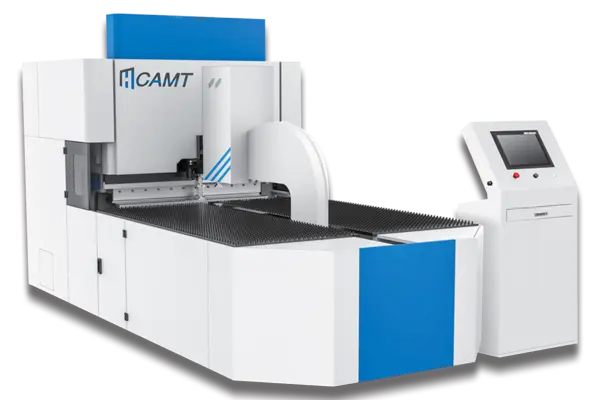
Electrical enclosures deserve one note for CAMT readers: they sit squarely in fiber’s sweet spot for cutting, and the cut blanks still need bending — which is why we serve that workflow with press brakes alongside lasers rather than treating the two as separate purchases.
Switching From CO2 to Fiber: What Actually Changes on Your Floor
Salvagnini’s Steve Aleshin reduced the switch to three motives: increase capacity, replace worn equipment, reduce operating cost. The fourth factor is the one buyers discover late — the switch changes the shop around the machine, not just the machine.
- Capital: fiber still carries a premium in some segments. LVD’s Stefan Colle attributed the 25%-or-more higher cost of high-dynamic fiber machines to linear-motor technology; TRUMPF’s Thompson countered that solid-state sources “can be substantially cheaper machines from both a cost of ownership perspective, as well as from a cost-per-part perspective.” Both can be true; which one wins depends on your hours and the configuration class you are buying.
- Automation pressure: as Hahn’s quote above implies, fiber speed turns manual loading and unloading into the bottleneck. Plan pallets, part removal and skeleton handling at purchase time — retrofits are harder than options.
- Downstream flow: parts arrive at deburring, bending and welding faster than the shop is used to. The constraint moves; it doesn’t disappear.
- Skills: the source needs less attention, but cutting-head and assist-gas discipline matter more, and the daily protective-window habit is unforgiving if skipped.
If your shop has spent years building in-house CO2 maintenance expertise, that competence is a real, if soft, reason not to rush the switch before the operating-cost math is overwhelming. The FABRICATOR laser buying guide makes the mindset point without apology: some manufacturers stay with CO2 “because they’ve used it for several years, and the company has in-house maintenance expertise.”
How to Decide: Five Questions Before You Compare Quotes
- What percentage of your cutting is metal? Anything near all-metal points to fiber; a heavy non-metal share keeps CO2 alive.
- Where does your thickness distribution peak? Below roughly 12 mm, fiber’s advantages are at full strength; a thick-plate-heavy mix needs sample cuts on your material before any decision.
- How many hours will the machine actually run? The electricity and maintenance gaps scale with hours; a machine idling one shift a day narrows every advantage.
- What does your assist-gas bill look like today? It survives the switch untouched, and nitrogen-heavy stainless work can dominate the new machine’s running cost.
- Who services it, with what parts availability? The FABRICATOR’s buying guide advises asking each OEM directly about post-warranty service and parts delivery — a laser that can’t cut while it waits for a part “just doesn’t cut it.”
Run those five answers against quotes, and the choice usually stops being close.
Where CAMT Fits
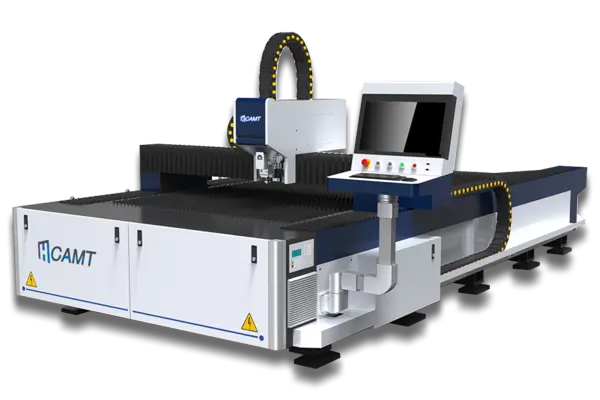
CAMT builds fiber laser cutting machines in three configurations — an open-type single-table series for smaller batches and workshops upgrading from traditional cutting, a fully enclosed exchange-table series (1 kW to 12 kW, per published specifications) for continuous medium- and large-batch production, and a dedicated tube and pipe model for round, square and rectangular profiles with optional automatic loading. For metal fabrication, this is where the technology has settled. See our laser cutting machine range to compare structures, and our technical support team can cut your sample drawings on your materials before you commit to anything. Start on our contact page.
FAQs: Fiber Laser vs. CO2 Laser: Key Differences in Cost, Speed and Applications
Is a fiber laser always better than a CO2 laser?
No. For metal cutting, yes in most cases — faster on thin sheet, lower running cost, less maintenance. But CO2 remains the practical choice for acrylic, wood, leather and other organics, and it keeps a niche in very thick mild steel edge quality and in shops with an established in-house CO2 maintenance capability.
Can a fiber laser cut wood or acrylic?
Not usefully. The 1-micron beam is poorly absorbed by organic materials and passes through or scorches many of them, which is why signage and woodworking shops stay with CO2 sources.
Can a fiber laser cut aluminum, brass and copper?
Yes, with an appropriate laser source, cutting head, process settings and machine protections. These metals are highly reflective and conductive, so parameters matter — but unlike CO2, fiber couples with them reliably.
Which costs disappear when you switch from CO2 to fiber?
Resonator laser gas and the mirror/turbine/bellows maintenance chain go away. Assist gas, nozzles, protective windows and chiller service remain on both technologies — budget for them.
Does a fiber laser require less maintenance?
Generally, yes. Hypertherm’s Jon Blom summarized it in the Canadian Metalworking survey: fiber sources “require little to no maintenance since they don’t rely on mirrors or turbines.” The honest fiber list is still a wiped protective window, chiller water and filters, and normal machine-tool service — not zero maintenance.
Do I need automation when I buy a fiber laser?
Not always, but decide at purchase time. Fiber cuts thin sheet faster than most shops can load and unload manually, so evaluate exchange tables or automatic loading while configuring the machine, not after it arrives.
Is an enclosed fiber laser worth the extra investment?
For medium- or high-volume production, yes: operator protection, fume and spark containment, and exchange tables that load while the machine cuts. For occasional custom work on one shift, an open-type machine is usually the more economical answer.
Which laser is better for thick metal plates?
Depends on material, power, assist gas and the edge quality your customer buys. Modern high-power fiber has closed much of the gap, but on very thick mild steel a configured CO2 machine can still match or beat fiber on edge finish — get sample cuts on your actual material before deciding.