The three formats in most quotations are 3015 (3000 × 1500 mm), 4020 (4000 × 2000 mm) and 6020 (6000 × 2000 mm). Start with the sheet you buy most often, then check what is left of that area once the sheet is located, clamped and nested. A 4020 gives 78% more nominal area than a 3015; it does not give 78% more parts per hour.
- Pull eight to twelve weeks of incoming sheet records before looking at any machine.
- Nominal working area is not nestable area. Four deductions sit between them.
- A larger table pays only when extra parts outrun the extra cutting, handling and pallet-change time.
- Ask every supplier for the same twelve fields, then cut a trial nest on your own stock.
1. The three formats, and the job each one fits
| Format | Nominal working area | Area | Typical work | Check first |
|---|---|---|---|---|
| 3015 | 3000 × 1500 mm | 4.5 m² | Cabinets, panels, general jobbing, small batches | Whether a full 1500 × 3000 sheet leaves room for location and nesting margins |
| 4020 | 4000 × 2000 mm | 8.0 m² | Large enclosures, HVAC panels, mixed orders | Whether 2000 mm stock is on normal lead time and can get through the door |
| 6020 | 6000 × 2000 mm | 12.0 m² | Long structural parts and repeated long blanks | Whether floor, lifting gear, sorting and forming all handle 6 m |
These are starting points, not a ladder. A shop running 1500 × 3000 mm sheet on a proven nest gains nothing from a 6020; a shop quoting 3500 mm panels weekly will shear and re-nest on a 3015 forever. The +78% is an area ratio, not an output ratio — Section 5 tests it. Published options on the ULE enclosed-type exchange-table fiber laser cutter run to 13000 × 2500 mm.
2. Start with the sheet you buy, not the biggest part you make

Before comparing machines, log eight to twelve weeks of incoming material: grade, thickness, ordered and measured width and length, flatness, accepted parts per sheet, remnant fate. Ask which widths your mill will commit to, whether remnants return to production, and whether your thinnest stock stays flat at the edges. If 2000 mm sheet is a special order with a long lead time, a 2000 mm format buys capability you cannot feed.
Sheet is ordered in coils or cut lengths. The general requirements in ASTM A568/A568M address length, width, thickness and flatness tolerances, so a 3000 × 1500 mm purchase order is a nominal size with permitted variation, not exact rectangles. Measure a few sheets from your last three deliveries before running a nest to the bed edge. Watch units: 5 × 10 ft is roughly 1524 × 3048 mm and exceeds a nominal 3000 × 1500 envelope in both directions, while 4 × 8 ft fits. Put every dimension in millimetres and state whether the quoted width is the sheet or the machine travel.
3. What "3015" does not tell you: four deductions
A model name describes approximate working area, nothing else. Ask which axis is gantry travel and which is loading direction, and get it on a drawing. Four layers sit between that number and the rectangle your nesting software can use.
| Layer | What it removes | Who supplies the number |
|---|---|---|
| 1 · Nominal working area | Published X × Y travel | Model specification sheet, with revision date |
| 2 · Location and exclusion zones | Datum stops, clamps, slat boundaries, edges of extraction zones | Supplier's table drawing, verified with your sheet on the table |
| 3 · Stock tolerance and condition | Width and length variation, edge lift and waviness | Material specification and your own incoming measurements |
| 4 · Nesting process margin | Lead-ins and lead-outs, part spacing, microtabs, skeleton strength, common-line and grain constraints | Your CAM software and a proven nest on your own parts |
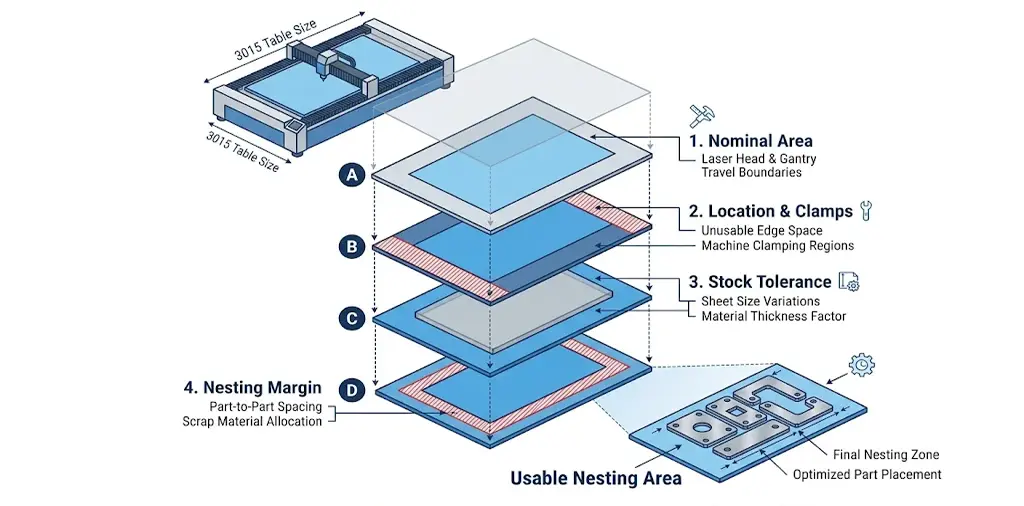
Layer 4 is the one buyers underestimate, and it is not a single figure. A 2014 Shop Metalworking Technology article on common-line cutting notes that parts need space for lead-ins, that thin skeletons may lack strength to hold parts, that microtabs need more space, and that heat-induced shifting shows on long, narrow parts. On a compact bed these margins take a larger share of the area.
A 3015 is the usual match for 1500 × 3000 mm sheet, but “match” is not “fits with a nest on it”. When working area equals nominal sheet size exactly, layers 2, 3 and 4 all come out of that same rectangle. Ask for the usable cutting rectangle with your sheet located. Any universal figure — always allow 100 mm, add ten percent — is a guess: clamp design, extraction zoning and slat layout differ.
4. The format ladder is longer than three numbers
| Published working area (mm) | What the step adds | What must be re-checked |
|---|---|---|
| 3000 × 1500 | Baseline | Whether layers 2–4 leave a usable nest |
| 4000 × 1500 | Length only | Long-part flatness, gantry travel, extraction along X |
| 4000 × 2000 | Width only | Whether stocked, sheet-pack width, doorway clearance |
| 6000 × 1500 | Length only, again | Long-axis accuracy, sheet support, skeleton removal |
| 6000 × 2000 | Length and width | Foundation, extraction zones, pallet mass and drive |
| 6300 × 2200 / 6300 × 2500 | Width steps at long length | Lifting gear, storage, sorting path, supply |
| 8300 × 2500 | Extra-long format | Floor plan, dual-drive sync, duct routing, logistics |
| 13000 × 2500 | Maximum published format | Whole-process review: logistics, extraction, acceptance |

“Only longer”, “only wider” and “both” are three different purchases. A length step keeps your sheet width and loading gear but changes gantry behaviour and full-travel accuracy. A width step changes what you buy and how it enters the building. Area ratios hide all of it.
A family overview is a navigation aid, not a controlling document: a category page and a model sheet can list different format and power ranges. Treat the specification sheet for your exact configuration as controlling, and ask for its revision date. Where no published format matches, request a written configuration check — area, power, head and loading system are confirmed together on that sheet. Power is a separate decision: a larger bed does not increase what the source can cut.
5. When the next size up actually pays
Measure four values on the format you run today: n, accepted parts per sheet counted at inspection; T_c, beam-on and motion time; T_h, loading, unloading, sorting and skeleton clearing; T_s, pallet or sheet-change time, counting only the non-overlapped part on an exchange table. Throughput is H = 60 × n / (T_c + T_h + T_s). Moving from A to B is worth the capital only when n_B / n_A > (T_cB + T_hB + T_sB) / (T_cA + T_hA + T_sA).
A bigger sheet raises n, but also the denominator: more cut length raises T_c, a heavier sheet and larger skeleton raise T_h, a heavier pallet raises T_s. As an illustration only — replace every value with timestamps from ten consecutive sheets on your own floor — 24 parts in 9 + 3 + 2 minutes gives 103 parts/hour, while 40 parts in 16 + 3 + 2 minutes gives 114. Eleven extra parts an hour, gone entirely if sorting rises to 5 minutes. Also measure u, the share of nominal area your real nests occupy: if u falls as the format grows, the n gain is smaller than the area ratio suggests. Michael Koch, writing in The FABRICATOR in 2023, put it plainly: “The automation has to be as fast or faster than the laser”. A larger format moves the bottleneck into loading, denesting and sorting.
Occasional oversized work gets its own arithmetic. Let f be the yearly count of parts exceeding your format; price the outside cut, the shearing and re-nesting, and the weld or alignment step a split design needs. Compare f × (C_outsource + C_split + C_join) against the annualised cost difference between formats, including floor space, handling gear and maintenance. If the left side is smaller, that job belongs outside the purchase. The enclosure decision is a separate one; see open-type vs fully enclosed fiber laser cutter.
6. Floor space, handling, and what a longer bed changes

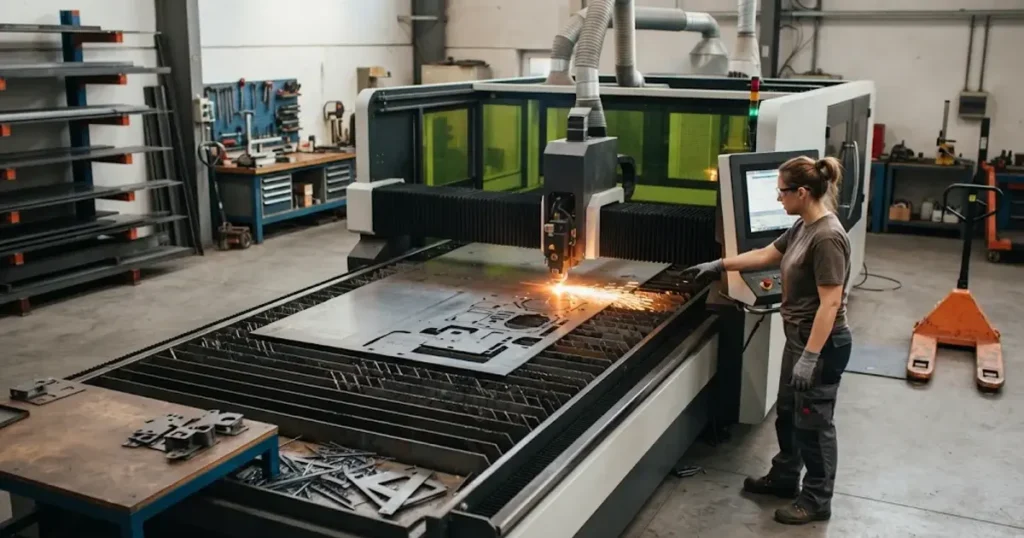
The working area is a rectangle on a specification sheet; the machine is a logistics system. A 2026 Sheet Metal Industries article on workshop layout notes that cutting tables need loading space on at least one side and room for a forklift or crane to swap sheet packs, before the machinery arrives. Route material in one direction so it does not cross its own path. In the United States, OSHA 29 CFR 1910.176(a) requires safe clearances for aisles, docks, doorways and turns where mechanical handling equipment is used. That is a general federal requirement, not a dimensional rule for laser tables; we do not assert compliance for your layout. Use it as a prompt to put clearances on the drawing.
Sheet weight (kg) = length (m) × width (m) × thickness (mm) × density (g/cm³). Use 7.85 for carbon steel, about 7.9 for stainless and 2.70 for aluminium. A 2000 × 4000 × 6 mm carbon steel sheet is 2.0 × 4.0 × 6 × 7.85 = 376.8 kg; the same footprint in aluminium is about 130 kg. A format that makes manual lifting marginal on thin gauge makes it impossible on plate, so the lifting method belongs in the format decision. CAMT technical support covers installation and commissioning and can review the access route while the layout is a drawing.
Four more things change:
- Accuracy over full travel. A short-bed positioning figure does not describe a 6 m machine. Ask for the test method and points at both ends and the centre of the longest axis, and put the result in the acceptance clause.
- Zoned extraction. Ask how many zones the bed has and what volume is extracted at the far end; poor capture there shows up as deposits on optics.
- Heavier pallet. Ask for the change time with your thickest sheet on board, plus pallet and storage rated loads — not the empty-table figure.
- Downstream equipment. Long thin sheet wavers, and a 6 m blank is only useful if the forming side can take it — see Choosing Bending Length, Throat Depth and Opening Height.
7. Match the format to your work, then to the machine
On standard 1500 × 3000 mm sheet with a mixed part list, start at 3015 and put the budget into a proven nest and handling. If 2000 mm stock is a regular purchase, evaluate 4020; if long parts recur weekly, evaluate 6020 or a longer format, with handling and sorting priced in the same quotation. If one occasional long part is the only reason to upsize, use Section 5 and keep it outside the purchase. If the work is a long profile, not a flat blank, the format question is the wrong one.
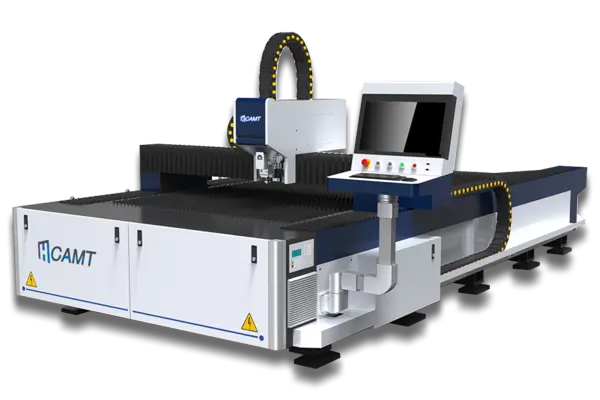
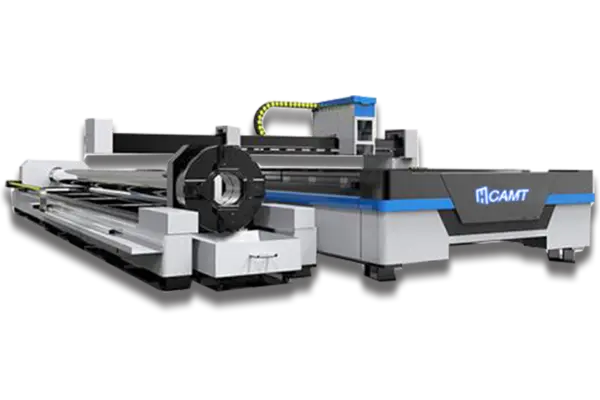
The CAMT fiber laser cutting machine range covers the two starting points: the ULF open-type single desktop fiber laser cutting machine (manual or crane-assisted loading) and the ULE exchange-table model mapped in Section 4. For long profiles, evaluate the ULT professional pipe laser cutting machine. As the format grows, quote operator and maintenance training and spare parts and consumables against the same serial number as the specification sheet. We will not claim a larger table is always more productive. If the arithmetic says a compact format plus an outside subcontract is better for your shifts, that is what we will quote. Contact CAMT with your sheet ledger and the fields below.
8. One worksheet for every supplier
Send the same sheet to every supplier; without it, two “4020” quotations cannot be compared. Fill in the left column, and require the right column back in writing.
| You fill in | Ask the supplier to state in writing |
|---|---|
| Ordered/measured width and length, tolerance, flatness | Usable cutting rectangle after stops, clamps and exclusion zones, with a drawing |
| Which axis is gantry travel, which is loading direction | Sheet orientation on the machine and the site drawing |
| Grade, thickness range, heaviest sheet | Maximum sheet weight, pallet and storage rated loads |
| Accepted parts per sheet, current nest occupancy u | Trial nest on your stock and drawing, with acceptance criterion and retained samples |
| T_c, T_h, T_s on ten consecutive sheets | Pallet-change time with a full-weight sheet, both table types |
| Door size, turning clearance, floor bearing | Installed footprint: machine, shuttle, extraction, chiller, cabinets, pallets |
| Crane coverage over loading point | Extraction zone count, switching logic, far-end volume, filtration |
| Downstream bending length, throat depth | Positioning test method, test length, points, instrument |
| Loading method, sorting capacity | Nesting capabilities for remnants, lead-ins, microtabs, grain — CAMT software support covers CAD/CAM integration and offline programming |
| Power, head, loading system selected | Spec sheet revision date, and confirmation that quotation, model, area, power and configuration match it |
The usable cutting rectangle, full-weight pallet-change time, installed footprint and trial nest are the four fields most often missing. Ask early, and cut the trial nest on your own stock before the specification is fixed.
9. FAQ
What is the most common laser cutting table size?
The 3015 (3000 × 1500 mm) is the most widely used format: it matches a common sheet size and keeps the machine compact. But if your mill delivers 2000 mm stock or your parts regularly exceed 3 m, it costs you a shearing operation on every job.
What is the difference between a 3015 and a 4020?
A 3015 has a nominal 3000 × 1500 mm area (4.5 m²); a 4020 has 4000 × 2000 mm (8.0 m²), about 78% more. It takes wider and longer sheets, but needs more floor space, heavier lifting gear and a higher investment. Section 5 tests whether that area converts into parts per hour.
Can a 3015 cut a 2000 × 4000 mm sheet?
Generally no — that sheet exceeds both nominal dimensions, so a 4020 or larger format is required. Note too that a 1500 × 3000 mm sheet does not automatically nest on a 3015: location stops, sheet tolerance and lead-in margins all consume the same rectangle. Ask for the usable cutting rectangle.
Is a bigger laser cutting table always better?
No. A bigger sheet carries more parts, but adds cut length, a heavier skeleton and a heavier pallet. Measure n, T_c, T_h and T_s on your own floor and compare the ratio of parts gained against the ratio of cycle time gained. If the second is larger, output per hour stays flat.
Does table size affect cutting accuracy?
Not directly — accuracy comes from the frame, motion system, drives, calibration and control. What changes with size is verification: a positioning figure measured on a short bed does not transfer to a 6 m or 13 m machine. Ask for the test method and measurements at both ends and the centre of the longest axis.
What should I send when requesting a quotation?
Send the left column of the worksheet in Section 8: ordered and measured sheet dimensions, grade and thickness, heaviest sheet weight, accepted parts per sheet, cycle timestamps, door and crane clearances, and downstream bending limits. Ask every supplier for the right column. Quotations missing the usable rectangle, full-weight pallet-change time or a trial nest are not comparable.