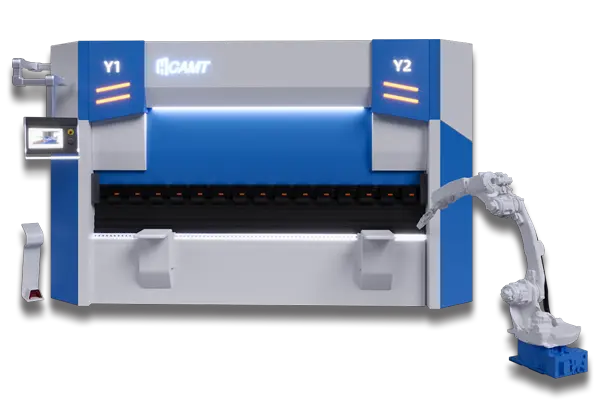
A fiber laser cutting machine is only as reliable as the components working together inside it. While laser power often gets the most attention when comparing machines, the laser source alone does not determine cutting performance. The cutting head, CNC control system, servo drive, transmission components, machine bed, cooling system, and gas supply all influence how accurately and consistently a machine processes metal.
In this guide, we explain the most important components of a fiber laser cutting machine, how each one works, and what buyers should evaluate before purchasing. We also look at how component quality affects long-term production efficiency, helping you choose a machine that matches your actual manufacturing requirements. The physics of the process itself is covered in our guide to how a fiber laser cutting machine works.
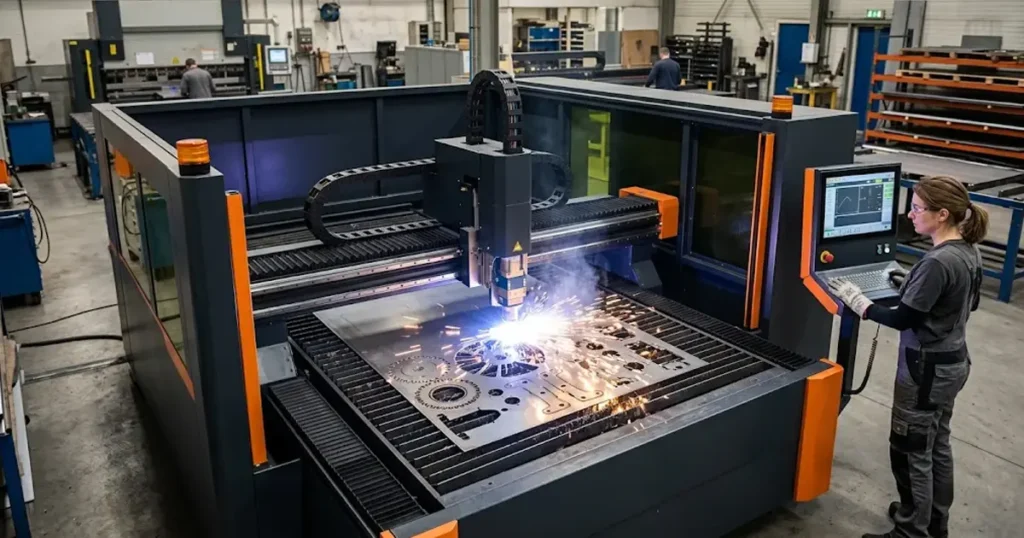
The Fiber Laser Source: What Sets the Ceiling
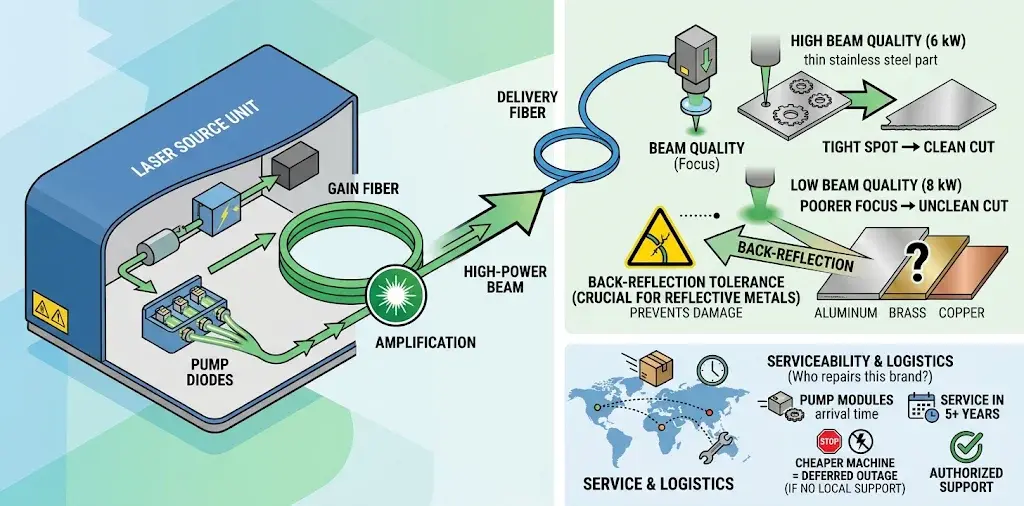
The source is a sealed unit. Pump diodes inject light into a doped gain fiber, the signal amplifies along that fiber, and the finished beam leaves through a delivery fiber to the head. Everything downstream is capped by what comes out of this box.
Two characteristics matter more than the kilowatt rating. Beam quality decides how tightly the beam can focus, and a tighter spot concentrates the same energy into less material — which is why a well-matched 6 kW source can outcut a poorly matched 8 kW one on thin stainless. Back-reflection tolerance decides whether you can cut aluminum, brass and copper at all: those surfaces bounce part of the beam back up the delivery fiber, and a source not built to absorb that return energy will trip or damage itself. If reflective metals are in your part mix, this belongs in the conversation next to power.
The source is the one component you cannot service yourself: it goes back to the maker’s network at module level, so the useful questions are logistical, not technical — who repairs this brand in your region, how fast pump modules arrive, and whether the machine builder can still get parts in five years. A cheaper machine built around a source with no local support is not a discount. It is a deferred outage.
The Cutting Head: Where Cuts Actually Fail

More engineering sits in the head than anywhere else on the machine. A collimating lens straightens the light leaving the fiber, a focusing lens concentrates it at or near the surface, a capacitive sensor tracks nozzle-to-sheet distance in real time, and the nozzle shapes the gas jet that clears molten metal from the kerf.
The cheapest part in that stack causes the most failures. A protective window — a cover glass sitting in front of the focus lens — takes the spatter, fume condensate and piercing backfire that would otherwise ruin expensive optics. It fails quietly. A single spot of contamination degrades edge quality across the whole machine, nothing alarms, and operators spend shifts adjusting power, speed and focus while the real cause sits behind the nozzle.
Service writers treat it as a standard diagnostic, documented in fiber laser service literature: bad cuts, traced to one spot on the window, fixed by a clean or a swap. Repeated window failures point upward — piercing parameters throwing molten metal back at the optics instead of sideways, which is why modern heads use lateral air jets during the pierce.
Focus is the head’s other job, and it is where the machine’s factory knowledge lives. Manufacturers map focus positions and nozzle gaps for every material and thickness, and that cutting library is only as good as the head’s ability to hit those positions repeatably. An autofocus head removes the most error-prone manual step in the process, and its adjustment range tells you how much of the library you can actually use. Look for crash protection too, so a tip-up or a wrong-height move costs a reset instead of a realignment.
The CNC and Software: How Much of the Machine an Average Operator Gets

The controller decides what fraction of the machine’s capability your real operators reach on a real shift. It reads the nested program, sequences pierces and cuts, trims power and speed through corners and small features, runs the exchange table, and alarms when something drifts.
Three things separate a serious control from a basic one. The cutting library should be deep and editable, tuned by the builder for the source and head it ships with — not a generic parameter table that leaves your operators dialing in every job. Piercing control should include progressive pierces for thick plate, since the pierce is where optics get punished and where cycle time quietly disappears. Nesting and tabbing matter more than buyers expect: parts nested too tightly without tabs tip up mid-cut, and a tip-up under a fast-moving head is a crash, not a rough edge. Many machine problems are program problems.
If automation is on your three-year plan — exchange tables, loading systems, production-data links — confirm at purchase that the platform supports it. Retrofitting a control is not a service call. It is a rebuild.
The Motion System: Judged at Its Worst Moments

Servos, drives, rack-and-pinion or linear-motor travel and preloaded guides do one job: put a focus spot within a fraction of a millimetre of where the program says, while accelerating hard and reversing direction hundreds of times a shift.
Never judge this system by its top speed. Judge it by its worst moments — how round a 3 mm hole comes out, how sharp an inside corner stays, whether the twentieth part matches the first after four hours of direction changes. Two mechanical faults show up in the cut long before they show up in a maintenance log. Backlash, the play that appears when direction reverses, leaves rounded corners and contour starts that miss their mark. Vibration from a weak structure or worn guides prints fine sawtooth marks along the edge. Both get blamed on parameters. Both are mechanical.
Guides and racks live on lubrication. Poor sealing and no automatic lubrication cost dynamic accuracy years before the laser dims.
The Machine Bed: The Part Nobody Asks About
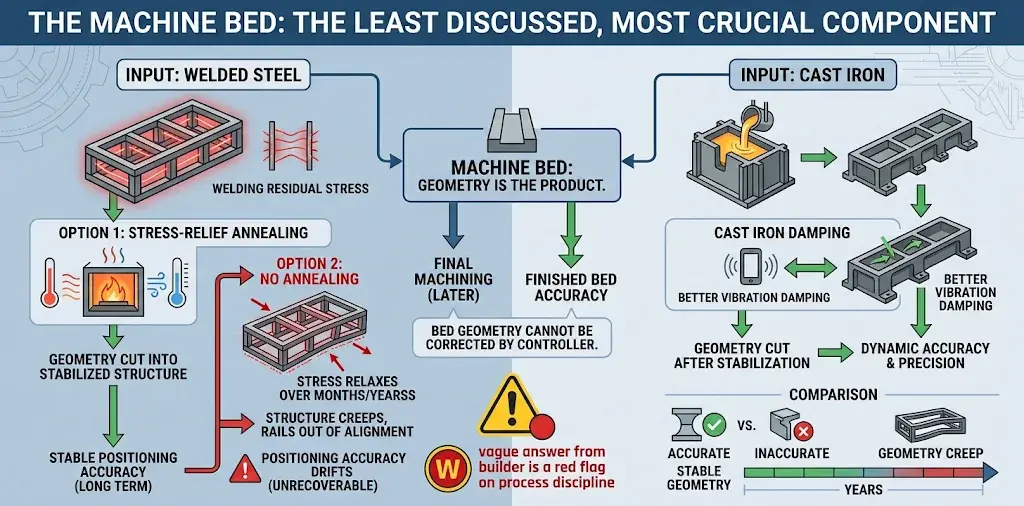
Under the rails and the table sits the bed — welded steel or cast — the least discussed major component in any buyer conversation and the most expensive to get wrong, because a bed that loses its geometry cannot be corrected from the controller.
Welded steel dominates fiber laser platforms because it scales to any table size, but welding locks residual stress into the steel. Left alone, that stress relaxes over months and years, the structure creeps, rails fall out of alignment, and positioning accuracy drifts in a way no parameter change recovers. The countermeasure is stress-relief annealing before final machining: heat the welded frame, cool it slowly, then cut the geometry into a stabilized structure.
Cast beds take the other route and remain common on precision machine tools because cast iron damps vibration better than steel — a property that matters when a gantry reverses direction all shift. Either approach can be done well or badly, and what separates them is process discipline, not the material name.
This is the one component where the manufacturing process is the product. Ask whether the bed is annealed after welding, at what temperature and for how long, and whether final machining happens afterward. A vague answer tells you more than any acceleration figure on the quote.
The Chiller: An Accessory Until It Isn't

The chiller is usually sold as auxiliary equipment bolted to the back of the machine, which is exactly how buyers undersize it. The source converts electricity to light and rejects most of the remainder as heat; the chiller carries that heat away at a stable temperature, hour after hour, and cools the head optics closest to the melt pool.
Two failure paths exist, and the second surprises people. The first is temperature: cutting performance tracks chiller stability, and a sustained excursion can damage the resonator — a repair measured in months rather than days.
The second is the water itself. Cooling circuits run on deionized water, and suppliers specify a conductivity ceiling because mineral-rich water corrodes the metal it touches. Water that sits idle drifts upward in conductivity, which is why many machines refuse to start the source after a long shutdown until the chiller has run and its self-checks pass. Run two shifts in a hot climate and chiller sizing, condenser cleaning and water quality stop being maintenance items. They become uptime.
The Assist Gas System: Where Edge Quality and Gas Bills Come From
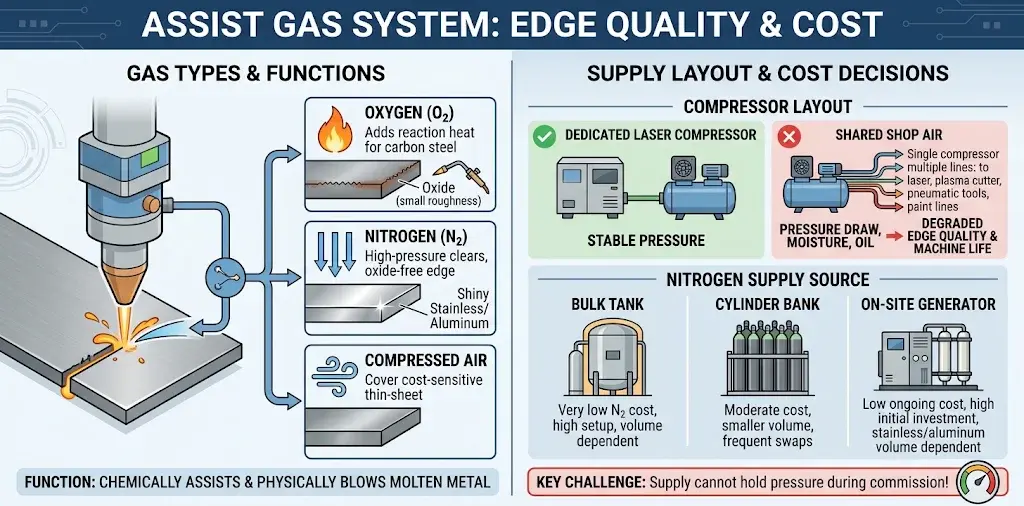
Gas does two jobs at once: it chemically assists the cut and it physically blows molten metal out of the kerf. Oxygen adds reaction heat for carbon steel, nitrogen clears stainless and aluminum at high pressure for oxide-free edges, and compressed air covers cost-sensitive thin-sheet work where a slightly duller edge is acceptable.
Two layout decisions then cost money for years. Give the laser its own compressor. If the machine shares shop air with plasma, paint lines or pneumatic tools, every one of those draws pressure away from the cut, and moisture or oil in that line degrades edge quality and machine life together. Decide how nitrogen reaches the nozzle — bulk tank, cylinder bank or on-site generator — because the three carry very different cost structures and the right choice depends on your stainless and aluminum volume. What does not work is discovering at commissioning that your supply cannot hold the pressure your cutting library expects.
The Systems That Get Cut From the Budget
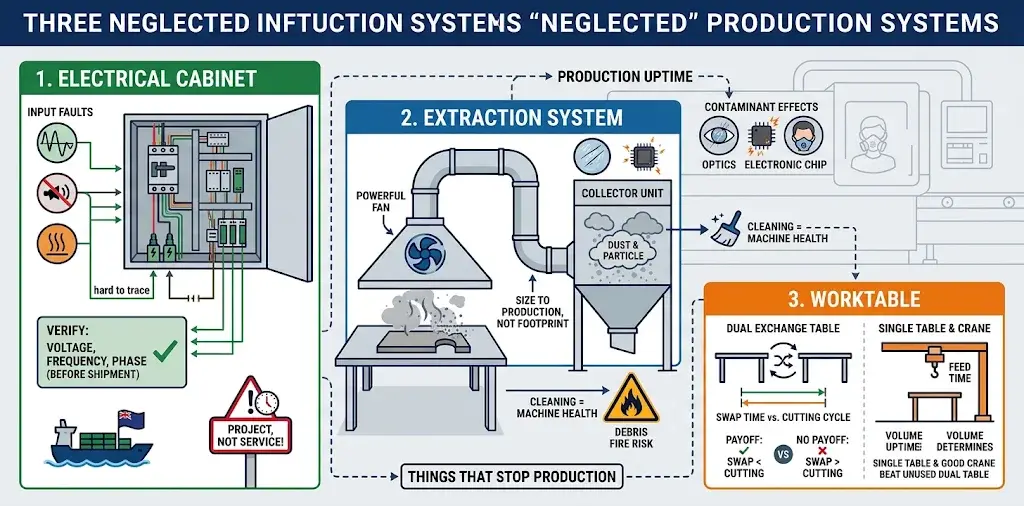
Three systems sit outside the main-component conversation and inside the list of things that stop production.
Electrical cabinet. Unstable distribution, poor grounding or inadequate cabinet cooling produce faults that are hard to trace: random alarms, communication drops, servo faults, sensor drift. On an overseas order, confirm voltage, frequency and phase configuration before the machine ships. Correcting it after installation is a project, not a service visit.
Extraction. Smoke, fume and particulate contaminate optics, electronics and operators. Size the collector to the dust your part mix produces, not to the machine footprint, and treat duct and filter cleaning as machine health rather than housekeeping — debris left in an uncleaned collector is a documented fire hazard in shops cutting mixed metals.
Worktable. An exchange table pays only if the swap finishes inside the cutting cycle. Measure your real load and unload time against your real cycle time before paying for the platform. On low-volume work, a single table and a good crane position beat a dual table you cannot feed.
Wear Parts vs Capital Components: Where the Money Actually Goes
The most useful way to think about these components is not by location but by how each one ages. Capital components are chosen at purchase and either last the machine’s life or fail expensively. Wear parts are consumed by cutting and belong in the monthly budget. Confusing the two — treating the chiller as an accessory, or the protective window as a one-time part — is how ownership costs surprise a new shop.
| Component | How it ages | What you see when it is wrong | Ask the supplier |
|---|---|---|---|
| Protective window | Consumable, changed on condition | Edge quality decays across all jobs; power readings sag | Cost per kit, local stock, cleaning procedure |
| Nozzle | Consumable, wear and spatter | Inconsistent kerf, dross on one side, gas waste | Orifice sizes stocked; how changes are made |
| Focus and collimator lenses | Long-life optics, not daily items | Gradual power loss that window changes stop fixing | Replacement price; who realigns after service |
| Pump diode modules | Long life, swapped at module level | Power instability, source alarms | Module turnaround in your region |
| Chiller resin and filters | Scheduled consumables | Conductivity alarms, source refuses to start | Resin interval; filter part numbers |
| Rack, guides, lubrication | Long life, condition-based | Corner rounding, backlash, sawtooth edges | Sealing, auto-lube, inspection interval |
| Machine bed | Permanent if stress-relieved | Accuracy drift no parameter fixes | Annealing process and machining order |
Consumable pricing belongs in the supplier comparison, not in the invoice after commissioning. A machine whose windows and nozzles ship in two days from local stock costs less per month than a nominally cheaper one waiting on international freight — which means the spare-parts list should be quoted, with unit prices and delivery terms, before you sign. Kits for all supported machines are listed on our spare parts and consumables page.
The Questions That Separate Two Machines With the Same Power
Put the parts back together and the purchase decision gets simpler. Money spent upgrading one component past the others is wasted.
| Component | What it decides | The question that separates machines |
|---|---|---|
| Laser source | Thickness, speed, reflective-metal capability | Who services this brand locally, and how fast do modules arrive? |
| Cutting head | Edge quality, focus repeatability, crash survival | Autofocus range? Window cost per kit? Pierce strategy tuned to protect optics? |
| CNC and software | Operator productivity, nesting efficiency | Is the cutting library tuned for this source and head, or generic? |
| Motion system | Dimensional accuracy, corner quality, throughput | Positioning accuracy, repeatability and acceleration — proven by a sample cut, not a spec sheet |
| Machine bed | Long-term geometry, vibration | Annealed after welding? At what temperature, for how long, before final machining? |
| Chiller | Uptime, source life | Independent circuits? Temperature accuracy? Rated for your ambient? |
| Assist gas | Edge quality, gas cost | Can supply hold pressure through a full nested sheet? |
| Electrical, extraction, table | Traceable faults, safety, throughput | Voltage and phase confirmed? Collector sized to your dust load? Swap time under cycle time? |
Three rules put the budget where it pays.
Match the source to your daily part mix, then stop. Power beyond your thickness range buys nothing, and paying for it by trimming the head, bed or chiller makes the extra power unusable anyway.
Weight what you feel every shift. For a mixed job shop, autofocus, a deep cutting library and reliable nesting return more per shift than extra kilowatts. For dedicated thin-sheet work, acceleration and corner control lead. For thick plate, gas supply and source stability decide.
Buy the support, not just the machine. Regional source service, locally stocked consumables and a builder who answers process questions after commissioning are components too — invisible ones that appear the day something stops working.
Configure the Machine Around Your Work
CAMT builds fiber laser platforms around the job, and the range maps to three different production problems. The ULF open-type single-table machine suits straightforward sheet work where value per part matters more than automation. The ULE enclosed exchange-table machine is for shops where safety and continuous throughput justify the platform. The ULT pipe and tube machine takes round, square and profile stock that no flat-bed machine can touch.
Configuration here starts from your production data, not our catalogue. Send your material types, maximum thickness, sheet or tube dimensions and expected monthly volume, and our engineers will recommend a source power, head, table configuration and gas supply matched to that mix — with the consumable list and local stock position attached, so ownership cost is visible before the purchase order rather than after commissioning. Drawings or a parts list are enough to start.
If you want proof before a decision, send a sample in your own material and thickness. We will return cut parts with the parameters used, so you can check edge quality, cycle time and gas consumption against whatever machine you are currently comparing.
Browse the full fiber laser cutting machine range or send your drawings to our engineers to begin.
FAQs: What Are the Most Important Components of a Fiber Laser Cutting Machine?
What are the main components of a fiber laser cutting machine?
The fiber laser source, the cutting head with its optics and nozzle, the CNC controller and software, the servo-driven motion system, the machine bed, the water chiller, the assist gas system, and the electrical and extraction systems that support them.
Which component matters most?
None of them alone. The source and head set the ceiling on what the beam can do, the bed and motion system decide whether that performance holds a tolerance, and the chiller and gas system decide whether it holds for years or months.
Which parts are consumables, and how often do they need replacing?
Protective windows and nozzles are the high-frequency items, changed on condition rather than on a schedule — often weekly on two-shift work, less on light use. Ceramic rings, seals, chiller resin and filters follow at longer intervals. Focus and collimator lenses are long-life optics, not daily consumables, and treating them as such leads to unnecessary replacements.
Does higher laser power always mean better cutting?
No. Power raises the ceiling on thickness and speed, but a machine with a weak bed, a mismatched head or an unstable gas supply will never reach it. Many shops get better returns from a properly matched 6 kW machine than from an oversized source trimmed elsewhere.
My settings have not changed, but cut quality has dropped. Where do I look?
Settings last. Check the component side first: a contaminated protective window, a worn or damaged nozzle, gas pressure drift, or chiller temperature outside its band. If the fault follows a shift pattern rather than a material change, it is almost always a consumable or a supply issue.
What should I confirm before placing an order?
Four things: the source’s local service network and module turnaround, the consumable list with unit prices and delivery terms, the bed’s annealing process, and a sample cut in your own material and thickness. Those answers predict year three better than any specification sheet.