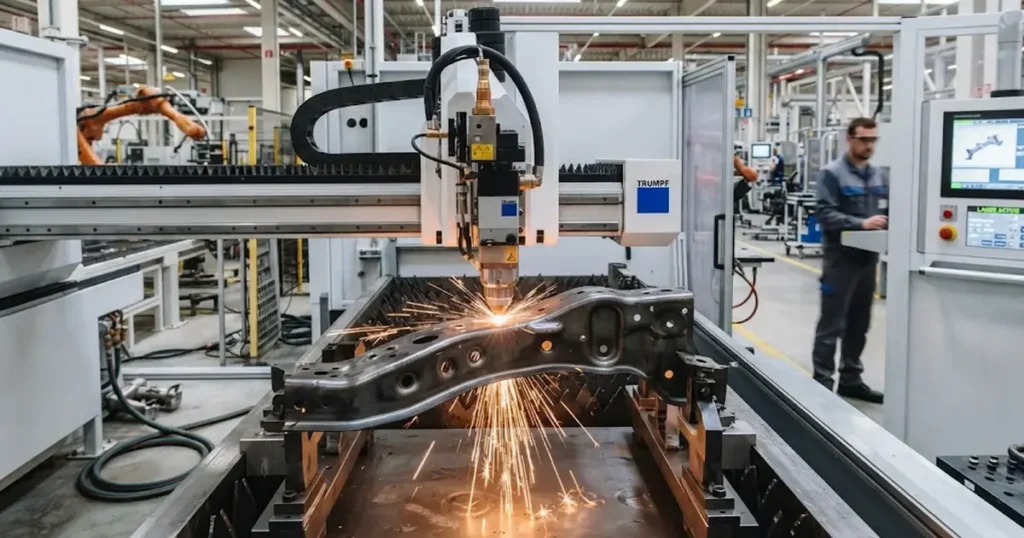
Fiber laser cutting has become an important manufacturing process for automotive sheet metal components because it can produce complex profiles, accurate holes, and repeatable geometries without dedicated cutting dies. However, selecting the right laser cutting machine is only part of the equation. Material properties, sheet thickness, cutting parameters, edge quality, nesting efficiency, and production automation all influence the final result.
This guide explains how to choose suitable materials, achieve reliable cutting precision, and configure an efficient laser cutting process for automotive parts production.
What Buyers Actually Mean by Materials, Precision and Production Requirements
Four layers have to be agreed before those words become enforceable. They have different owners; treating them as one “precision problem” is why corrective-action reports end with “operator to be more careful”.
| Layer | Who defines it | How it is verified | What breaks it | What the contract must state |
|---|---|---|---|---|
| Drawing tolerance | Your design authority | Inspection against a stated datum scheme | Missing datums, ambiguous general-tolerance note | Tolerance value, datum scheme, standard and edition year |
| Cut-edge condition | Your process and downstream owners | Reference samples plus the downstream process test | Dross, oxide, burr, taper, coating damage | A separate edge clause; a clean edge is not a class |
| Process capability | Your quality team | Repeated measurements across shifts, lots and maintenance events | Drift a first-off reading cannot see | Characteristic monitored, sampling frequency, record owner |
| Change control | Both parties, in writing | Re-qualification against the signed first-off sample | New coil, gas, nozzle, program revision, calibration, fixture change | Trigger list and what each requires before release |
A machine specification answers only part of the second row. A supplier can hand you a well-measured machine and still deliver parts that fail assembly, because the datum, the lead-in burr and shift drift were never in the agreement. Put the four rows into the RFQ as four questions.
Laser cutting vs. stamping: choosing by volume and design stability
Flat-sheet work covers chassis brackets, seat-frame supports, battery enclosure panels, reinforcement plates, exhaust and heat-shield parts, and prototype blanks; tubular seat frames are a separate machine class. What these parts share is a downstream operation — welding, bolting, coating, bonding or sealing — that punishes a bad edge.
Laser cutting and stamping are complements, not rivals. The choice is a volume and design-stability decision, not a brand claim.
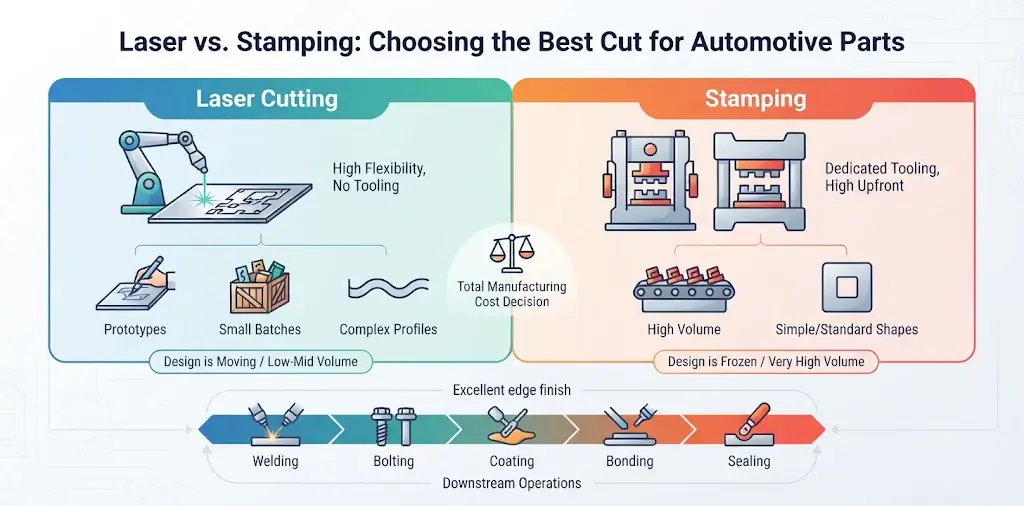
| Decision | Fiber laser cutting | Stamping |
|---|---|---|
| Tooling | No dedicated cutting die | Dedicated dies, higher upfront cost |
| Prototypes and pilot builds | Well suited | Tooling cost dominates |
| Small and mixed batches | Often cost-effective | Cost per part stays high |
| Very high volume of one stable part | Cycle time can be the limit | Usually lower unit cost |
| Complex 2D profiles and hole patterns | Highly flexible | Depends on die design |
| Speed | Depends on geometry, thickness and handling | Very high on suitable parts |
| Material utilization | Nesting and remnant control | Strip layout and offal design |
Choose laser when designs are still moving, volumes are low to moderate, or one fiber laser cutting machine must serve several part numbers. Choose stamping when the design is frozen and volume is consistently very high. Many suppliers run both. Decide on total manufacturing cost, not cutting cost alone.
Hot-formed steel is where the two are not alternatives. Frank Geyer, writing in The FABRICATOR in 2013, described how the strength of hot-formed parts makes hard-die trimming impractical, which is where multiaxis laser cutting found its role in post-forming trim and hole cutting. That is a 2013 account of one route, not a current specification; it shows why the edge here is functional, not cosmetic.
Automotive metals fail differently in laser cutting, impacting downstream steps
Automotive cutting is not one material with one recipe. AHSS, coated sheet, aluminum and stainless each fail differently and push cost downstream. Qualifying on one sample sheet proves nothing about the rest of the bill of materials.
| Material family | Typical parts | What changes or fails first | What to lock in the RFQ |
|---|---|---|---|
| Carbon steel | Brackets, mounting plates, crossmembers | Oxide from oxygen cutting; underside dross | Assist gas, edge condition before welding or coating |
| HSLA, dual-phase and other AHSS | Reinforcements, safety structures | Strength level, residual stress, edge hardness, microstructure | Grade, heat lot, whether cut before or after forming |
| Stainless (304 / 316) | Exhaust parts, heat shields, trim | Discoloration, dross, protective film handling | Film handling, edge reference sample, cleaning owner |
| 5xxx / 6xxx aluminum (5052, 5754, 6061) | Battery trays, thermal parts, lightweight supports | Alloy and temper, reflectivity, distortion on thin panels | Temper, written suitability for reflective stock, flatness |
| Galvanized and coated sheet | Body structures, corrosion-protected panels | Coating weight, zinc fume, e-coat adhesion at the edge | Coating type, fume handling, who signs off the coating trial |
| Hot-formed boron steel | Post-formed trim and hole cutting | Trim quality after forming, weld fit-up | Cut-after-forming route, edge integrity |
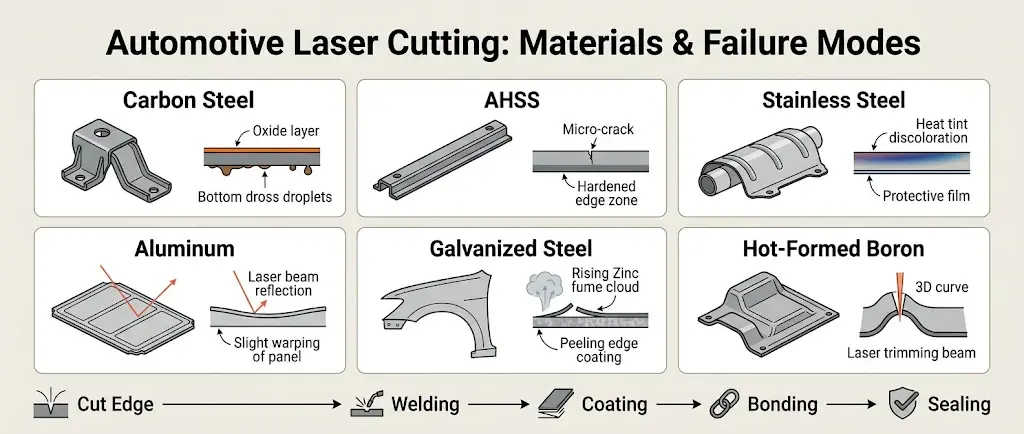
On automotive parts the cut edge is rarely finished — it is the input to a weld, an e-coat line, an adhesive bond or a sealing joint. An oxygen-cut carbon steel edge carries oxide that must be handled before welding or coating; a nitrogen-cut edge can still carry dross or a burr, so oxide-free is not ready-to-weld. Coating, fume and downstream adhesion belong in one acceptance clause.
A kerf is the width the beam removes; the heat-affected zone is material whose microstructure changed without melting; temper is an alloy’s delivered condition, not its grade. A 2022 Sheet Metal Industries report on hot-formed aluminum components, supplied by the equipment vendor involved, shows the coupling: alloy, forming route and heat-treatment parameters were defined together after trials with several suppliers, then validated before industrialization. Borrow the mechanism, not the numbers — a new grade is a process-development project, and vendor-supplied cases are not independent data.
Reflective and coated stock brings equipment-safety questions: aluminum and copper alloys can return light into the beam path, and fume handling depends on the configuration. We do not assert compliance or suitability for your material mix — that must come from the equipment supplier in writing, with your site EHS team. Ask before release: is this material rated for the configured source, what back-reflection protection is fitted, and what are the optic grade and inspection intervals. ISO 11553-1 and ANSI Z136 are the laser-safety references by name; guarding, extraction and high-pressure gas are settled in writing, not inferred from a product page. Document that review with technical support before ordering, and put the guarding scope under safety arrangements.
Sustain laser cutting quality via material, process, and inspection logs

A first-off reading is one point, not a distribution. What holds a program is evidence collected before anyone knew there would be a dispute.
Three records do most of the work. The material record identifies grade, heat, coating, thickness and incoming flatness. The process record snapshots the program version, assist gas supply, nozzle and lens state, focus reference and any maintenance event in the time window. The inspection record names the characteristic, gauge, datum, sampling location, reading count and whether lead-ins or tab break-outs were excluded. With those three, both parties first agree which characteristic is in dispute — a dimension, an edge condition, a burr, an oxide layer.
Re-qualification triggers to write down: a new heat, coating lot or supplier; a gas supply change or generator service; a nozzle, lens or focus-zero change; a program or nesting revision; any alignment, height sensing or calibration event; and a fixture, datum or inspection-method change. Each re-opens the parameter set as a whole — controller sign conventions differ, so check the manual first. Changing one gas is not “the same program with one line edited”.
First-article inspection is part of this package, not the end of it: record dimensions, hole position, contour, edge condition and flatness against the approved drawing, then keep the signed sample with the parameters that produced it. This feeds your production approval process — PPAP where your customer requires it — but a supplier delivers inputs, not approval; your quality system owns that decision. A library that lives only in one operator’s memory is not a controlled process: program revisions and backups belong to software support, beam and focus recalibration to maintenance and upgrades, and both are handover items.
Front-end engineering matters as much as the cut. Tim Heston’s 2016 account of coil-fed laser blanking entering production describes how flatness, leveling and handling had to be engineered before the line could serve automotive customers — throughput is a line property, not a head velocity.
Troubleshooting: Read the Evidence Before Changing the Program
When defects repeat, changing several parameters at once makes the cause invisible. Check the three records first, then work down this table.
| Symptom | First thing to check | Then adjust |
|---|---|---|
| Excessive dross | Gas supply at the point of use, nozzle condition, focus reference | One parameter at a time, then re-cut a coupon |
| Incomplete cutting | Material thickness against the recipe, protective lens state | Power delivery and focus, not speed first |
| Distorted thin panels | Residual stress, part spacing, cutting sequence | Nesting layout and sheet support |
| Out-of-size holes | Piercing parameters, datum and gauge alignment | Hole-specific recipe, then true position |
| Rough or tapered edges | Optic contamination, nozzle concentricity | Cutting recipe, one change at a time |
| Quality drift between batches | Material lot, consumable state, program revision log | Re-qualify against the signed first-off sample |
If the disagreement is about fit rather than the cut, check whether the allowance was ever in the precision budget. A configured machine reduces a risk; it does not replace the acceptance contract.
Matching the Configuration to the Bottleneck
Cutting speed is the easiest number to quote and the least useful to plan with. Geyer’s 2013 account makes the point: cycle time includes cutting, loading, handling, unloading and head positioning, not just contour velocity. A part with many holes forces repeated reorientation, so two parts from the same grade can have very different real cycle times.
| Bottleneck in your program | Machine class | Configurations listed on the site | What to ask before ordering |
|---|---|---|---|
| Prototypes, custom jobs, mixed low-volume batches | Open-type single-table ULF | 1–6 kW; 1500×3000 mm and 2000×4000 mm working areas | Table access and changeover frequency |
| Repeated batches where loading interrupts cutting | Enclosed exchange-table ULE | 6–12 kW; fully enclosed; automatic pallet exchange | Part mix, peak takt, loading sequence |
| Round, square and rectangular tube work | Plate-and-tube ULT | 1–6 kW; plate-and-tube cutting; manual clamping chuck | Tube range and joint preparation |
All figures above come from the site’s model pages; the model sheet with its revision date governs. Confirm any automatic loading, unloading or bevel capability in writing rather than assuming it from a category page.
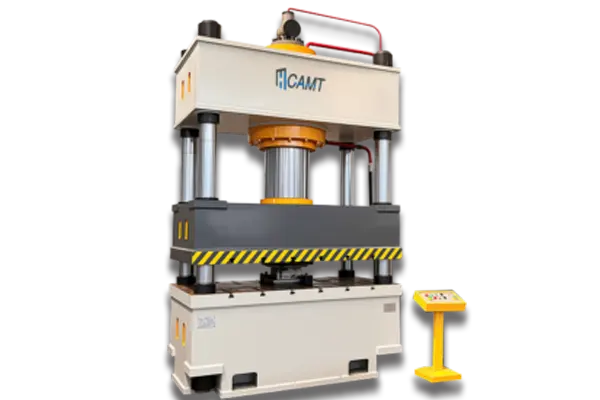
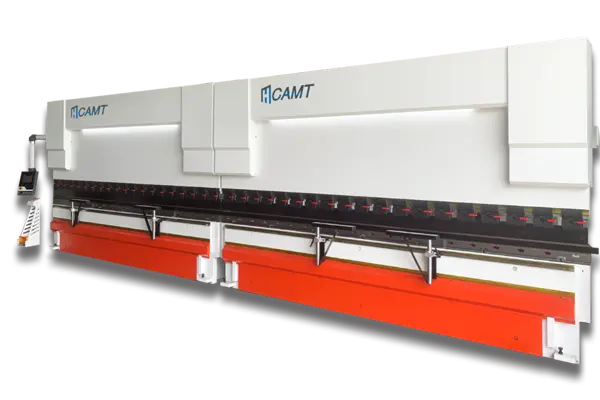
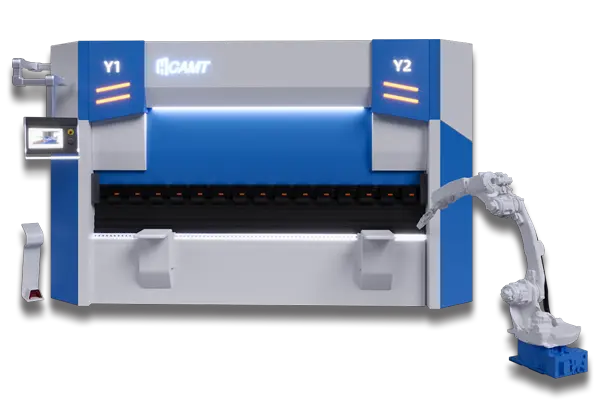
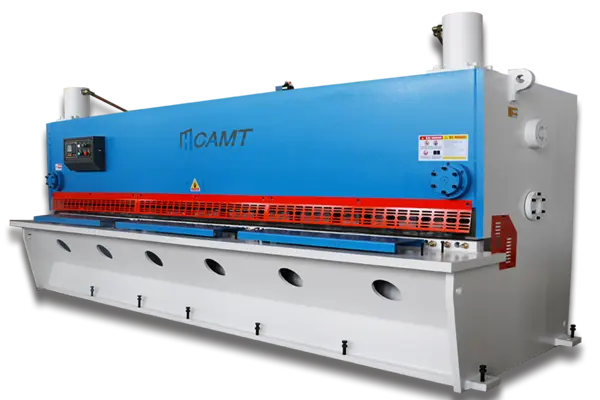
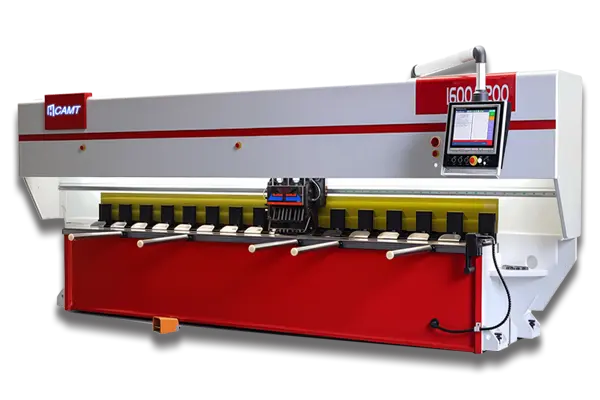
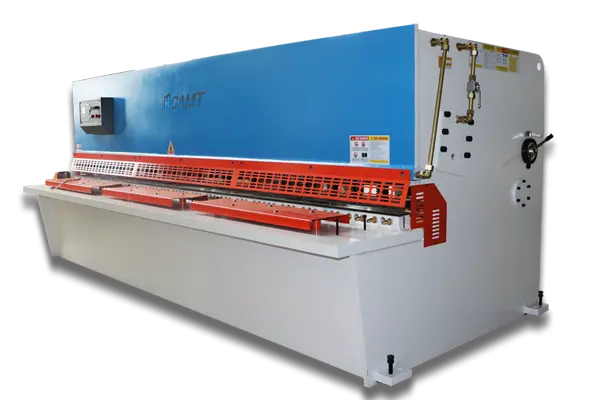
Laser cutting is usually the first operation, not the last. Brackets go to a CNC press brake, blank preparation to a hydraulic shearing machine, and selected forming work to a hydraulic press machine. All three consume the tolerance allowance, so the budget above has to be agreed before the configuration is fixed.
Define buyer requirements and supplier deliverables clearly in RFQ annexes

Require written answers as an annex to the purchase order. Both sides can then see which field is still blank.
You provide: the drawing with datum scheme, individual tolerances and general-tolerance standard with edition and class; grade, coating, temper, thickness range and incoming flatness; downstream route (weld, e-coat, powder coat, adhesive, sealing); annual volume, peak takt, part mix and changeover frequency; inspection method, gauge, uncertainty and sampling plan; change-notification rules and re-approval authority; traceability requirements; your reflective and coated material list and site EHS requirements.
The supplier returns in writing: a signed first-off sample plus the parameters that produced it; the model sheet with its revision date; a separate edge clause covering dross, oxide, burr and taper; a functional description of loading, unloading and table configuration; the parameter-library field list, version format and backup ownership; a written re-qualification trigger list; the revision log format and who can approve a revision.
We will not promise an achievable ISO 9013 quality class for any model — that is measured on your material and configuration — and we provide a signed first-off sample plus its parameters, with your inspection setting the baseline. We will not assert compliance with your plant’s safety or quality system, nor say our machines never fail. Our records are inputs to your production approval, not a substitute.
Operator familiarity is part of the package: training should cover recipe changes and shift handover, not just startup, and nozzles and protective windows are consumed on a working-hours clock — put those on the spare parts and consumables order with the machine. Installation, commissioning and support are listed on our services page.