Buying a fiber laser cutting machine is a significant investment for any metal fabrication business. However, comparing prices from different manufacturers can be confusing. Two machines advertised with the same laser power may have noticeably different quotations, even when their working areas appear similar.
The reason is that fiber laser cutting machine price depends on much more than laser power. The laser source, cutting head, machine bed, motion system, CNC controller, automation level, safety configuration, and after-sales support all influence the final cost.
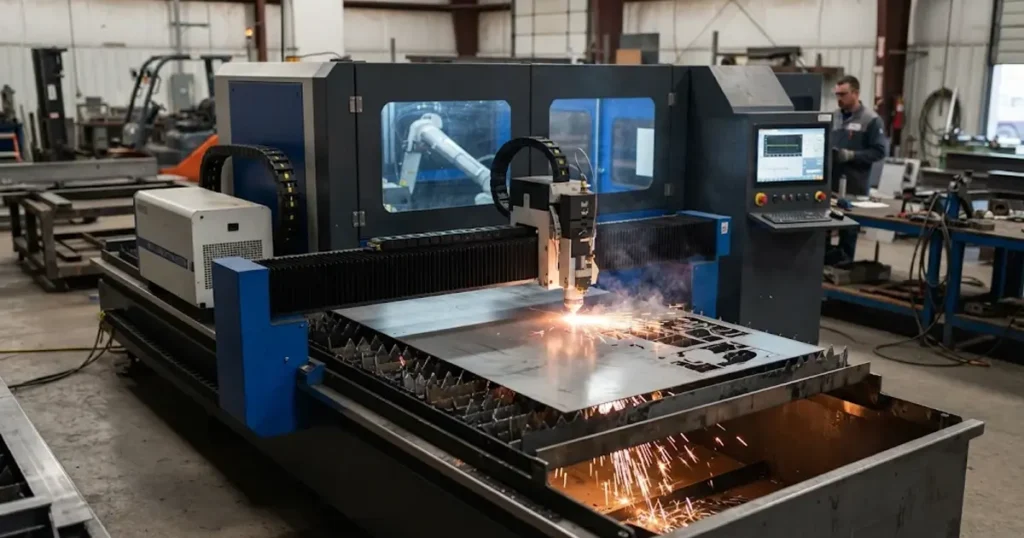
1. What does a fiber laser cutting machine cost?
| Configuration | What it actually includes | The threshold it crosses | Relative investment level |
|---|---|---|---|
| Entry open-type, single table | Basic source and head, manual loading, no enclosure | One shift, thin sheet, narrow part family | Lower |
| Standard production machine | Larger envelope, upgraded motion and control, single table | More sheet per shift, wider material mix | Medium |
| Enclosed machine with exchange table | Guarding, interlocks, twin pallets, extraction integration | Continuous shifts, loading time becomes the bottleneck | Medium to high |
| High-power machine on a heavy frame | Larger source, matched head optics, cooling and site supply | Thick plate in the regular workload, not as an exception | High |
| Automated cell with storage | Load and unload, tower, part sorting, line control | Labour and material flow, not cutting, limit output | Highest |
These are relative levels, not market prices. Published figures for this query disagree by more than an order of magnitude, and any single number would be a snapshot of one configuration, one component market, one steel price, one exchange rate and one freight rate on one day. A generic price list prices one component in the machine. It cannot price your row.
Before reading either total, align the three boundaries in the next section. Buyers who compare totals first are comparing two different products.
2. Four factors define why laser cutting machine quotes differ in price
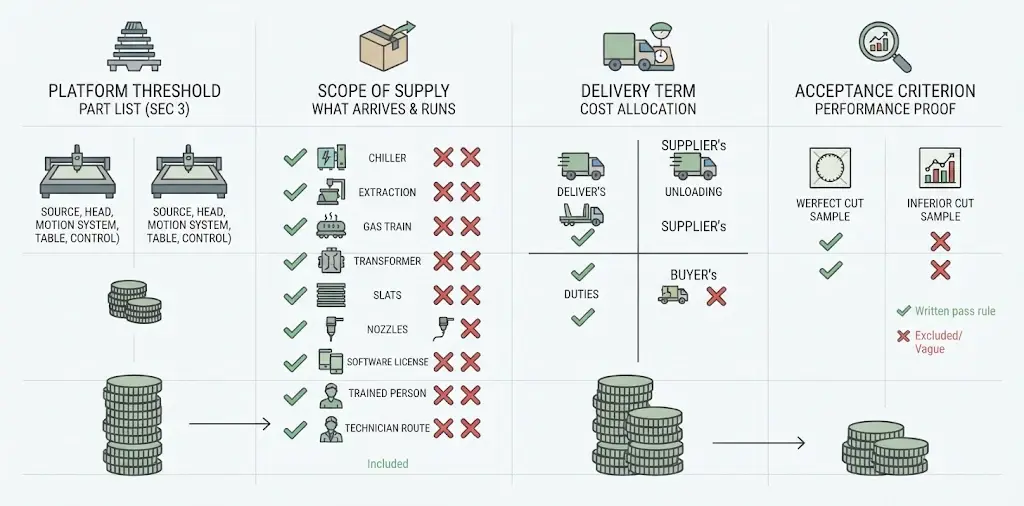
A quotation settles four things at once. The platform threshold comes from your part list (section 3). The other three are choices each supplier makes for themselves.
The scope of supply. What physically arrives, what is switched on, and what keeps running. A cutting machine needs a source, a head, a motion system, a table and a control. To run, it also needs a chiller sized for the source, extraction and ducting, an assist-gas train, a stable electrical supply and a floor that will take the frame. To keep running, it needs nozzles, protective windows, slats, software licences, trained people and a route to a technician. Which of those sit inside the quoted number is a decision, not a standard.
The delivery term. Export Development Canada’s guide states that Incoterms rules define “who pays for transportation, packaging, unloading and duties” (EDC, 27 May 2026). The same guide is explicit about what the rules do not do: even with a term selected, they do not “address all conditions of a sale”, do not “identify the goods being sold or list the contract price”, and do not specify the documents your clearance needs. A delivery term allocates costs; it does not describe the machine or fix its price. Two quotes that both say “delivered” can still leave the chiller, the extraction, the transformer and the commissioning engineer on your side of the line. An ex-works number and a delivered number are not two prices for one machine.
The acceptance criterion. “Cuts 20 mm” is not one claim. It is different claims depending on material, assist gas, pierce time, edge quality and how many consecutive parts have to pass. ISO 9013 gives the industry a shared language for thermal-cut quality, but a standard name on a brochure is not an acceptance test. Without a retained sample cut from your own material and a written pass rule, the performance lines in two quotations are not comparable however similar the numbers look.
Three units that make unlike quotes look alike
Buyers reach for a unit because they need to divide one number by another. Aligning the configuration is a necessary condition for comparison; using kilowatts or table size as the denominator is a different and wrong move. Three of the usual units fail for this machine.
| Unit | Why it fails | Use instead |
|---|---|---|
| Cost per kilowatt | The kilowatt step changes the head, chiller, extraction, gas train, motion system and site supply together. Two 6 kW machines can share almost nothing but the nameplate | The total difference between two quotes aligned on scope, delivery term and acceptance criterion |
| Maximum cutting thickness | A single reachable result, quoted without material, gas, pierce time, edge criterion or the number of consecutive parts that must pass. It is not a production rate | A production thickness band and a cutting speed you measured on your own three jobs |
| Nominal table size | Describes the bed. It says nothing about how a sheet reaches it, how the skeleton leaves, or where the extraction zones are | Nestable area on the sheet you actually buy, plus measured sheet-change time |

Under all three sits a more basic mistake: counting parts. A bracket with two metres of cut edge and a nested panel with eighty metres are both “one part” to a job ticket, but they are not one part to the source, the gas meter, the nozzle or the slats. A job shop quotes in parts; the machine wears in metres of cut edge and hours of laser-on time. Whichever unit you use to compare machines has to be the machine’s unit, or the comparison will quietly favour whichever quote happens to suit your current part mix.
Two defensible denominators, both built from your own numbers: cost per accepted metre equals annualised machine, site and service spend divided by metres of cut edge accepted per year; cost per available laser-on hour divides the same numerator by laser-on hours available per year. “Accepted” is doing real work in the first one — scrapped parts and reworked edges do not belong in the denominator. The second has support from the shop floor, not just arithmetic. A 2023 FABRICATOR article separates part cost into “equipment, job costs (things like the material purchased or the assist gas used), and labor”, then states plainly that “a laser machine’s charged hourly rate hinges on throughput” (Thompson, Cuseo and Quaranta, 24 May 2023). A machine that completes more billable work in the hours available is a different asset from one with a lower hourly cost and nothing to cut. Shops budgeting for forming as well as cutting can apply the same cost breakdown with our press brake price guide.
We would not tell you which of two machines wins on these denominators without your job list. That is a calculation for your own numbers, and a supplier’s confidence is not evidence.
Where CAMT's machines and services sit on these thresholds
We build these machines, so read this as a map of where each threshold lands in our range rather than a recommendation.
| The threshold in your enquiry | Where to read it on our site |
|---|---|
| 1–6 kW, open single table, hand loading, tight floor space | ULF open-type single desktop fiber laser cutting machine |
| 6–12 kW, enclosed housing, twin pallets, continuous shifts | ULE enclosed-type exchange table fiber laser cutter |
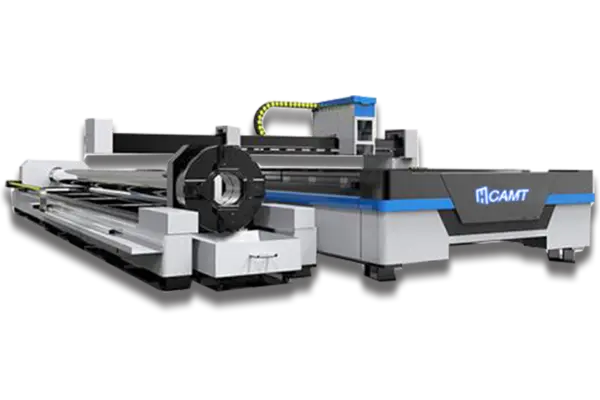
| Round, square or rectangular tube, or a plate-and-tube mix | ULT professional pipe laser cutting machine |
| Format still open between the three | Fiber laser cutting machines |
| Nesting, CAD import and offline programming licences | software support |
| Commissioning, start-up and fault diagnosis | technical support |
| Operator instruction and a second trained person | training |
| Nozzles, protective windows, slats and part numbers | spare parts and consumables |
| Long-term service and later upgrades | maintenance and upgrades |
Get a quotation based on your part list
The price of a fiber laser cutting machine is set by the complete configuration, not by its laser power. Choosing well means balancing the initial investment, cutting performance, production efficiency, component reliability and long-term operating costs against the work you actually have.
Tell us your material types, thickness range, sheet format, weekly laser-on hours, production volume, delivery destination and the Incoterm you want quoted. We will come back with a configuration, a line-by-line included, excluded and optional list, and our reasoning — including where a smaller machine would do the same work. Start at Contact CAMT.
FAQ About Fiber Laser Cutting Machine Price
How much does a fiber laser cutting machine cost?
There is no single figure worth printing, and a number given without a specification, a delivery term and an acceptance criterion is not a quotation. Section 1 gives relative investment bands rather than market prices. Use section 3 to find your own threshold, then price that same row with three suppliers.
Why do two quotes for the same kilowatts differ so much?
Because the kilowatts describe one component, not the machine. The two suppliers have usually placed the dividing line between “included” and “by buyer” in different places — chiller, extraction, gas train, licences, installation, spares and response time are the common ones — and they may quote different delivery terms and acceptance rules. Align the three boundaries before reading either total.
Is a higher-power machine always more expensive to own?
It has a different cost structure rather than a uniformly higher one. Stepping up a power band changes the source together with the head optics, cooling, extraction, gas demand and site supply, and it can shorten cycles enough to change what one shift produces. Whether that pays depends on how many laser-on hours you actually sell; section 4 tests the occasional thick plate.
Does the quoted price include installation, assist gas and extraction?
Not necessarily, and a delivery term will not tell you. Incoterms rules allocate transport, packaging, unloading and duty costs between buyer and seller; they do not describe the goods or list what is in the price. Ask for a line-by-line scope with each item marked included, excluded or optional, plus the quotation validity and the lead time’s starting point.
Is buying a fiber laser cutting machine from China a good investment?
Apply the same three boundaries to any supplier, us included. Ask for the source, head, control, drives and reducer by make and model, the warranty in writing, spare part numbers with a response time, and an acceptance run on your own material. A supplier who explains the configuration clearly and names what is excluded is easier to audit than one who only quotes a total.
How do I get an accurate quotation?
Send your materials, minimum and maximum thickness, sheet format, weekly laser-on hours, whether you need an exchange table or enclosure, your delivery destination and the Incoterm, and the acceptance criterion you will measure against. Those are the fields in section 8. A configuration-based answer follows from that list, not from a model number.