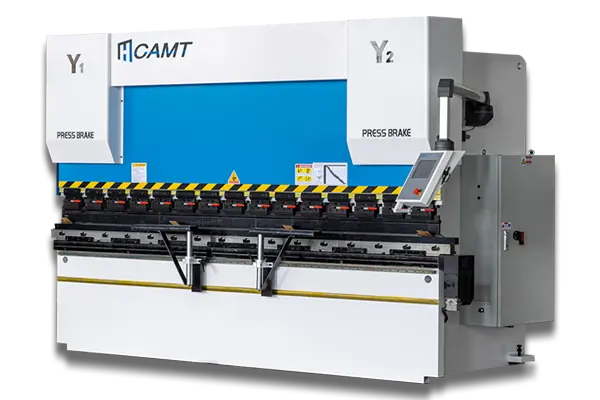
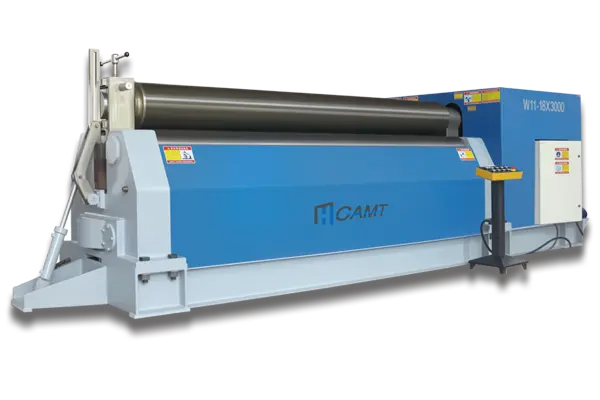
The two machines are not two sizes of the same tool, so the answer does not come from the power column on a quotation. It comes from four facts: what arrives at the loading bay, what must happen before a part can be welded, the hours each family needs, and the floor the material travels through.
Five answers cover most shops:
- Almost everything starts as a flat sheet → buy a flatbed.
- Your tube parts need holes, mitres, copes or bevels that now leave the building for a saw, a drill or a machining subcontractor → buy a tube machine.
- Both families are small, interleaved, and the floor has room for one machine → a dual-use plate-and-tube unit is a defensible first purchase.
- Either family already fills most of a shift → buy two dedicated machines. One shared laser source does not give you two machines; it moves the queue from the saw to your newest asset.
- You already own a flatbed and tube orders are arriving → treat this as an incremental purchase, not a replacement. Price the tube route you run today before deciding whether a second machine or a shared one adds the hours you need.

What each machine actually does
A flatbed cuts a flat sheet on a bed: the head follows X and Y, and nesting software arranges parts for good blanks per sheet. A tube laser grips a profile in a chuck, rotates and feeds it, wrapping holes, slots, mitres, copes and bevel ends around the section in one setup. Typical sheet materials are carbon steel, stainless, aluminium, galvanized sheet and brass, with copper or titanium on some model sheets; tube profiles are round, square, rectangular and selected special sections. Check both lists against the model sheet, not the family overview.
Sheet laser
Value sits in good parts per sheet and per laser-on hour. Electrical cabinets, enclosures, appliance housings and architectural panels are the typical output.
Tube laser
Value sits in the geometry put into the tube, which replaces drilling, outside machining and often the fixture itself. Furniture frames, fitness equipment, agricultural machinery and structural components are the typical output.
| Sheet metal laser cutter | Tube laser cutter | |
|---|---|---|
| Primary workpiece | Flat sheets and plates | Round, square, rectangular tubes and profiles |
| Material loading | Sheet onto a cutting table | Stock into a chuck and support system |
| Workholding | Slatted bed | Pneumatic or electric chucks; a manual clamping chuck on some dual-use machines |
| Cutting movement | X/Y head motion | Linear feed plus coordinated rotation |
| Typical operations | Contours, holes, slots, 2D profiles | Cut-to-length, holes, slots, notches, mitres, saddle intersections, bevel ends |
| What limits yield | Sheet nesting and the skeleton | The tube end the chuck cannot grip |
| Automation options | Exchange tables, sheet loaders | Automatic bundle loading, offload sorting |
Two negatives are worth more than the table. A standard flatbed is not automatically able to cut tube just because it uses a fiber source: workholding, rotation, clearance, CNC coordination and software are separate line items. A dedicated tube laser is not a substitute for a large-format flatbed when panels are your volume.
Three differences appear only after installation: flat nests and tube programs are separate environments with a handoff; a flatbed leaves a reusable skeleton while a tube machine leaves an end it cannot clamp; and a shared machine stops for bed clearing, hardware setup, program reload and a first-off check. Nothing stops between nests on a flatbed or between sticks on a dedicated tube machine.
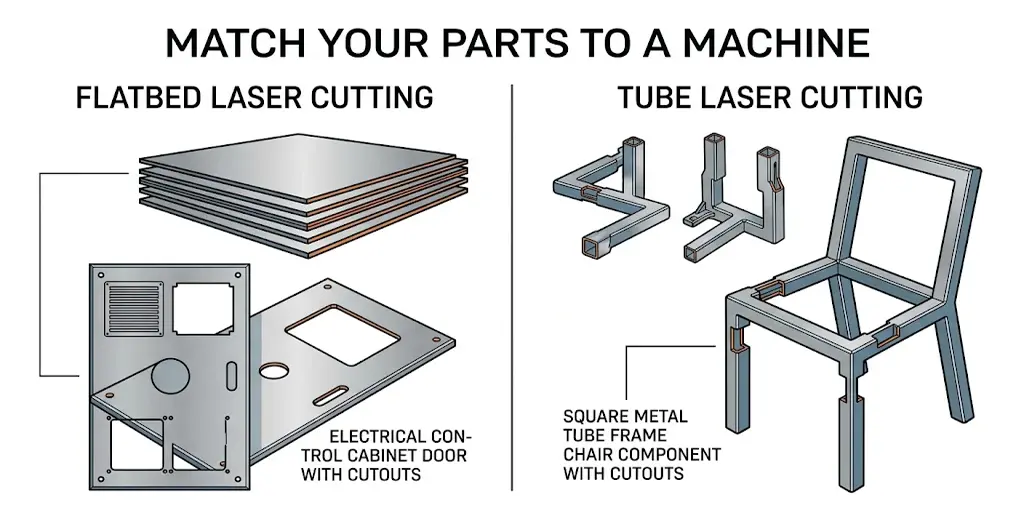
Match your parts to a machine
Signs the flatbed is the answer
An electrical control cabinet is the cleanest example: doors, side panels, bottom plates, mounting plates, ventilation openings and cable entries all start as flat blanks, cut from one CNC program without a punching or drilling step per feature. If you run standard formats such as 1500 × 3000 mm or 2000 × 4000 mm, working area is a purchase-order field: record your largest finished part, the sheet sizes you buy and the loading space. The largest table available is not automatically the best decision.
For small to medium batches and frequent geometry changes, the ULF open-type single desktop fiber laser cutter is the straightforward loading-access option. Where loading time dominates a batch run, the ULE enclosed exchange-table fiber laser cutter pairs a housing with automatic pallet exchange. That is a structural description, not a compliance claim: the protective state in each mode, interlocks, windows and extraction need written confirmation from the supplier and, where required, the authority having jurisdiction.
Signs the tube machine — or a dual-use machine — is the answer
A square-tube chair frame tells the other story: cut to length, connection openings and end profiles that must meet at a welding fixture. Today that may be sawing, drilling, marking and fitting; a tube laser puts those features into one program. Frame builders, fitness-equipment and agricultural-machinery shops are the usual fit. If both families are small, the ULT professional pipe and tube laser cutting machine is published on its model page as a dual-use plate-and-tube machine — not as a dedicated tube-only cutter. §10 explains how to reconcile that page with the broader family description.
Why a tube laser earns its place after the cut
Most comparisons ask “how much tube do I cut?” The more useful question is “what happens to a tube after it is cut?”
In a 2025 Tube & Pipe Journal comparison by Lincoln Brunner, BLM GROUP specialist Robert Adelman puts the boundary plainly: “If a customer’s doing straight cut-to-length, I would love for them to buy a tube laser, but there’s really no justification for it. As soon as you add a hole or a miter, then we’re in business.” The article lists what a cold saw does not add — coping, drilling, tapping, bevel ends — and records service engineer Victor Wooster’s caution that running a tube laser costs “significantly higher than a saw.” These are named supplier engineers, not industry averages. It also gives the exception: where internal debris cannot be tolerated, as in hydraulic conduits, a cold saw was right.
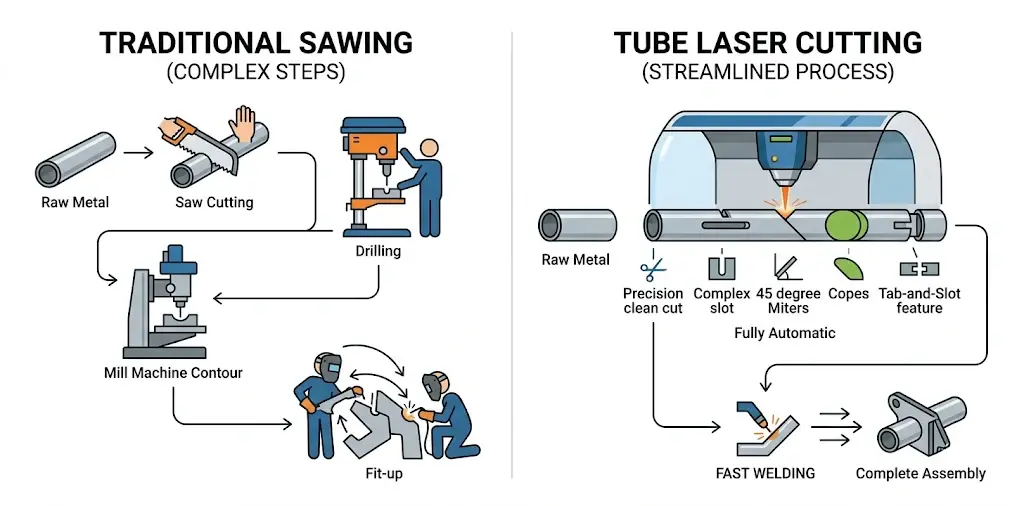
The arithmetic is visible in Lollis Metals’ account of buying two tube lasers (The FABRICATOR, 10 February 2025). Laser manager Travis Satterfield describes a part that began at a saw, went to an outside machine shop for 15 to 20 minutes per part and needed a driver to collect it. The same work is now cut in one setup; TRUMPF product manager Adi Buerkler describes 45-degree bevels and countersinks as removing second and third operations. The justification was that shop’s own machining spend, not a generic payback period: the mechanism transfers, the numbers do not.
Canadian Metalworking’s February 2026 profile of Tubeway describes a shop that began with one tube laser and now runs more than ten alongside flat sheet lasers, with “notches and tabs locking into each other” cited for reduced welding time. At that scale both families have already been bought, more than once.
So the first filter is the downstream route, not the tonnage. Straight cutoffs with no features, no fit-up requirement and no outsourced machining may stay on a saw. Add a hole whose position sets a weld datum, a cope that replaces grinding, or a tab-and-slot joint that removes a fixture, and the tube laser earns its place. Where flat blanks go on to be formed, that route belongs to the press brake that forms the flat blanks — a different machine decision.
Balance sheet and tube cutting queues to optimize combo machine ROI
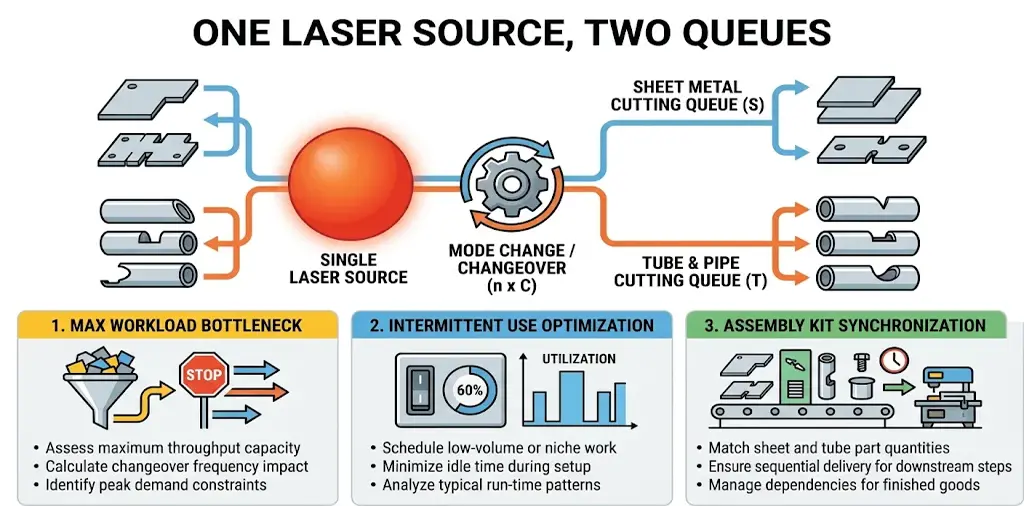
A combination machine has one source, one head and one green-light clock. Both families draw on the same hours — not a defect, but the reason it costs less than two. Cost that before comparing quotations.
Measure five quantities over a representative month: S = sheet laser-on hours per week, including trial cuts and rework; T = tube laser-on hours per week, measured or estimated from your current saw, drill and subcontract route; n = sheet-to-tube or tube-to-sheet mode changes your schedule would require per week; C = minutes from the last accepted part in one mode to the first accepted part in the other, timed on a comparable machine including bed clearing, hardware setup, program load and first-off inspection; A = hours the machine is genuinely available per week.
The necessary condition is S + T + (n × C / 60) ≤ A. Necessary, not sufficient. Three checks decide the format:
- If
max(S, T)is close to A, one family already consumes the machine. The other will always be scheduled around it, and two dedicated machines buy parallelism, not speed. - If
min(S, T)is small and genuinely intermittent, a combination machine converts otherwise idle hours into capability. This is the case the format was designed for. - If both families belong to the same assembly kits, check the worst week, not the average: sheet parts wait for tube parts, neither ships, and the shared machine is the only bottleneck in the building.
Shop Metalworking Technology’s 2019 profile of Reggin Industries documents that boundary being managed. Its owner describes needing “another 20 feet to load your tubes” behind the rotary index and reorganising the shop into a horseshoe flow; the cell footprint alone was not the footprint. Installation took about ten days and the supplier spent four weeks training operators. Those are one shop’s 2019 figures: training, services and material flow are project items, and the quotation should name who owns each.
None of S, T, n, C or A is a number we can supply. A supplier offering a universal “tube should be under X percent” threshold is quoting someone else’s order book. Fill the inequality with your own timestamps, then ask what the quoted configuration changes. We will not claim a changeover minute, a workload percentage or a payback period.
Total cost of ownership without invented numbers
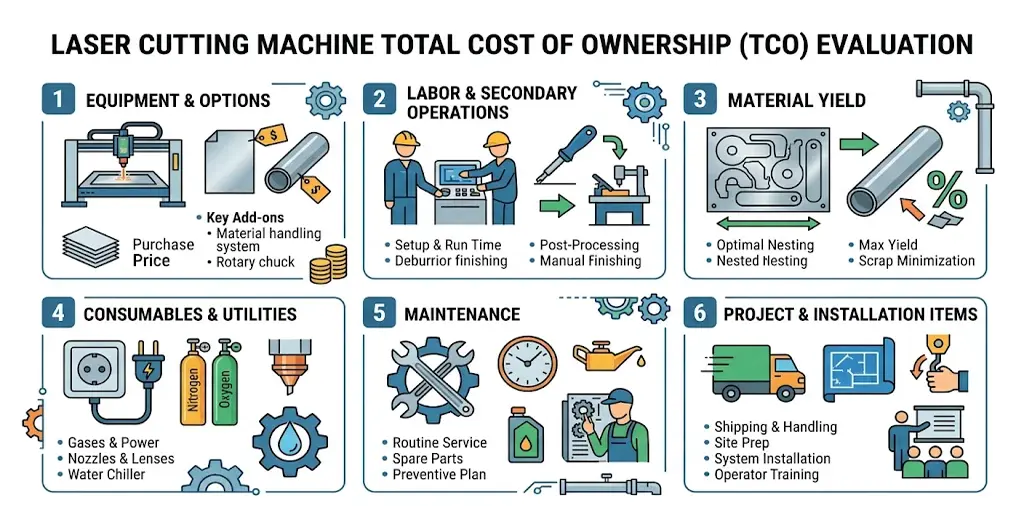
Machine price alone does not decide value. Six cost items belong in the comparison, each as a number from your shop:
- Equipment and options — align both quotations on the same source, head, chuck range, loader, licences and service scope before comparing totals.
- Labour and secondary operations — price the saw, drill, subcontract, driver time, marking and fixture hours you would remove. §4 gives the mechanism; use your invoices for the amount.
- Material yield — measure good parts per sheet, skeleton weight, the unusable tube end and offcut policy. Nesting efficiency is one line, not a section.
- Consumables and utilities — nozzles, lenses, assist gas, extraction filters and power, per laser-on hour rather than per month.
- Maintenance — the beam path on either machine, plus chuck alignment, supports and rotary mechanisms on a tube machine.
- Project items — installation, services, training and floor reorganisation, including the loading path §5 shows can exceed the machine envelope.
Where a supplier offers a payback month or a changeover minute, ask for the conditions: what was switched, by whom, on which machine, with which loader, and whether the clock stopped at the first accepted part. Published figures disagree by an order of magnitude, so we do not repeat them. Power and thickness economics are separate — settle the format first, then the power rating.
10 Essential Quotation Fields - Laser Cutting Checklist Infographic Diagram
A comparison is only as good as the data sent with the enquiry. These ten fields change the answer, and the first six become acceptance criteria later. Mark each S (sheet only), T (tube only) or B (both), and send the table with your enquiry.
| # | Field | What to record | Why it changes the choice |
|---|---|---|---|
| 1 (S) | Flat part mix | Sheet formats, grades, thickness bands, weekly hours | Fixes table size and power band |
| 2 (T) | Tube profile family | Round, square, rectangular, special; dimensions, wall, stock length | Fixes chuck, supports and loader |
| 3 (T) | Tubing specification and condition | Standard, welded or seamless, seam position, straightness, coating | Sets achievable feature accuracy |
| 4 (T) | Features per assembly | Holes, slots, mitres, copes, bevels, tab-and-slot joints, marking | Empty list → keep the saw |
| 5 (B) | Downstream route | Forming, welding fixture, coating, assembly, inspection | Decides which features are cut |
| 6 (B) | Hours and peaks by family | S and T per week, plus the busiest week in twelve months | Feeds §5; exposes peak weeks |
| 7 (B) | Changeover frequency | n, with steps timed individually | Turns changeover into C |
| 8 (B) | Remnant and scrap policy | Skeleton, minimum clampable end, offcut ownership, spatter removal | Sets usable tube yield |
| 9 (B) | Floor path | Infeed/outfeed clearances, crane access, extraction, services | Installed footprint ≠ cell |
| 10 (B) | Software and documents | Nesting, 3D tube programming, STEP import, licences, revisions, first-off records | Fixed at purchase |
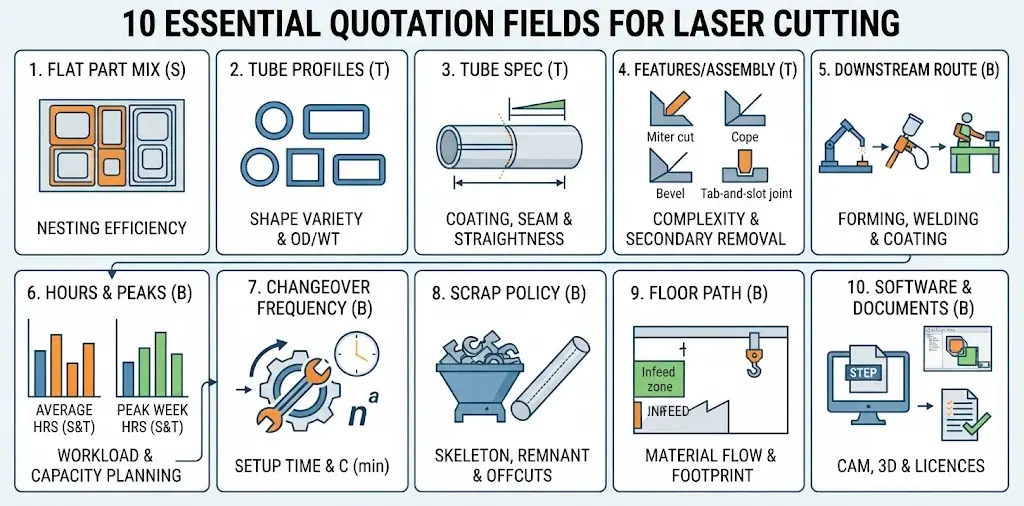
Field 3 deserves one extra check. A tube has a seam position, a straightness tolerance and often a coating; a machine that detects or avoids the seam is a configuration item. ASTM A500/A500M-23 covers cold-formed welded and seamless carbon steel structural shapes and states that welded tubing is made from flat-rolled steel by electric-resistance welding. Put the answer beside the hole-position tolerance on your drawing. Field 8 is the other surprise: ask what length of tube end the chuck cannot use, and who owns the offcuts.
Two judgements belong here. Maximum cutting capacity and recommended production thickness are not the same: a machine may cut a thickness under specific conditions without holding your speed or edge quality there. Choose the machine type first, then the power rating. Name the software support and offline programming scope in the order, not after delivery.
Trial cut on the same assembly kit
Do not compare two demonstration parts. Take one production assembly kit from your own order book — the flat blanks, the tube members, the holes and joints that matter at fit-up, and the stock you actually buy — and run it through both candidate configurations. Ask for the measurements in writing, with a retained sample from each path.
| Measurement | Path A: one shared source | Path B: dedicated machines or your current route | Who records it |
|---|---|---|---|
| Hours from drawing released to accepted kit | Measured | Measured | Your planner |
| Mode changes and measured minutes for each | Measured | Not applicable | Supplier and your operator |
| Hole position and mitre fit relative to the assembly datum | Measured on the assembled joint | Measured on the assembled joint | Your inspector |
| Weld fit-up gap at critical joints | Measured | Measured | Your welder |
| Skeleton weight and unusable tube end length | Measured | Measured | Your operator |
| Operator interventions per part, including re-clamping | Counted | Counted | Your operator |
| Program handoff: STEP import, revisions, final program owner | Documented | Documented | Your programmer |
Measure the whole kit, not the fastest part: mode changes and fit-up only appear at kit level. Single-part quality still needs checking — accuracy, hole position, edge quality, dross, burrs — but the criterion is the assembled joint, not a specimen. Write the retained samples, datum, edge criteria and a retest clause into the purchase order, and name the standard and gauge for any cut-edge quality class rather than writing “clean edge”. If you want an engineer present, put that in scope with the technical support and commissioning arrangements.
Where CAMT's machines and support fit
CAMT (Nanjing Huameng Machinery) builds press brakes and fiber laser cutting machines; the fiber laser cutting machine range lists the laser families together. Three answers map to §1: ULF for flexible sheet work, ULE for sustained batches, ULT for tube parts with features or two small families sharing one source.
A family overview is not a specification sheet. The ULT model page describes dual-use plate-and-tube cutting with a manual clamping chuck and push-type cutting; the category page describes automatic chuck rotation, 3D bevel cutting, a different accuracy pair and selected dual-use configurations. Where they differ — power range, alloy, chuck, profile size — the model specification sheet for the machine you order controls. Get it in writing, with chuck and support range, loader type, licences and what tube mode includes. We do not certify your installation or assert compliance on your behalf.
The project items
Operator and programmer training covers the two program environments and the first-off routine; maintenance and upgrades covers the chuck, supports and motion system a dual-mode machine asks more of; spare parts and consumables covers nozzles, protective lenses and wear parts in both modes. These are line items to name in the order, not performance promises.