An open-type fiber laser cutter generally offers a lower purchase cost, easier access to the cutting table, and greater flexibility when loading large or heavy metal sheets. A fully enclosed fiber laser cutter provides a more controlled cutting environment, better containment of laser radiation and cutting fumes when properly designed, and often comes with an automatic exchange table for higher production efficiency.
So, which one should you choose?
The answer depends on your production volume, material handling requirements, workshop layout, safety arrangements, and long-term operating costs. This guide compares both configurations from an engineering and purchasing perspective to help you select the right fiber laser cutting machine for your business.
1. What the two machine formats actually are
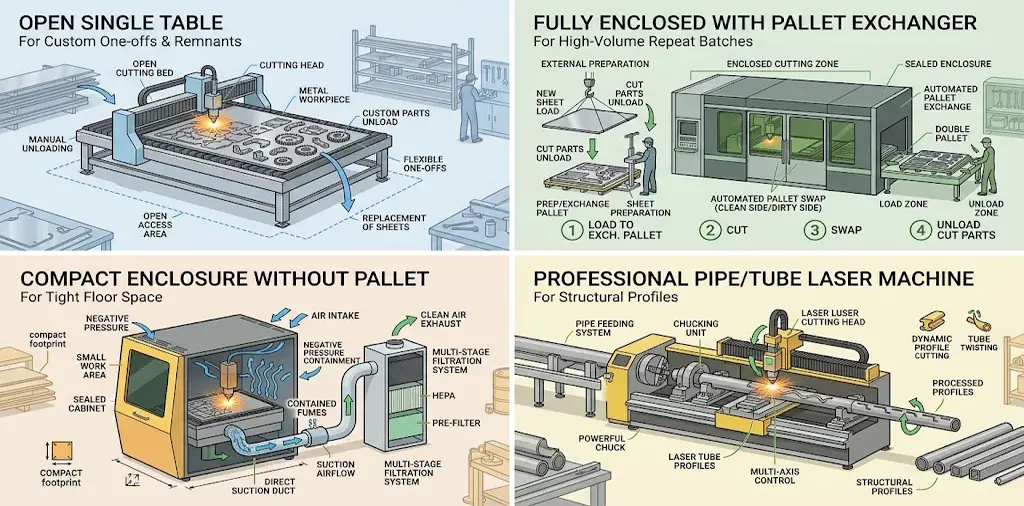
An open-type fiber laser cutter is a floor-standing gantry with an exposed cutting table: the cutting head, worktable and transmission are accessible from the surrounding floor, and there is no complete protective housing. A fully enclosed machine surrounds that cutting zone with protective panels, laser-rated observation windows, access doors with safety interlocks, and a connection to an extraction system. Many enclosed models also carry two exchangeable pallets so that one sheet can be unloaded while another is being cut.
A 6 kW open-type machine and a 6 kW enclosed machine built around the same source and cutting system can deliver comparable cutting performance. The enclosure does not determine cutting speed, accuracy or maximum thickness. What differs is who carries the safety duty and how a sheet reaches the table.
2. Two separate decisions, four configurations
Guarding and material handling are independent axes, and only two of the four combinations normally appear in a catalogue.
Ask for the enclosed single-table option by name. Shops that need fume containment and a defined boundary but run long cutting cycles often pay for a second pallet they cannot use, because the guarding decision was allowed to answer the handling decision.
Our catalogue covers two of those corners. The ULF open-type single desktop fiber laser cutter is an open, single-table gantry machine published at 1–6 kW; the ULE fully enclosed exchange-table fiber laser cutter combines a full protective housing with a twin pallet exchanger at 6–12 kW. Both model pages list carbon steel, stainless, galvanised sheet, aluminium alloy, brass and titanium. Use the specification sheet of the exact machine you order as the controlling document — a family overview is not a spec sheet, and any alloy outside it needs written confirmation.
3. Class 1 laser certification measures accessible radiation, not source power
A laser classification describes the radiation a person can reach, not the power of the source inside the cabinet.
Under the FDA’s laser product guidance there are four major hazard classes: Class I, “considered non-hazardous”, and Class IV at the other end, an “immediate skin hazard and eye hazard from exposure to either the direct or reflected beam” that can also present a fire hazard. That page also puts the duty for 21 CFR 1040.10 compliance on the manufacturer, not the buyer.
The operative sentence is in the regulation itself. 21 CFR 1040.10(c)(1) states that “the product classification shall be based on the highest accessible emission level(s) of laser radiation to which human access is possible during operation.” Read it literally: the class describes what a person can reach, in the configuration the machine is operated in. The rule also treats all viewing optics, viewports and display screens — “regardless of its class” — as part of the attenuation path, and its measurement conditions include operation with parts of the protective housing removed and safety interlocks defeated. So a viewing window is not a sight glass, an interlock is not a convenience switch, and a machine built around a high-power source can be a Class I product when no hazardous radiation is accessible in normal operation.

Five shop-floor situations take the machine out of the state its label describes:
- A service door opened with the beam available — the assessed configuration changes; get the permitted modes and the authorised people in writing.
- An interlock defeated, bypassed or failed — access is no longer removed; ask for the fail-safe behaviour and reset requirement.
- A window scratched, yellowed or replaced with unmatched glazing — a rated part has left the attenuation path; record wavelength rating, part number and replacement interval.
- A sheet longer than the housing, or any open pass-through — a physical opening can also be a radiation path; the machine must be rated for it.
- Added ducts, cameras, automation ports or a pallet opening — every penetration can modify the assessed product.
For an open machine that duty sits with the facility: a controlled area with entryway controls and signs, eyewear matched to the wavelength and power, training records for everyone who enters, and a rule for visitors, contractors and neighbouring workstations. Which of these are required follows the whole-machine classification and the authority having jurisdiction at the installation — not the shape of the machine. Budget them as recurring work with a named owner.
Compliance is split, not sold with the machine. The manufacturer answers for the product, the employer for the workplace, and the destination market’s authority decides which rules apply. The references here are US product and workplace documents; installing elsewhere means asking the supplier to name that market’s product and machinery requirements in writing. We do not certify installations.
4. Fumes: what each format contains and what still escapes
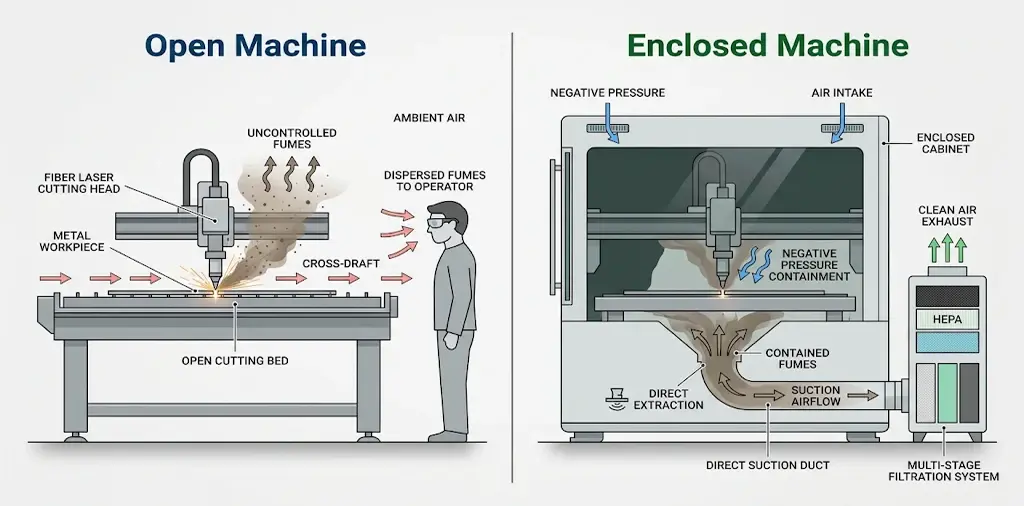
An enclosure changes where the fumes are captured; it does not remove the need for extraction.
Laser cutting vaporises metal and coating locally. What comes off the sheet depends on the alloy, the coating and the process gases, so stainless, galvanised and coated stock need an extraction and exposure assessment written for that exact grade and duty cycle, not for “sheet metal” in general. Oregon OSHA’s laser safety fact sheet lists “inhalation hazards from the fumes generated by cutting lasers” among non-beam hazards. That is one US state’s published guidance, not a universal rule, but it shows why extraction belongs in the same review as the beam.
An open-type machine usually extracts at or beneath the table. Cross-drafts from a nearby fan, an open door or an air-conditioning outlet can move that plume into the operator’s breathing zone before it reaches the collection opening. A fully enclosed machine holds the cutting zone under negative pressure and can direct zoned airflow toward the active cutting area, which puts capture closer to the source. In both cases the exhaust capacity, duct diameter and layout, filter type, replacement interval and discharge location still have to be specified, and a properly engineered enclosure without a working collector is still an exposure problem.
Ask the same question on both configurations: who sizes the fan and filter, and who verifies capture with the machine installed. If the answer is “the extraction unit is included”, ask for the connection size, the required airflow at the machine, the filter type and the replacement interval in writing.
5. The handling motions an enclosure takes away
A second pallet removes waiting time from the cutting cycle; it does not remove the work of handling parts.
Walk four motions through the proposed machine before you commit: placing a small remnant on the bed for two quick parts without setting up a nest; lowering a heavy or oversized sheet from an overhead crane; reaching in to straighten a sheet that has shifted mid-cycle; and clearing cut parts, slugs and the skeleton. On an open single table all four are trivial. Inside a housing with a pallet exchanger each becomes a procedure, and for some shops those procedures are the reason the machine feels slower than the quotation predicted.
Tim Heston, writing in Canadian Metalworking (19 October 2026), opens with the observation that “machines have become so fast that denesting, not the cutting itself, has become the constraint.” Nick Plourde of MC Machinery Systems recalls denesting “right off the shuttle table, if I could finish before the machine stopped cutting the next job.” Automating the pallet does not delete that race; it hands it to whoever or whatever sorts the parts. Heston describes shops that deliberately keep open access to the work envelope for remnant jobs. If one-offs are a real share of your work, that access may be worth more than the pallet.
Test the second pallet with your own stopwatch numbers, not ours. Take one shift of 40 sheets, 10 minutes of cutting each and 3 minutes of unloading and loading — these are illustrative assumptions, not industry averages. A single table needs 40 × (10 + 3) = 520 minutes. With a pallet exchanger the same shift needs 40 × (10 + T_load), where T_load is the interruption you actually measure on the proposed machine. If your T_load stays near 3 minutes, the second pallet buys almost nothing; if loading can be completed inside the cutting cycle, the gap widens. Replace every number with your own part mix, sheet weight and crew availability before you use it.
Where that gain peaks is a utilisation calculation — cutting minutes against handling minutes — and it belongs in the broader machine-selection guide rather than here. Keeping guarding and handling on separate lines stops two common mistakes: paying for a pallet to fix a safety problem, or ordering a housing to fix a loading problem.
6. The cost neither quotation shows
The cheaper machine usually moves a cost rather than removing it: an open machine buys a room, an enclosed machine buys a handling procedure.
A shop with a dedicated laser bay already owns the controls an open machine needs; one that puts the machine beside a walkway is buying an uncosted second project. A pallet exchanger bought for long cutting cycles waits beside the laser. Compare cost per finished part over the service life, using your floor plan, shift pattern and handling times — not the two quotations.
7. Twelve fields for the purchase order
A classification claim is worth exactly as much as the documents behind it.
No single contact owns all twelve fields. Ask the safety arrangements team for guarding and classification, technical support for interlock behaviour, pass-through and service-mode procedures, and training for operator and LSO-facing instruction. Service-opening routines and post-modification re-assessment are handled by maintenance and upgrades; rated windows, seals, switches, nozzles and slats by spare parts and consumables. Quote the same machine serial number to each. A classification certificate that names no serial number will not survive an audit.
8. Which configuration fits your shop
Match the format to the motions and the duty, not to the size of the company.
- Mixed one-offs, remnants, oversized or irregular sheets, frequent manual intervention: open single table — provided you can fund and administer the controlled area, and your extraction plan covers the alloys you actually cut.
- Repeat nests in medium-to-large batches, other workstations within walking distance, or an EHS review already in progress: fully enclosed. Add the second pallet only after checking that loading time is a real share of the sheet cycle; if it is not, ask for the enclosed single-table configuration.
- Containment needed but floor space tight: enclosure without a pallet exchanger. It is a valid configuration even if it is not the one in the brochure.
- Heavy or oversized plate loaded by overhead crane: open, subject to the lifting route, guarding and extraction being planned together. If an enclosure is required for safety or environmental reasons, confirm that its loading system can accommodate your actual workpieces before ordering.
- Tube, pipe and structural profiles: neither format. Guarding a sheet machine does not make it a tube machine; look at the ULT professional pipe laser cutting machine instead.
To work the two axes against your own part mix, send the material and thickness range, the sheet format you buy, and how a sheet reaches the table today to Contact CAMT. You can also start from the full fiber laser cutting machines range and read the two model specification sheets side by side.
9. FAQ